

So why do people mix up cicadas and locusts? The main reason is that both insects show up in large numbers at the same time. But here's the key difference: only locusts can truly swarm. Locusts release special hormones into the air that attract other locusts and keep them together. Cicadas cannot swarm, because they don't make those hormones.
Both cicadas and locusts are common in spring and summer. Many people get confused because the two insects look similar and make noise. But are they really the same bug? No, they're actually quite different.
A locust swarm forms when the weather is just right, food is plentiful, and the locust population suddenly grows. When that happens, a chemical called serotonin is released, and the whole group starts acting like one giant creature. These swarms can cause huge damage to crops and plants.
Cicadas in large groups are less destructive, but they are still a nuisance. Their extremely loud singing is hard to ignore. Young plants are especially at risk, because cicadas lay their eggs inside plant branches.
Locust vs. Cicada: At a Glance
| Feature | 🦗 Locust | 🐝 Cicada |
|---|---|---|
| Insect group | Short-horned grasshopper, order Orthoptera, family Acrididae | True bug, order Hemiptera, family Cicadidae |
| Body & legs | Thin body up to 3 in; very long hind legs built for jumping | Stout body; legs not built for jumping |
| Wings | Shorter than the body, making flight ungainly | Transparent, veined, and longer than the body |
| Eyes | Compound eyes on the head | Large black or red eyes on the sides of the head |
| Can it swarm? | Yes, hormones keep millions together as one | No, lacks the swarming hormones |
| Life cycle | Usually a single year: egg → nymph → adult | Periodical: 13-17 years; annual: up to 3 years |
| Main damage | Eats vegetation, a swarm can strip whole regions | Egg-laying splits branches and stems |
| Sound | Chirps, but quieter | One of the loudest insects, ~120 dB |
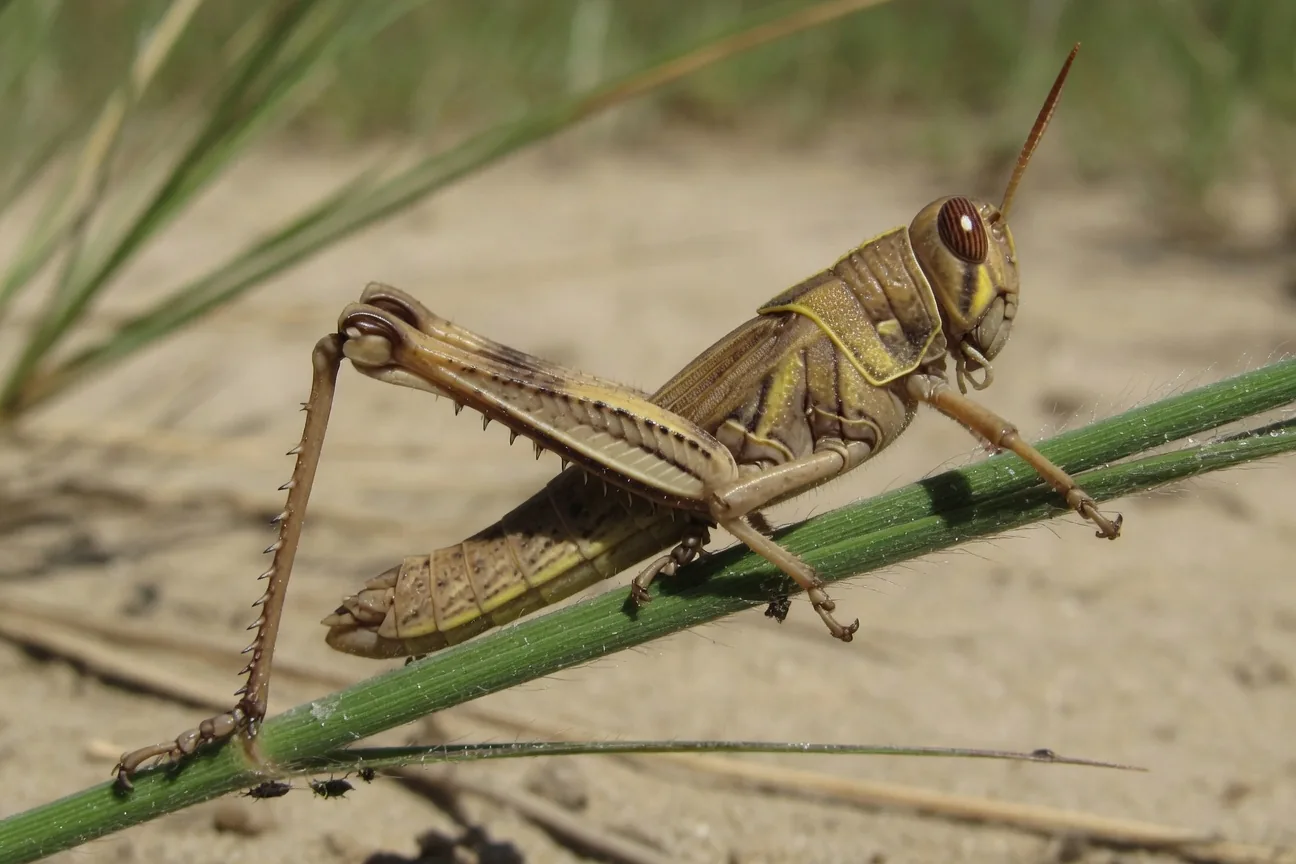
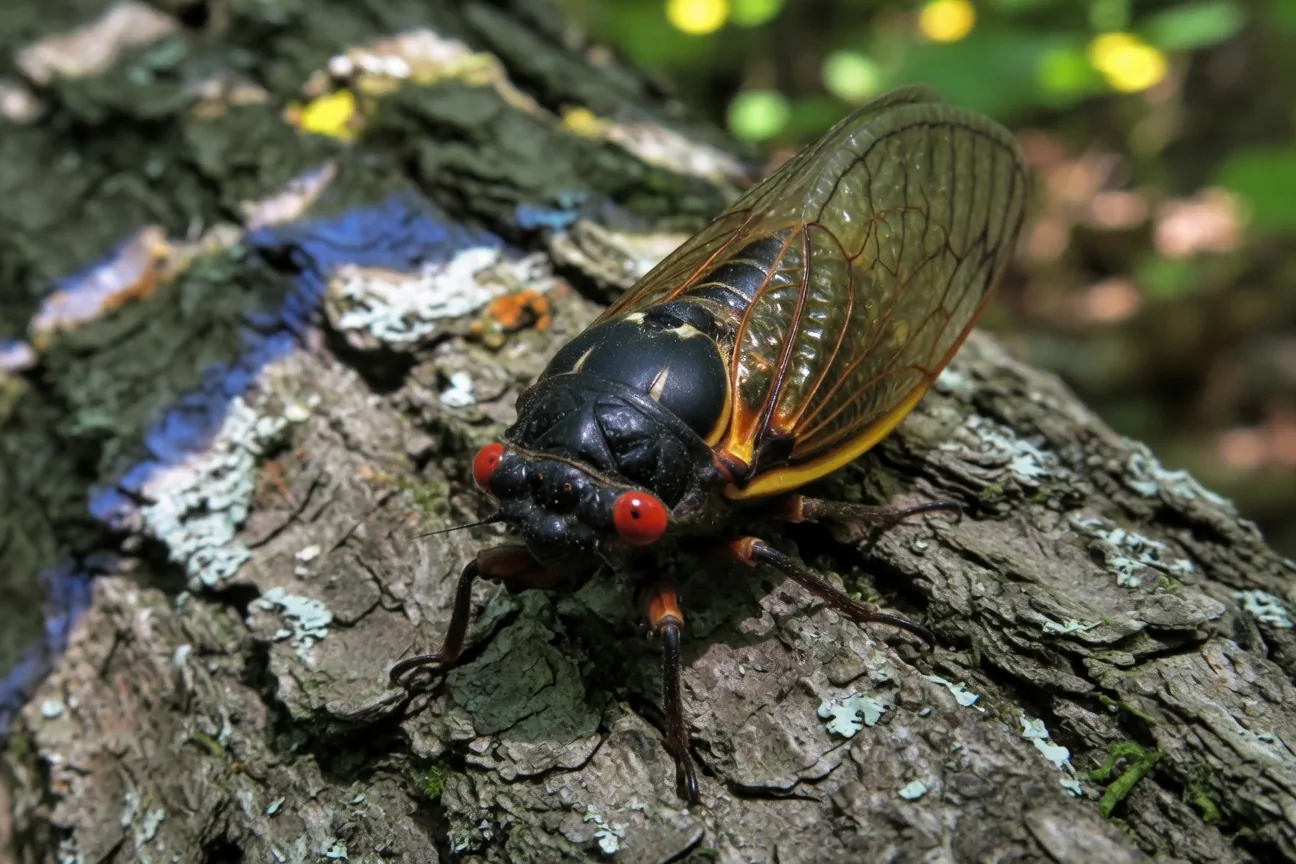
Locusts
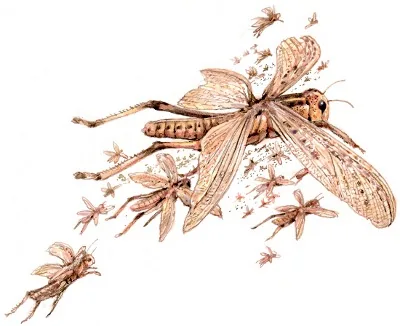
Scientific Classification
Locusts are a type of short-horned grasshoppers. Like crickets, they are arthropods. They belong to the order Orthoptera and the family Acrididae.
Appearance
The easiest way to spot a locust is its very long back legs, built for powerful jumps. Locusts have thin bodies that grow up to 3 inches long. Their wings are actually shorter than their bodies, which makes their flight look a bit clumsy. They come in many colors, from bright green to sandy brown. Some types are even multicolored.
Reproduction and Life Cycle
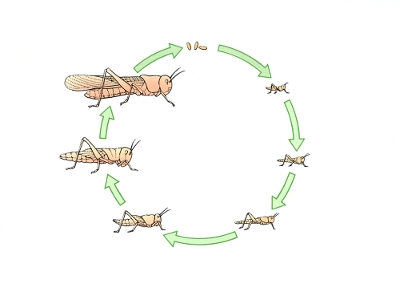
Most locusts complete their whole life cycle in a single year. There are 3 stages: egg, nymph, and adult.
The female digs a hole in the ground and lays a cluster of 20-30 eggs. A frothy covering protects the eggs from disease and predators. After about 2 weeks, the eggs hatch into nymphs, tiny versions of the adult, but with no wings yet.
As the nymph grows, it molts (sheds its skin) several times. With each molt, the wings get a little bigger. After the final molt, the locust is a full adult. It takes a few more weeks to become ready to mate. Then the cycle starts all over again.
Behavior
Locusts can behave in two very different ways, depending on the climate and how much food is around. These are called the solitarious phase and the gregarious phase.
Frequently Asked Questions
What is the main difference between locusts and cicadas?
Only locusts swarm. Locusts release hormones that attract other locusts and keep them together; cicadas lack these hormones and cannot swarm.
Are locusts a type of grasshopper?
Yes. Locusts are short-horned grasshoppers in the order Orthoptera, family Acrididae.
How long do cicadas live?
Periodical (Magicicada) species have a 13 to 17 year life cycle, while annual species live for a maximum of about 3 years.
How loud is a cicada?
Cicadas are among the loudest insects on Earth, singing at around 120 decibels, loud enough to be heard from half a mile away.
Which insect is more harmful to crops?
Locusts. In a swarm, each locust eats its own weight in vegetation every day, and millions together can strip whole regions of plants.
In the solitarious phase, locusts keep to themselves and don’t form swarms. They cause little damage.
But when conditions change (the weather warms up, food is everywhere, and the population explodes) locusts switch to the gregarious phase. They gather into swarms of millions. Each locust eats its own weight in vegetation every single day. With millions of them feeding at once, entire states (and in rare cases entire countries) can be stripped of all plant life. The largest swarm of locusts ever recorded was said to be as large as the island of Japan.
Cicadas
Scientific Classification
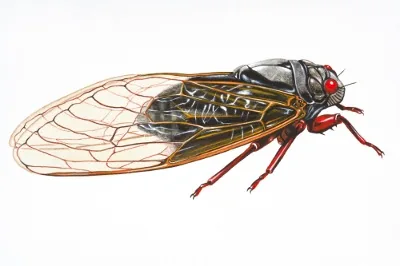
Like plant lice, cicadas are arthropods. They belong to the order Hemiptera and the family Cicadidae. There are two main types:
- Magicicada species, whose life cycle runs for 13-17 years.
- Annual species, whose life cycle runs for a maximum of 3 years.
Appearance
Most adult cicadas have large black or red eyes set wide on the sides of their head, a striking look you won't miss. Their wings are transparent, with clearly visible veins, and they are longer than the body. Nymphs (babies) do not have wings yet.
Take the Locust vs. Cicada Quiz!
5 quick questions. Can you tell these two summer insects apart?
Reproduction and Life Cycle
Whether a cicada's life is long or short depends on its type, periodical or annual.
To lay her eggs, the adult female finds a sturdy plant and splits open a branch or twig. She inserts her eggs inside, sometimes laying a few hundred eggs spread across many stems. About a month later, the eggs hatch into tiny nymphs.
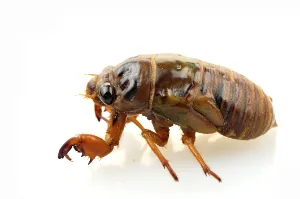
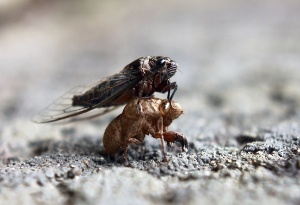
The nymphs then burrow underground and feed on plant roots until they fully mature. When ready, each cicada digs back up to the surface, sheds its skin, and molts into a fully winged adult. The adults live for around two months. During that time they mate, lay eggs in plants, and then die.
Behavior
Cicadas don't chew plants, but they still cause damage by laying their eggs inside branches and stems. This is especially bad when huge numbers of periodical cicadas all emerge at the same time.
Cicadas are also one of the loudest insects on the planet. They sing using a drum-like organ called a tymbal, producing different tones and patterns to attract mates. Their song can reach around 120 decibels, loud enough to cause damage to the human ear at close range. You can hear it from half a mile away. And the loudness isn't just for finding a mate. It also helps scare away birds that might try to eat them.
Now that you know more about both insects, it should be much easier to tell a locust from a cicada, and to protect your garden if either one shows up in large numbers.
Explore More Animals
 Grasshoppers: Habitat, Facts, Anatomy & Life CycleThe complete kids' guide to grasshoppers: where they live, what they eat, their 5 eyes and no ears, super-tough mandibles, record-breaking jumps, singing, and w
 Types of Flying Insects With PicturesThe complete kids' guide to flying insects, every main order from dragonflies and beetles to bees and butterflies, how their bodies and wings work, the species
 Why Do Crickets Chirp? These Reasons Will Simply Amaze You!Chirping is an essential part of a cricket's communication repertoire. Although the sound is very common, especially in rural areas, very few people actually kn
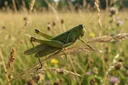 A Precise Explanation of the Life Cycle of a GrasshopperThe life cycle of grasshoppers covers three major stages, eggs, nymphs, and adults. Learn how each stage works, how long it lasts, and why grasshoppers matter

 Fun fact for today!Only locusts can swarm. Cicadas gather in big groups too, but they can't form a true swarm, because they don't make the swarming hormones locusts do.