

Camouflaging at its Best!
The mimic octopus doesn't just hide, it changes its disguise based on who is threatening it. If a damselfish comes too close, the octopus will impersonate a banded sea snake, because sea snakes eat damselfish. That's a smart move!
Like all octopuses, Thaumoctopus mimicus is an invertebrate with one mantle and eight arms. But what makes it special is its ability to transform itself into almost any creature to escape predators. Most of the animals it imitates are venomous, which makes the disguise even more effective.
Scientific Classification
| Kingdom | Animalia |
|---|---|
| Phylum | Mollusca |
| Class | Cephalopoda |
| Order | Octopoda |
| Family | Octopodidae |
| Subfamily | Octopodinae |
| Genus | Thaumoctopus |
| Species | T. mimicus |
What Does It Look Like?
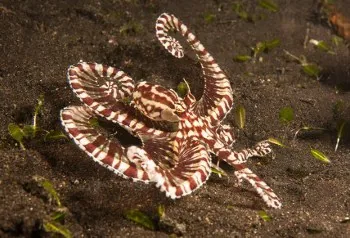
The mimic octopus is small, it grows to about 60-70 cm (around 2 ft) long. Its body is brown with irregular white spots or stripes. Like all octopuses it has three hearts, one mantle, and eight arms. Each arm is around 25 cm long and about 1-2 cm wide.
To change its look, the octopus uses tiny pigment sacs in its skin called chromatophores. It can expand or contract thousands of these sacs at once to shift its color and pattern, almost instantly. It's like having a full-body costume switch built right into the skin.
People often mix up the mimic octopus with the wonderpus octopus. They look similar, but there are clear differences (see the comparison section below).
Where Is It Found?
Where it lives: The mimic octopus was first discovered in Indonesia. It lives in the warm tropical waters of South East Asia, mainly in the Indo-Pacific Ocean near Sulawesi and Bali, Indonesia.
Its favorite habitat: It likes to live near estuaries (where rivers meet the sea) and river mouths. These areas are very muddy, which helps the brownish-white octopus blend in with the background. Estuaries are also packed with the small fish and crustaceans it eats, so it's the perfect hunting ground.
What Does It Eat?
The mimic octopus is a carnivore. It eats smaller fish and crustaceans like crabs, lobsters, and shrimp. It hunts like an ambush predator, blending in with corals and rocks, then waiting for prey to come close.
It also pokes its arms into cracks and holes in rocks to find hidden food, then sucks it out using its powerful suction cups. It does not eat sea plants or seaweed.
Is It Poisonous?
Scientists haven't yet proven whether the mimic octopus is venomous or not. Many researchers think it probably isn't, because venomous animals don't usually need elaborate disguises. If it had powerful venom, it could simply defend itself directly rather than spending energy imitating other creatures.
Frequently Asked Questions
Where was the mimic octopus first discovered?
Off the coast of Sulawesi, Indonesia, in the early 1990s.
How many animals can the mimic octopus impersonate?
It can mimic more than a dozen species including flatfish, lionfish, sea snake, brittle stars, sea anemones, jellyfish, stingray, crabs, and shrimp.
Is the mimic octopus poisonous?
It has not been scientifically proven. Scientists believe it is likely not venomous, since venomous animals typically don't need elaborate camouflage strategies.
How is the mimic octopus different from the wonderpus octopus?
The mimic octopus has irregular brown-and-white stripes and a bright white line at the base of its suckers. The wonderpus has regular white spots at fixed distances. The mimic is diurnal; the wonderpus is crepuscular.
What does the mimic octopus eat?
It is carnivorous, feeding on smaller fish, crabs, lobsters, and shrimp.
How Many Sea Animals Can It Impersonate?
Many animals can blend into the background, but the mimic octopus goes much further. It is the only known aquatic animal that can copy the behavior, shape, color, and size of more than a dozen different species. It can impersonate the flatfish, lionfish, sea snake, brittle stars, sea anemones, jellyfish, stingray, crabs, and shrimp, among others.
Three Signature Impersonations
Flatfish
To copy a flatfish, the octopus pulls all eight arms together and glides flat, parallel to the ocean floor. Suddenly the soft, easy-to-eat octopus looks like a venomous flatfish, and most predators back off.
Lionfish
The lionfish lives in the same Indo-Pacific waters as the mimic octopus. To impersonate one, the octopus spreads its arms wide, making them look like the lionfish's spiky, venomous fins.
Sea Snake
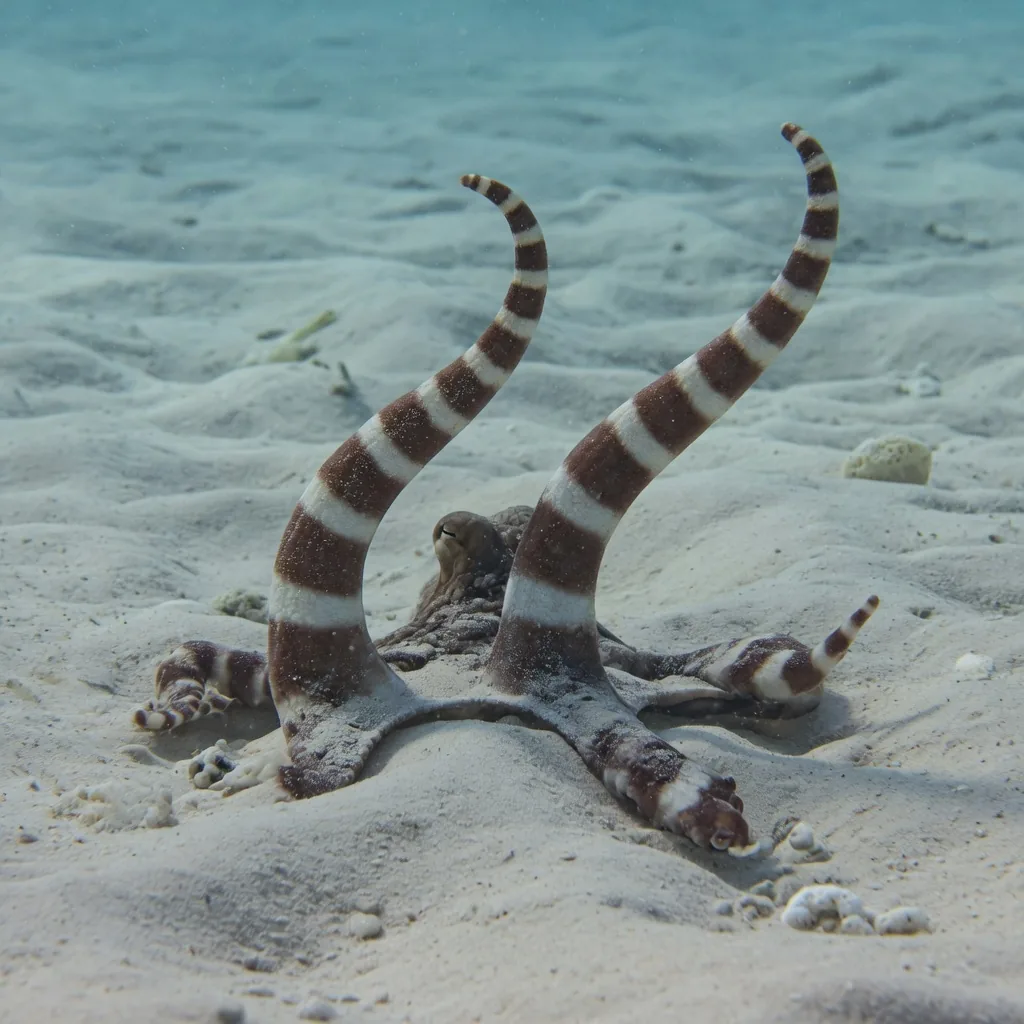
This is perhaps the most impressive trick. The mimic buries six of its arms and its mantle in the sand, leaving just two arms poking above the seafloor. Those two arms undulate back and forth, and to any predator, it looks exactly like a brown-and-white banded sea snake.
Test Your Mimic Octopus Knowledge!
5 quick questions about the ocean's greatest shape-shifter.
Is the mimic octopus same as the wonderpus octopus?
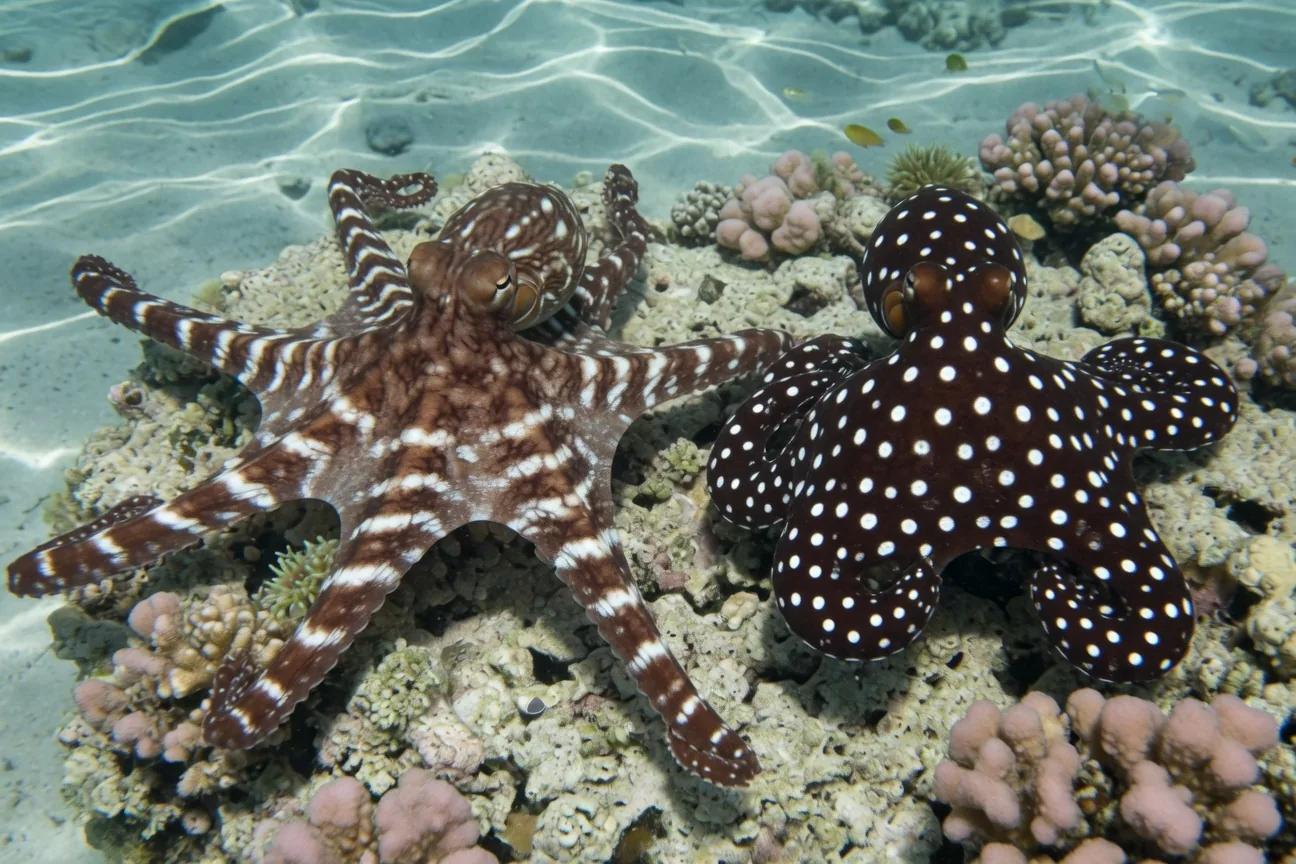
The Thaumoctopus mimicus (mimic octopus) looks similar to Wunderpus photogenicus (wonderpus octopus), but they are two different species. Here's how to tell them apart.
The easiest clue is the pattern on their arms. The mimic octopus has irregular brown-and-white stripes and a bright white line at the base of its suckers. The wonderpus has regular white spots spaced at roughly even distances, no white line at the suckers.
They also behave differently. The mimic octopus is diurnal, it's active during the day. The wonderpus is crepuscular, it comes out mainly at dusk and dawn.
| Feature | Mimic Octopus (T. mimicus) | Wonderpus (W. photogenicus) |
|---|---|---|
| Mantle pattern | Irregular brown-and-white stripes | Regular white spots at fixed distances |
| Sucker base | Bright white line present | No white line |
| Activity time | Diurnal (daytime) | Crepuscular (dusk and dawn) |
| Mimicry ability | Extensive: 15+ species | Limited |
| Named for | Its mimicry behavior | Its photogenic appearance |
Population and Conservation
Because this species was only formally described in 2001, scientists still don't know a lot about how its population changes over time. One concern is that the chemicals released into estuaries and river mouths (the areas where the mimic octopus lives) may be reducing its numbers. More research is needed.
Explore More Animals
 Octopus Facts for Kids: Eight Arms, Blue Blood, and Big BrainsThe octopus is an intriguing creature of the seas that derives its name from a Greek word which means eight-footed. Discover fascinating octopus facts for kids:
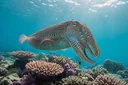 Truly Incredible Facts about CuttlefishThe cuttlefish is not a fish. In fact, it is a mollusk, and is well-known for its chameleon-like behavior. Discover the anatomy, camouflage, ink, diet, mating,
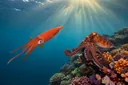 Squid vs. Octopus: What's the Difference?Squid or octopus? Both are clever cephalopods with three hearts and blue blood, but their bodies, homes, and habits are different. Here's a clear side-by-side
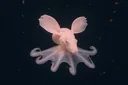 Surprisingly Not-so-dumb Facts About the Dumbo OctopusThe Dumbo octopus gets its name from Walt Disney's famous cartoon character, Dumbo the Flying Elephant, because of its ear-like fins that resemble the ears of t

 Fun fact for today!The mimic octopus was only discovered in the early 1990s, because scientists kept thinking it was other animals!