

The blue whale is the largest animal known to have ever lived on Earth, even bigger than the largest dinosaurs. Blue whale calves are already enormous at birth, ranking among the planet's biggest creatures from day one. These massive animals were common in all the world's oceans until the start of the twentieth century. Then whalers hunted them to near extinction. Thanks to conservation efforts the species has survived, and the population is slowly growing back.
Blue whales are ocean mammals, not fish, they are warm-blooded. They have a small amount of hair and feed their young with milk. They belong to the order Cetacea, and their scientific name is Balaenoptera musculus.
They belong to the family of rorquals, the same family as the humpback whale, fin whale, and Bryde's whale. Despite their massive size and powerful tails, blue whales are completely harmless. Their long, slightly tapered, streamlined body helps them glide through the water with ease.
Description
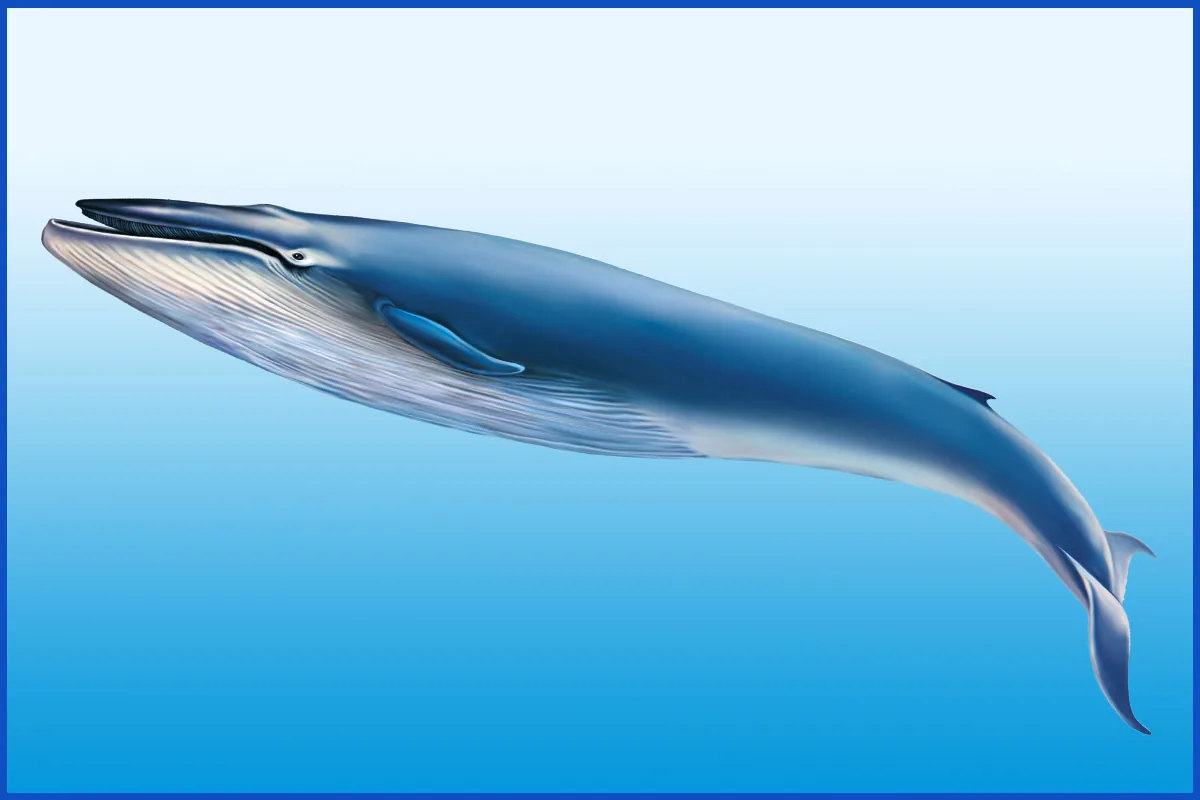
Blue whales have a long, tapered body built for speed. They look true blue underwater, but at the surface their color is more bluish-gray. They are not actually blue at all, they have light gray mottling (a blotchy pattern) on a darker background, or the other way around.
The skin is very smooth and almost free of parasites. A few barnacles do attach to the tips of the flippers, the dorsal fin, and the edge of the fluke.
The flippers are short and tapered, 3 to 4 meters (9.8 to 13 ft) long. The dorsal fin is small and curved, growing up to 12 inches. The tail flukes are wide and triangular.
The head makes up about 25% of the total body length. It is U-shaped, flat, and broad. At the top of the snout sit two blowholes, held inside large splash guards. When the whale breathes out, the blow shoots straight up, over 20 feet high! The front of the mouth is lined with thick, fringed plates of fingernail-like material called baleen. These plates act like a strainer, trapping krill while the whale pushes the water back out.
Running from the lower jaw to the navel are around 55-68 ventral grooves, or pleats. These expand like accordion folds when the whale takes a huge gulp of water. At any given age, the female is larger than the male.
Classification
| Scientific Name | B. Musculus |
|---|---|
| Kingdom | Animalia |
| Phylum | Chordata |
| Class | Mammalia |
| Order | Cetacea |
| Family | Balaenopteridae |
| Genus | Balaenoptera |
Length and Weight
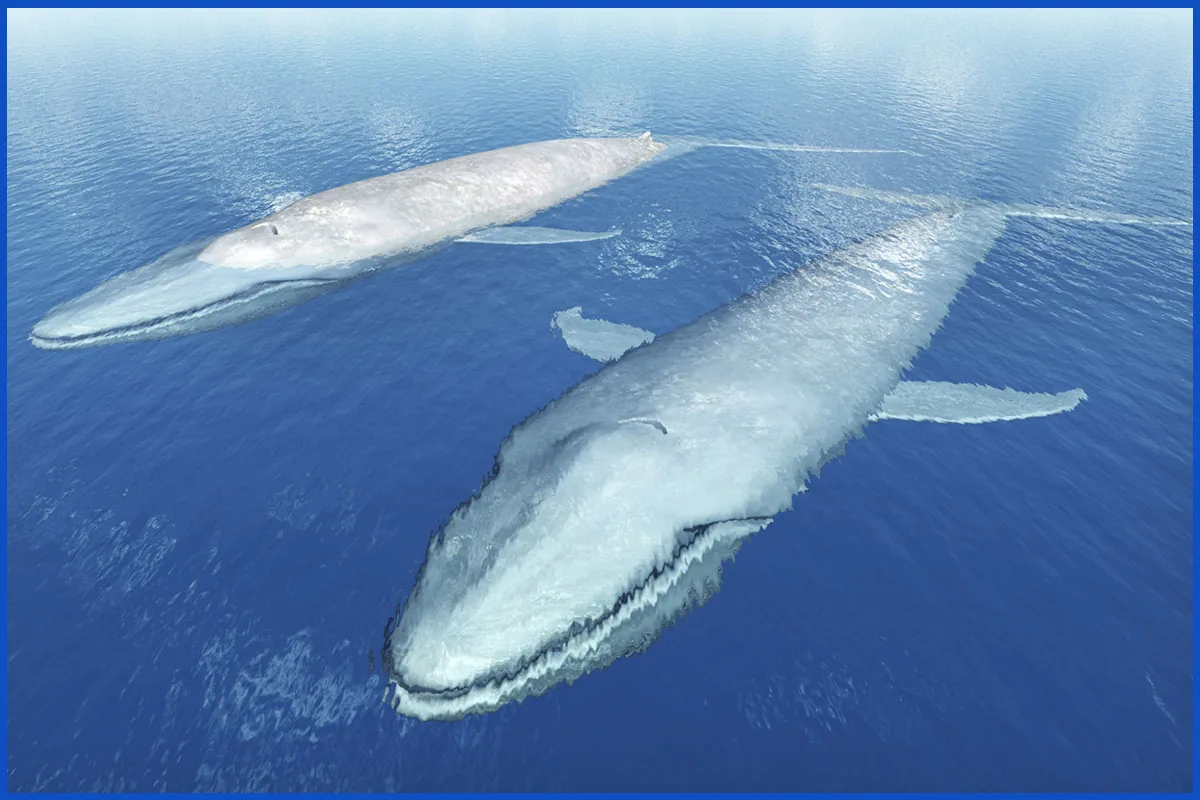
A full-grown blue whale can reach 25-30 meters (82-105 feet) in length. It can weigh up to 180-200 tons (163,293-181,437 kilograms).
Blue whales in the Northern hemisphere are typically about 75 to 80 feet long. Southern hemisphere blue whales grow even larger, around 90 to 100 feet.
- As long as 2-3 school buses parked end to end
- As heavy as 30 African elephants
- Its heart is the size of a small car
- Its main arteries are wide enough for a small human to swim through
Just How Big? The Record-Breakers
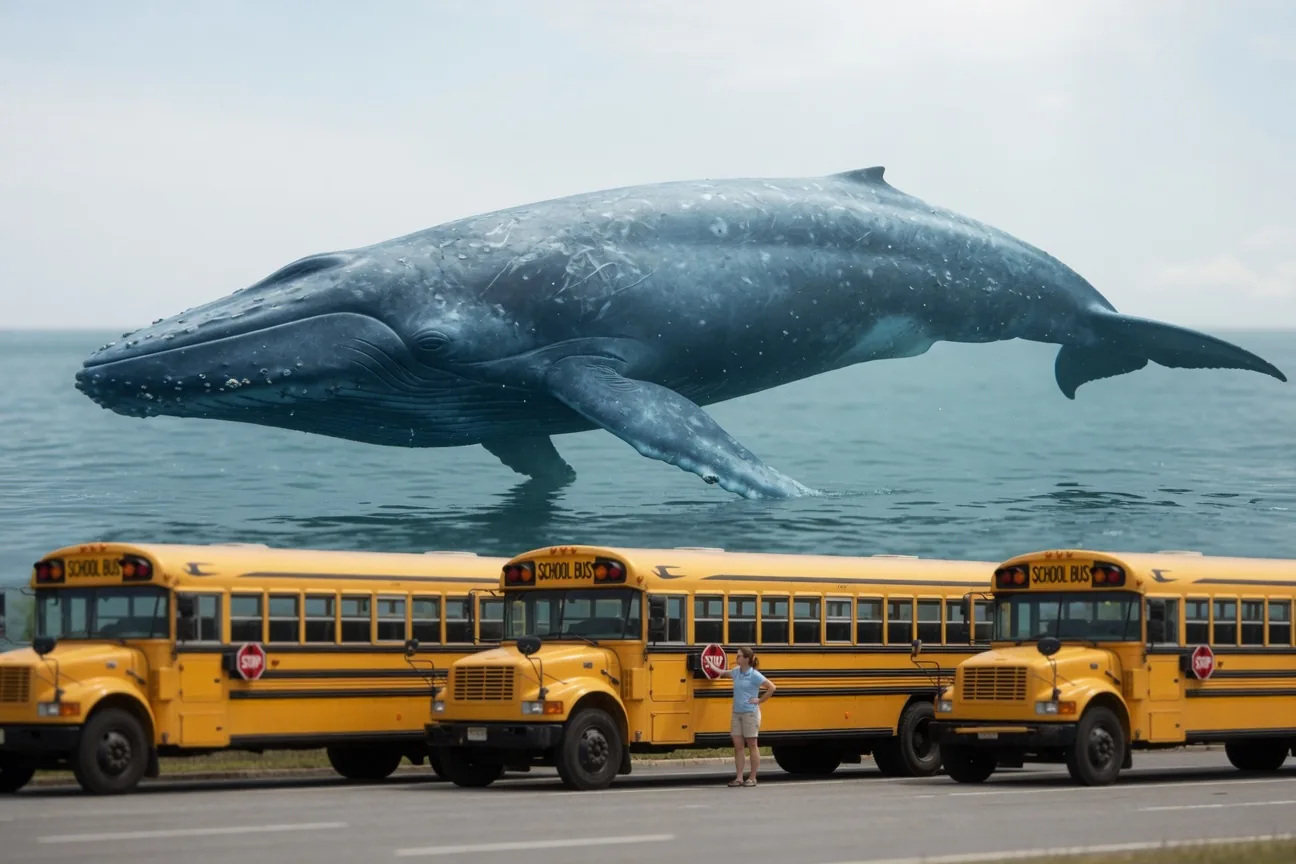
On average, a blue whale is about 80 feet long and weighs around 120 tons. It is so heavy that it is nearly impossible to weigh one accurately. A blue whale is bigger than any dinosaur that ever walked the Earth.
The biggest one ever measured was caught in 1947 by the Japanese Whaling Fleet's factory ship Hashidate Muru. That female blue whale was 89 feet (27.12 m) long and weighed 136,353 kg (134.2 tons), the heaviest ever recorded. That is about 136 metric tonnes, or 353 times the weight of a grand piano!
Inside that gigantic body, the heart alone weighs 1,000 pounds, and more than 14,000 pounds of blood circulate through the whale's veins. The blue whale also holds another record: it is the loudest animal on Earth. Its deep rumbling calls can reach 188 decibels and travel hundreds of miles through the ocean.
Range and Distribution
Blue whales are found in all the world's oceans. Several separate populations live in the Atlantic and Pacific. They are shy animals, and sightings have become even rarer since the whaling era. The best chances of spotting them are around Iceland and off the west coast of the USA, where numbers have been slowly rising.
In the Antarctic, blue whale numbers remain very low. Blue whales are long-distance migrants. In winter they prefer warm tropical waters closer to the equator. In summer they head to cooler polar waters to feed. Along the coasts of Adelaide and Melbourne, they are often spotted from January to May each year.
Behavior
Blue whales are usually seen alone or in pairs. Sometimes they travel in small groups. Despite their enormous size, they are fast swimmers, they cruise at about 12 mph. If startled, they can speed up to 30 mph.
As winter approaches, blue whales travel great distances toward the equator from the polar regions. They are often spotted off the coasts of California and Mexico. They move to tropical waters mainly to reproduce and give birth. Come summer, they return to the polar regions to feed.
Blue whales are among the loudest animals on the planet. They "sing" using a series of pulses, groans, and moans. Scientists believe that, under ideal conditions, blue whales can communicate over a distance of about 1,000 miles (1,600 kilometers).
Take the Blue Whale Quiz!
9 quick questions. How much do you know about the biggest animal on Earth?
Lifespan and Reproduction
Blue whales are ready to mate between the ages of six and ten years. By this time they have generally grown to about 74 to 79 feet in length. Scientists still know very little about exactly how they mate. Females give birth every 2 to 3 years, and pregnancy lasts almost a year. The average lifespan of blue whales in the wild is around 80-90 years.
Diet
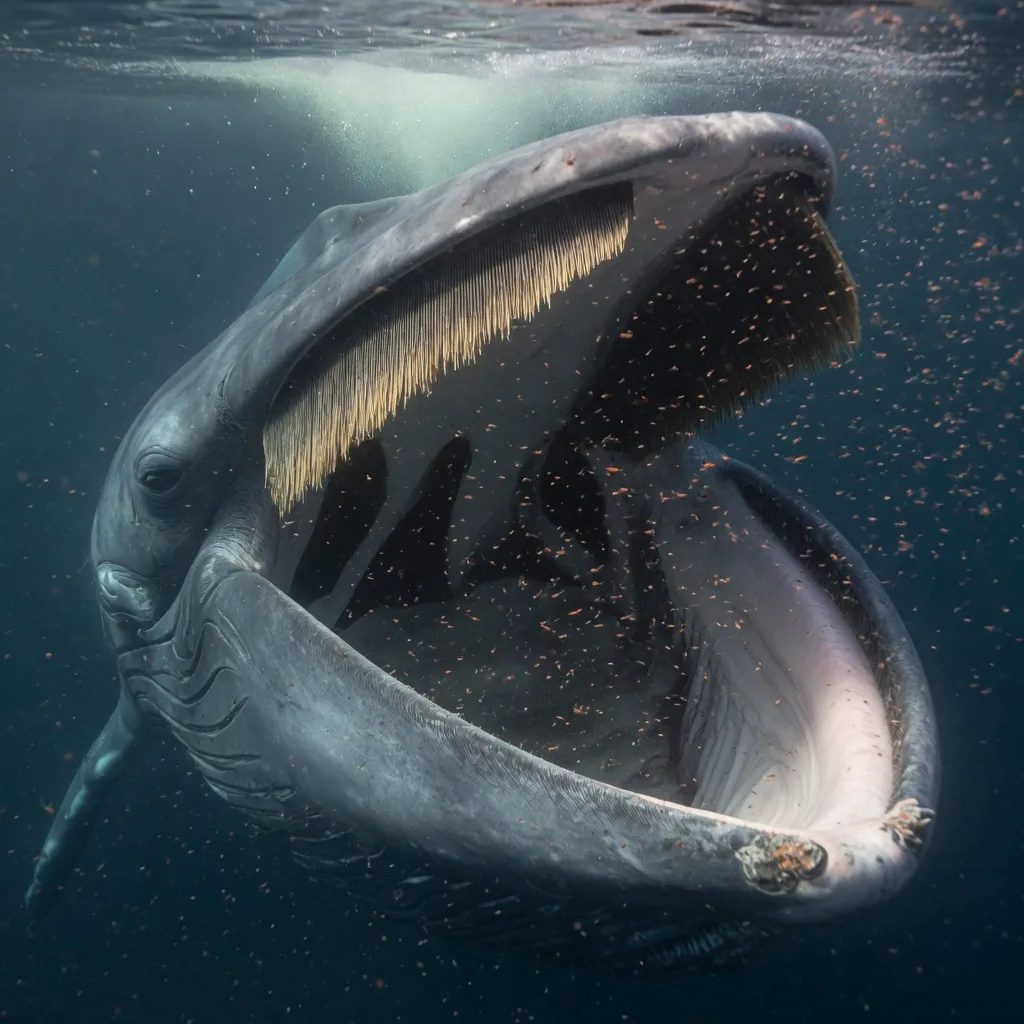
A blue whale's main food is tiny, shrimp-like creatures called euphausiids, or krill. An adult blue whale can eat up to 40 million krill in a single day.
In summer, blue whales feed about 4 times each day, diving deep to find thick swarms of krill. They usually feed during the day and come up to surface-feed at night. Depending on which ocean they are in, they also eat other tiny zooplankton, and sometimes small fish, crustaceans, and squid.
To feed, a blue whale swims open-mouthed through a cloud of krill, gulping in an enormous mouthful of water. Instead of teeth, it has baleen plates that work like a giant strainer. The water is pushed out, and the krill (along with some plankton and small fish) stays behind.
A blue whale has approximately 320 pairs of baleen plates. Each plate is 1 meter long, 53 centimeters wide, and weighs 90 kg. Once the water is expelled, the trapped food is moved toward the tongue and swallowed.
Interesting Facts
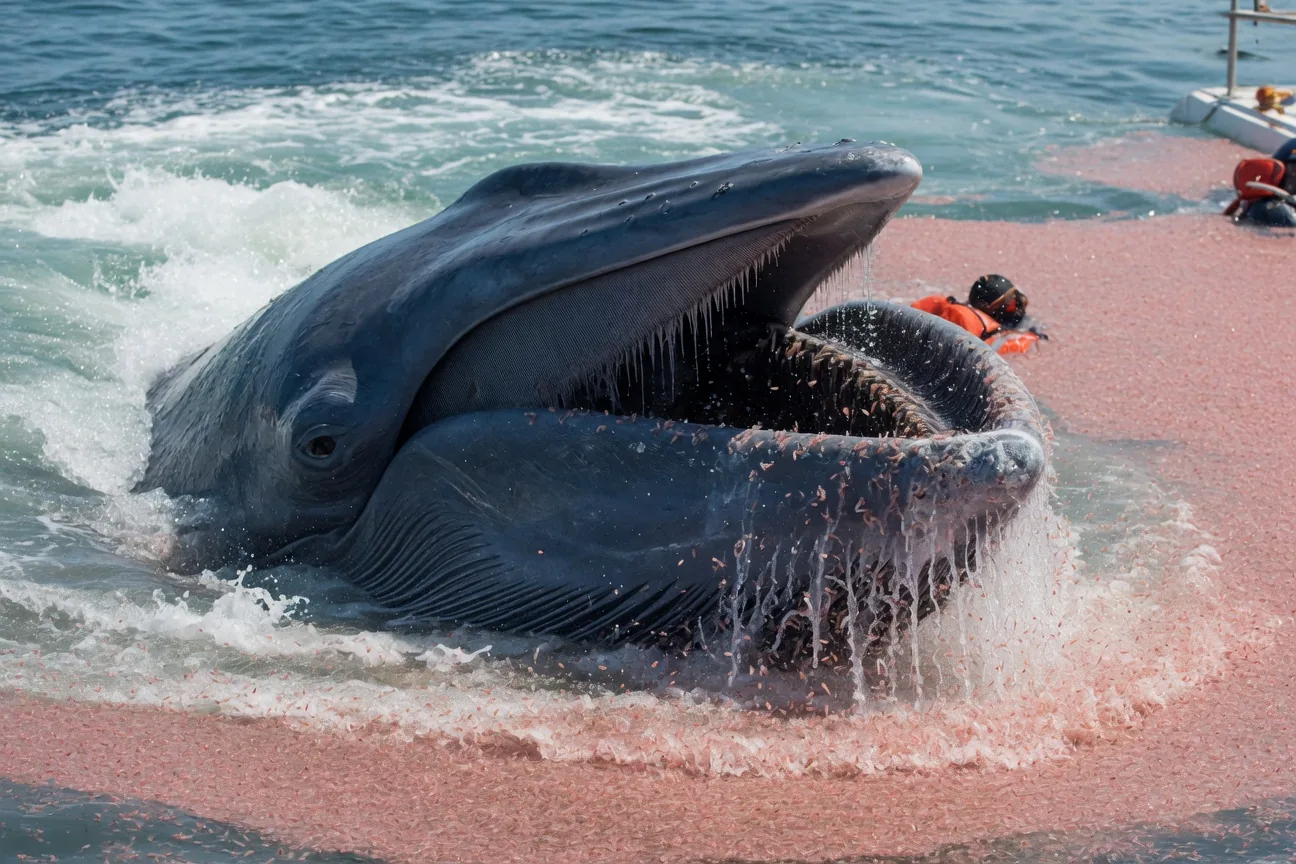
A blue whale's tongue alone can weigh two to three tons, big enough for fifty people to stand on it! When the whale surfaces to breathe, the spout from its blowhole shoots up to 30 feet into the air.
The call of a blue whale can reach 188 decibels. That makes it louder than a jet engine, which clocks around 140 decibels.
Blue whales are about 1250 times larger than the krill they eat. Those tiny krill are on average only 1 or 2 centimeters long.
The main arteries of a blue whale are so wide that a small person could swim through them. Blue whales feed mostly at depths of less than 330 feet, but they can dive down to 1640 feet. One dive can last anywhere between 10 to 20 minutes.
This mammal is roughly as long as a Boeing 737 aircraft, yet the blue whale's heart weighs as much as a small car. These graceful swimmers cruise the ocean at more than five miles an hour (eight kilometers an hour). When they need to move fast, they can reach more than 20 miles an hour (32 kilometers an hour).
Frequently Asked Questions
What is the scientific name of a blue whale?
Balaenoptera musculus
How big is a blue whale?
The average blue whale is about 80 feet long and weighs around 120 tons. The largest can reach up to 30 meters (100 feet) and 180-200 tons, the largest animal ever known to live on Earth.
What is the biggest blue whale ever recorded?
In 1947 a female blue whale measured 89 feet (27.12 m) long and weighed 136,353 kg (134.2 tons), the heaviest ever recorded.
What do blue whales eat?
Primarily krill (euphausiids). An adult can eat up to 40 million krill per day.
Are blue whales endangered?
Yes. Blue whales are classified as Endangered on the IUCN Red List. They were nearly hunted to extinction in the twentieth century.
Size Champion: More Amazing Facts
So many of the most jaw-dropping blue whale facts come down to one thing: just how enormous these animals really are. Here are some record-breakers worth knowing:
- The blue whale's heart is the size of a small family car.
- Its aorta is so large that a human can literally crawl through it like a tunnel.
- Blue whales measure about 89 feet for females and 82 feet for males.
- One blue whale is as long as 3 school buses lined up end to end.
- Twenty-five elephants standing in a row are about equal to one blue whale in size.
- A blue whale calf is about 23 feet long at birth and weighs over 7,000 kg.
- A blue whale needs about 8,000 pounds of seafood every day to be well fed.
- Its low rumbling calls are louder than a commercial jet, which reaches around 120 decibels.
- A blue whale can swim about 3 to 20 mph, and even reach 24 to 30 mph when in danger.
- The blow (spout) of a blue whale rises about 15 to 20 meters above the water's surface.
- Some scientists put the average lifespan of a blue whale at about 35 to 40 years.
A blue whale is so massive that if it were taken out of the ocean, it would be crushed by its own weight. The ocean is the only place big enough (and strong enough) to support the largest animal that has ever lived on Earth.
Conservation
No other living species is a natural threat to blue whales, only humans. Commercial whalers killed 99% of the world's blue whale population, pushing the species close to extinction. These gentle giants were hunted in such huge numbers that they were placed on the United States endangered species list. Since then, many efforts have been made to help blue whales recover. Their population is slowly growing, but the threat is not over. Illegal whaling still happens, and many whales are killed by oil spills or struck by large ships. Blue whales are currently classified as endangered on the World Conservation Union (IUCN) Red List.
Explore More Animals
 Why Are Blue Whales Endangered and Why Should We Be Concerned?Blue whales are the largest animals ever to have lived on Earth, yet they nearly went extinct. Find out why blue whales are endangered and what is being done t
 Blue Whale HabitatThe blue whale habitat ranges from the Arctic to the Southern Ocean, which basically means that it can be found in all the oceans of the world. This AnimalSake
 28 Amazing Blue-colored Animals (With Pictures)Blue is one of the rarest colors in the animal kingdom. Meet 28 amazing blue-colored animals (ocean creatures, birds, frogs, lizards and bugs) with a stunnin
 Unusual and Little-known Facts About MammalsMammals are a class of vertebrates which began to evolve on Earth around 200 million years ago. Discover record-holders, classification, and surprising facts ab

 Fun fact for today!A blue whale's heart is as big as a small car, and beats just 8-10 times per minute!