

If you're visiting one of the many islands between the Indian and the Pacific Ocean and happen to come across what looks like the largest, scariest spider you've ever seen, have no fear, it is not a spider. It's the coconut crab.
Coconut crabs belong to a group of crab-like creatures. They are related to hermit crabs and king crabs. They look like crabs and are named like crabs, but scientifically, they fall into a different category.
True crabs belong to the infraorder Brachyura. Hermit crabs, king crabs, and coconut crabs all belong to the infraorder Anomura. Together, these two infraorders form the clade Meiura.
All members of the clade Meiura evolved from a common ancestor. But there are clear differences between Anomura and Brachyura. The biggest difference is the position and size of the last pair of legs.
Both true crabs and false crabs have five pairs of legs. In false crabs, however, the last pair is very small compared to the other four. It stays hidden under the body. False crabs don't use that fifth pair for walking, they use it for reproduction instead.
Classification
| Kingdom | Animalia |
|---|---|
| Phylum | Arthropoda |
| Subphylum | Crustacea |
| Class | Malacostraca |
| Order | Decapoda |
| Superfamily | Paguroidea |
| Family | Coenobitidae |
| Genus | Birgus |
| Species | B. latro |
Distribution
Coconut crabs are found from the coast of African islands in the Indian Ocean all the way to Micronesia. You'll find them in almost exactly the same places as coconut trees. They live on most islands in the Indian Ocean, on the Malay archipelago, and beyond Australia. They used to live in Australia and Africa too, but those populations have been wiped out.
Size & Body
Coconut crabs are the largest terrestrial arthropods in the world. They can reach a leg-span of up to 1 meter (about 3 feet) (though 60-70 cm is more common) and can weigh as much as 4 kg. This species can grow to as large as a meter in size. Like true crabs, coconut crabs have 5 pairs of legs. But the last pair is hidden under the carapace, which is the hard shell covering their main body.
Males use those hidden legs to pass sperm to females. Females then use them to protect and clean their embryos. Both males and females use the legs to clean the underside of their body.
The coconut crab is really a type of hermit crab that grows to gigantic proportions. Most hermit crabs live their entire lives inside the shells of other sea creatures, to protect their soft bodies from predators. The coconut crab is different. Only very small coconut crabs use the shells of other animals to protect their soft-skinned abdomens while they are still developing. Once they reach the juvenile stage, they abandon those shells. Their abdomen then develops a hard exoskeleton over the rest of the body. This hard skin protects the crab, reduces water loss, and continues to grow along with the crab.
Physical Description
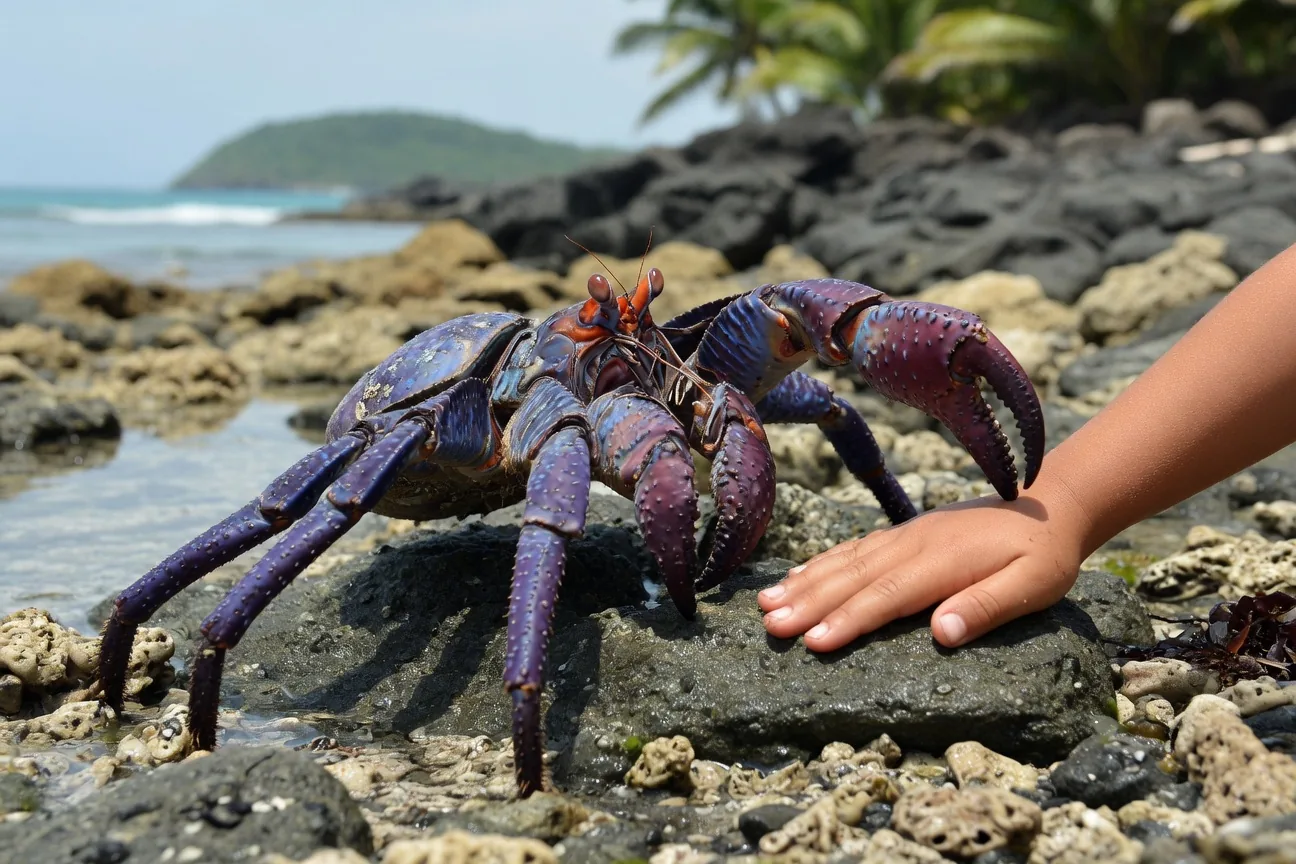
Coconut crabs come in two main colors: red (ranging from orange to red) and blue (ranging from purple to blue). The exact color varies depending on the island where the crab lives, from orange-red to purple or blue. Crabs on the African side of their range (especially in the Seychelles) tend to be red. Most other populations are blue. Like hermit crabs, their closest relatives, young coconut crabs use mollusc shells to protect their soft abdomens.
Males are considerably larger than females. The coconut crab's stalked eyes are red. Its antennae are quite different from those of other crabs, they look like the smelling organs of insects. Although insects and the coconut crab do not evolve in the same way, they both need to detect smells in the air. Because of this shared need, both groups have evolved with remarkably similar organs. The coconut crab flicks its antennae the way insects do to improve its reception, and it has an excellent sense of smell. It can detect odors over large distances, particularly the smell of rotting meat, bananas, coconuts, and other potential food sources.
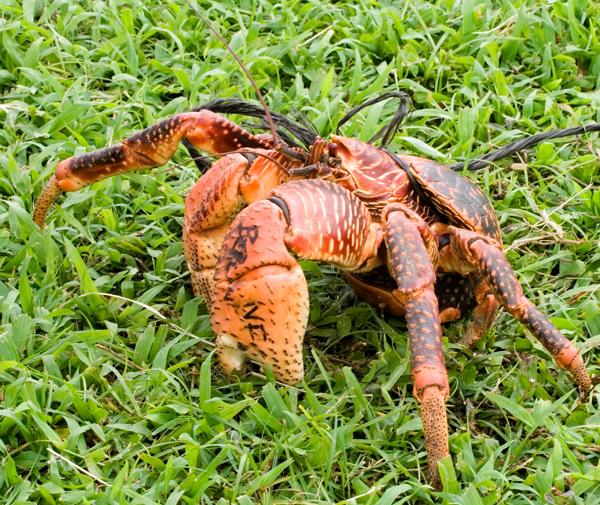
As adults, coconut crabs grow a hard outer plate over their abdomens instead of using a shell. This plating has to be shed and regrown every year, a process called molting. During molting, the crab is soft and vulnerable until its new plate hardens.
Names & Nicknames
The coconut crab is also called the palm thief or robber crab, because some people have claimed that it steals shiny objects such as silverware and pans from houses and tents. The coconut crab also has various local names among the islands where it lives, such as ayuyu on Guam, and kaveu or unga in the Cook Islands. Some people call the coconut crab a taotaomo'na, because they think the crab might be an illusion brought about by ancestral spirits also called the taotaomo'na.
Dependence On Land & How It Breathes
Coconut crabs are built for life on land. If you dropped one in water, it would drown in less than 24 hours! Even small specimens will drown in water. They have special air-breathing organs called branchiostegal lungs. These are an in-between step, part lung, part gill. They can't breathe underwater, except as larvae. But branchiostegal lungs need to stay moist to work properly.
The chambers of the branchiostegal lung are located in the rear of the thorax. They contain tissue similar to gill tissue, but it is better suited for absorbing oxygen from the air rather than from water. A coconut crab uses its tiny 9th and 10th legs (the smallest pair, at the back of its body) to clean these breathing organs and to moisten them with sea water, which they need to work properly. The crab may even drink salt water by using that smallest pair of legs to carry the water to its mouth. Coconut crabs also have an undeveloped set of gills that lets them survive in water for a short time.
Take the Coconut Crab Quiz!
8 quick questions. How much do you really know about the world's largest land arthropod?
Diet
Despite their name, coconuts are not the coconut crab's favorite food. They mainly eat the flesh, seeds, and pith of fresh fruits. They also scavenge carcasses and hunt for nuts. Coconuts are just an occasional treat, not a daily meal.
In fact, the coconut crab will eat nearly anything organic. Its diet includes leaves, rotten fruit, dead animals, tortoise eggs, and even the shells of other animals. It may also eat live animals that move slowly, such as freshly-hatched sea turtles. One coconut crab has even been observed catching and eating a Polynesian Rat. Crabs often try to steal food from each other, and they will pull food into their burrows to keep it from being stolen.
Coconut crabs have a very good sense of smell. They rely on it almost entirely to find their food.
How It Opens a Coconut
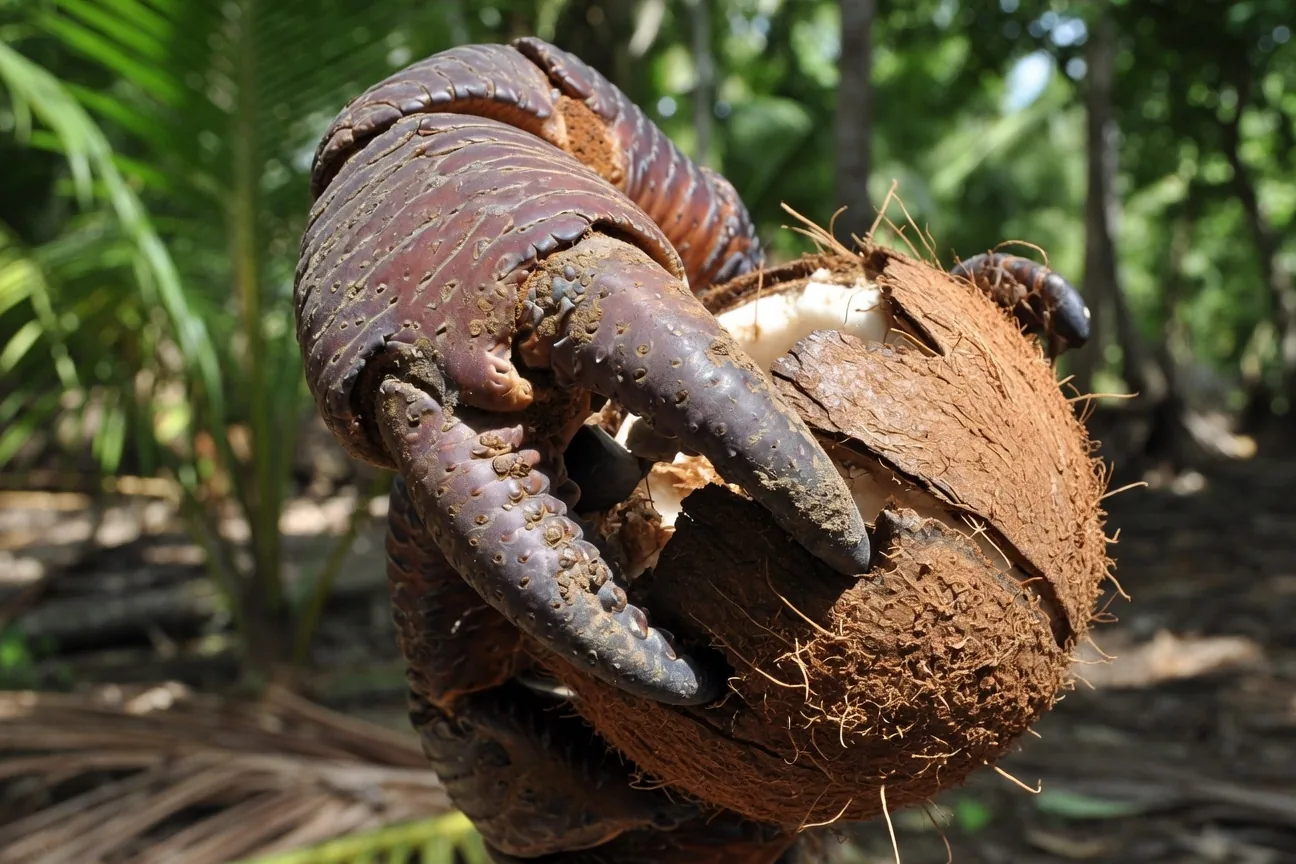
When a coconut crab does eat a coconut, it rips off the husk first. It uses its strong claws to cut holes into the shell and reach the moist fruit inside, a behavior that is unique in the animal kingdom. If the coconut is still covered with a husk, the crab uses its claws to rip off strips of husk, starting from the end with the three small germination holes. Once the pores are open, the crab bangs its pincers on one of them until the coconut breaks open.
Afterward, the crab turns around and uses the smaller pincers on its other legs to tear out the flesh inside the coconut and carry it to its mouth. Some crabs take a different route entirely: they use their powerful pincers to crack the tough shell (which can take days) or they climb a tree and drop the coconut from a height to break it.
Adaptations & Strength
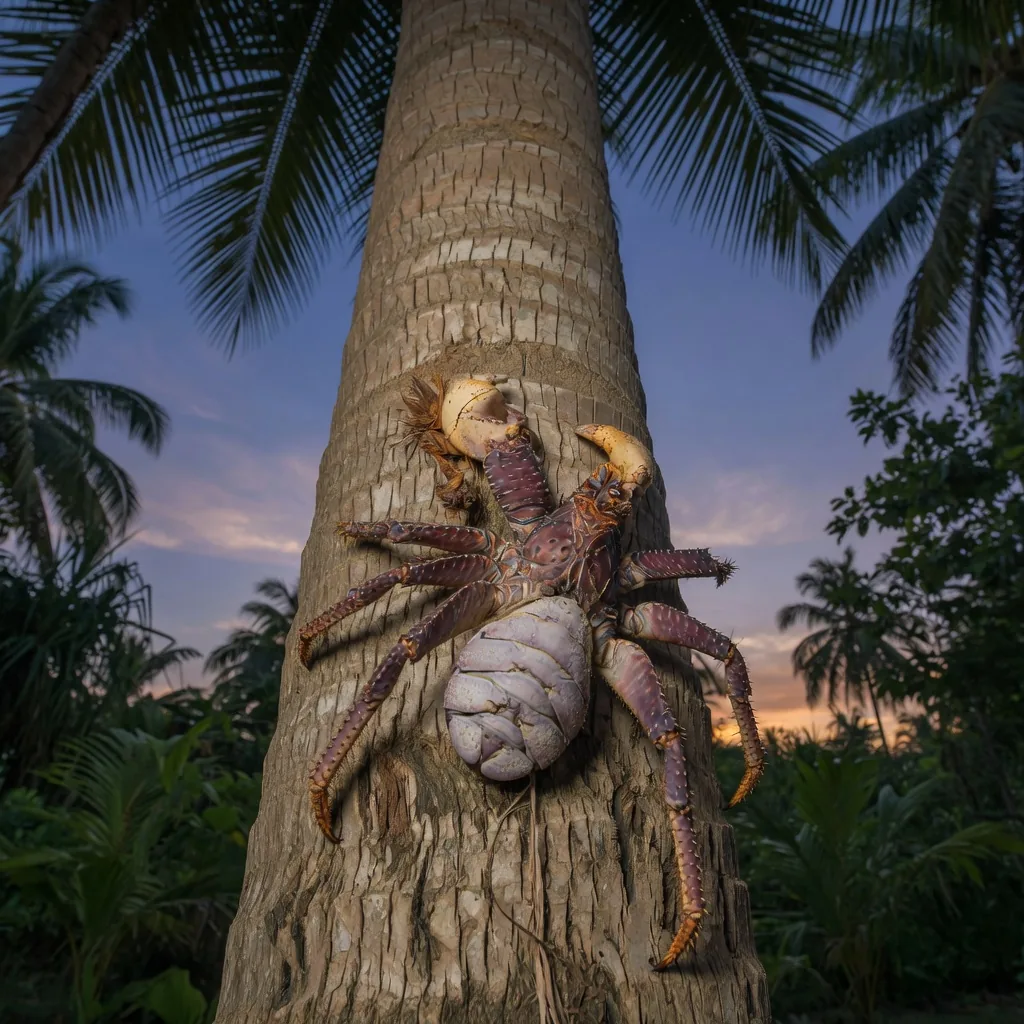
Although most crabs live near and swim in water, the coconut crab cannot swim. But this gigantic crustacean is superbly adapted to living on land. It has long, strong legs and large, muscular claws that are so powerful they can lift heavy objects such as coconuts and vegetation weighing several pounds. The large claws are used for husking coconuts and opening the shell to eat the flesh inside, which is exactly why the species is called the coconut crab.
Life Cycle
Coconut crabs breed between late May and early September. Fertilization happens on dry land. The female carries her embryos on the underside of her body until they are ready to hatch. When the time comes, she releases the larvae into the ocean, the only time in their lives they will spend in water.
The larvae float in the sea for about a month. Then they find a shell that fits their size and start making short trips onto dry land. As they grow, they swap shells for bigger ones. Eventually, they grow hard exoskeletons of their own and leave the water permanently. From that point on, they slowly lose the ability to breathe underwater. They reach sexual maturity after five years.
Coconut crab larvae are easy prey for many predators. Like most species, many larvae don't survive to adulthood.
Frequently Asked Questions
Are coconut crabs true crabs?
No, they are classified under Anomura (like hermit crabs), not Brachyura (true crabs).
What do coconut crabs mainly eat?
Mostly fresh fruit and seeds, but they will eat nearly anything organic, leaves, dead animals, tortoise eggs, and even slow-moving live animals. Coconuts are only an occasional treat.
Can coconut crabs swim?
No. Adult coconut crabs cannot breathe underwater and will drown in under 24 hours if submerged; even small ones will drown in water.
How big can a coconut crab get?
Leg span up to 1 meter (about 3 feet); weight up to 4 kg, the largest land-dwelling arthropod on Earth.
Why is the coconut crab called the robber crab?
Because people have reported it stealing shiny objects such as silverware and pans from houses and tents. It is also called the palm thief.
Where do coconut crabs live?
Tropical islands from African islands in the Indian Ocean to Micronesia, roughly following coconut tree distribution.
Cultural Significance
The coconut crab is admired for its strength and holds a special place in the local culture of many areas where it lives. Villagers in some places use it to guard their coconut plantations, because the crab may attack a person if it feels threatened. Adolescent crabs are sold as pets in Tokyo and other places, but they must be kept in a cage strong enough that the animal cannot use its powerful claws to escape. If a frightened crab pinches a human, not only is the pinch painful, it is very difficult to dislodge the powerful claw.
Uses & Threats
On many islands, people hunt coconut crabs for their meat, which is considered a delicacy. Their habitat has also shrunk wherever humans have settled nearby. Adults have virtually no natural predators, yet this fascinating creature is threatened with extinction in some areas because significant numbers are eaten by people. In some areas, populations are declining because of over-harvesting, and in remote areas the crab has become a valuable commodity. It is purchased and eaten privately or sold in restaurants.
So, like many of nature's most interesting and lovely creatures, the coconut crab is in danger of vanishing because humans descend and exploit it. Even so, coconut crabs are not currently considered a species under serious threat overall, and some groups have been formed specifically to work toward preventing the extinction of this unique animal.
Explore More Animals
 What Do Crabs Eat? Diet, Body, Food & Amazing Crab FactsWhat do crabs eat, and what makes them so strange? Explore the crab's chewing stomach, body plan, diet, how humans eat crabs, and the weirdest crabs in the ocea
 Facts About Spider Crabs That are Insanely BizarreWhat exactly is a spider crab? Discover the giant Japanese spider crab, European spiny crabs, portly crabs, sheep crabs, and more, with facts, a quiz, and glos
 Did You Know These Facts About Creepy-crawly Centipedes?Centipedes are scary little creatures with a segmented body and numerous legs. Learn how many legs they really have, what they eat in the wild and as pets, and
 Gripping Facts About the Largest Spiders in the WorldTwo spiders share the title of world's largest: the Goliath birdeater (heaviest) and the giant huntsman (longest leg span). Discover the facts, quiz, and more.

 Fun fact for today!Coconut crabs are the largest land-dwelling arthropods in the world, with a leg span up to 1 meter!