

Classification
- Kingdom, Animalia
- Phylum, Chordata
- Class, Reptilia
- Order, Squamata
- Family, Viperidae
- Genus, Agkistrodon
- Species, Agkistrodon contortrix
Appearance
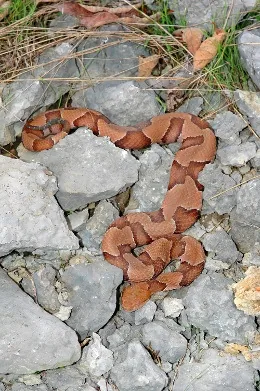
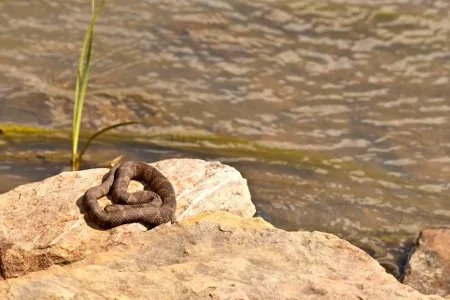
Copperhead snakes get their name from their unmarked, copper-colored head. Their bodies are orange, light brown, or sometimes pinkish. Darker chestnut-brown bands run across the body in a series of hourglass shapes. The width and thickness of these bands is one of the main ways to tell the five subspecies apart.
The belly has gray-to-black splotches blended into a marbled pattern. Copperheads are usually 2 to 3 feet (24 to 36 inches) long. Some have been found as long as 4½ feet (54 inches). Females tend to be longer than males, but males have proportionally longer tails. The body is thick and muscular, narrowing sharply near the tail. Baby copperheads have bright yellow tails and use them to attract prey.
Habitat and Distribution
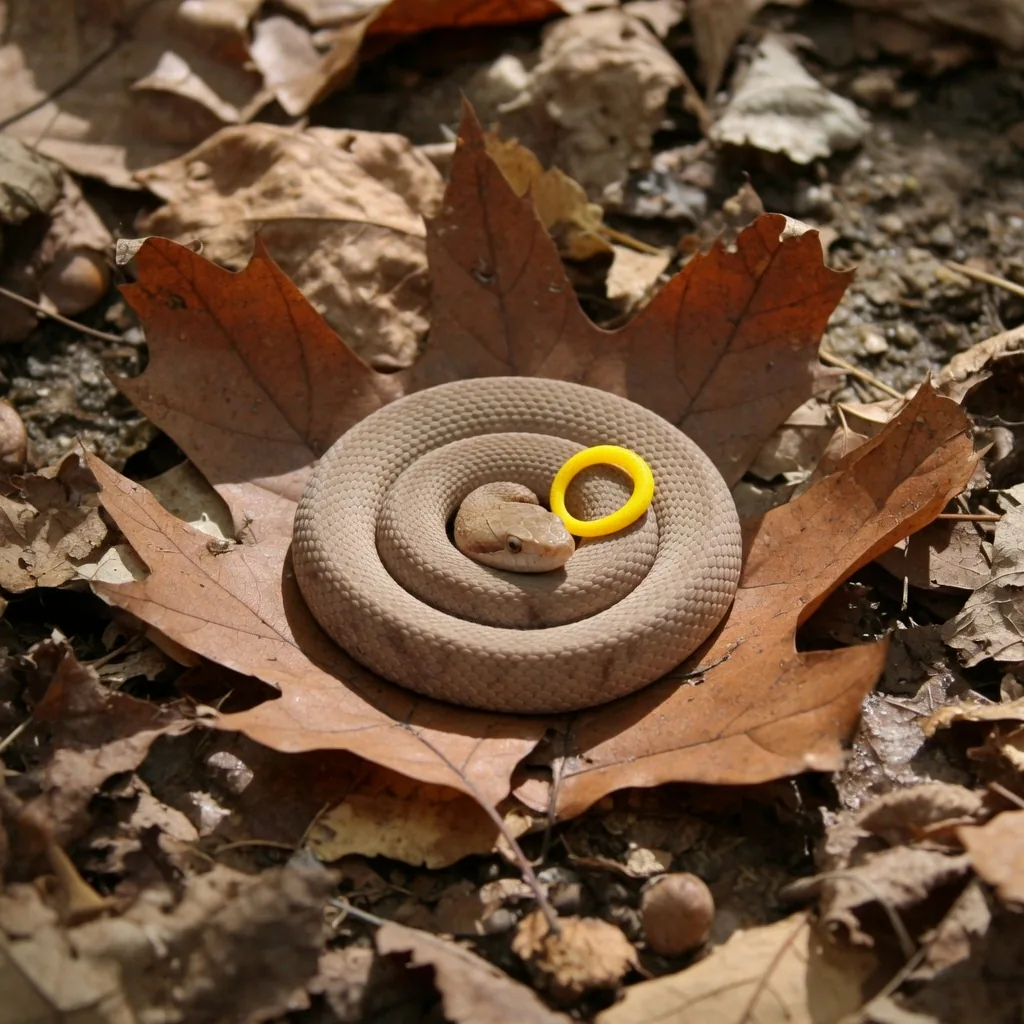
Copperheads can thrive in almost any environment. They live in rocky areas, wooded hillsides, mountains, swamps, canyons, and even desert oases. You might also find them in brush piles, sawdust piles, abandoned farm buildings, or bushy areas along streams.
They are found throughout Central and Eastern United States, from Kansas to Connecticut and from Western Texas to Florida. The five subspecies are spread across the northern, southern, and western parts of this range.
Hibernation
Copperheads are mostly solitary animals, except during the mating season. In winter, they hibernate in communal dens with other copperheads and even other snake species. In fall and spring, they are active during the day. In summer, they switch to being nocturnal, most active at night. Warm, humid nights after rain are a great time to spot one.
Diet
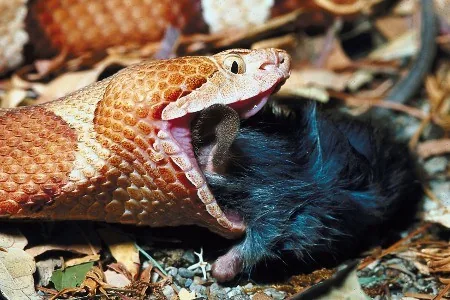
Copperheads are pit vipers. That means they have special heat-sensing pits between their eyes and nostrils. These pits let the snake "see" the warmth of a nearby animal, even in total darkness. Copperheads eat mice, chipmunks, frogs, lizards, other snakes, insects, and even small birds. A single copperhead might only eat 10 to 12 meals in an entire year.
Once a copperhead finds its prey by heat and smell, it strikes fast and injects venom. The venom breaks down blood cells, which quickly collapses the prey's circulation. The snake then swallows its meal whole, letting powerful digestive juices do the rest.
Take the Copperhead Snake Quiz!
5 questions about the US's most-encountered venomous snake. How much do you know?
Mating Season
Male copperheads fight each other for the right to mate. A male that loses a fight is unlikely to challenge another rival again. Females can also be choosy, they won't mate with a male who backs down during a contest.
Mating season runs from late spring into early fall. Fertilization happens in spring, and by fall the female gives birth to 1 to 14 live young near her hibernation den. Bigger females have larger litters. Newborn copperheads are 8 to 10 inches long.
Bite
Copperheads bite more people in the US than any other venomous snake. The good news is that their venom is mild and rarely fatal to a healthy adult. Pets and children, however, can have very serious reactions.
The venom is hemolytic, it breaks down red blood cells and tissue around the bite. This causes intense pain, swelling, nausea, and throbbing. Even though the venom is relatively mild, a copperhead bite is always a medical emergency.
Frequently Asked Questions
Are copperhead snakes deadly?
Rarely fatal to healthy adults, but the bite causes serious pain and swelling and is always a medical emergency.
How do you identify a copperhead snake?
Look for the distinctive unmarked copper-colored head and chestnut-brown hourglass bands on a pale orange or light brown body.
Where do copperhead snakes live?
Throughout Central and Eastern United States, from Kansas to Connecticut and Western Texas to Florida, in habitats ranging from forests and mountains to swamps and rocky hillsides.
What do copperheads eat?
Primarily rodents (mice, chipmunks), frogs, lizards, other snakes, insects, and small birds, only 10 to 12 meals per year.
Camouflage
Most snakes flee when they sense a threat. Copperheads don't, they freeze in place instead. They also skip the warning signs that other snakes use, like rattling the tail or opening the mouth wide. A copperhead can strike without any warning. If you see one, give it space and let it move on.
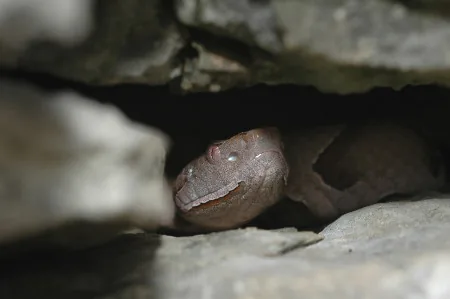
Copperheads are masters of disguise. Their hourglass pattern blends perfectly with dead leaves and forest debris. When clearing leaf piles or log stacks, always check carefully, a copperhead can be almost invisible until it moves.
Other Interesting Facts
- Their fangs are solenoglyphous (hollow, folding, and front-mounted) measuring 0.3 inches long. Bigger snakes have longer fangs.
- Fangs wear out and get replaced. Each copperhead goes through 5 to 7 sets of fangs in its lifetime.
- The average lifespan in the wild is 18 years.
- When touched or threatened, they sometimes release a musky smell very similar to cucumbers.
- After a meal, they like to lie in a sunny spot and bask, digesting food takes energy, and warmth helps.
- Baby copperheads are born with fully working fangs and venom. They can hunt from day one.
- Copperheads go by many nicknames: highland moccasin, clunk head, pilot snake, death adder, and poplar leaf.
Explore More Animals
 45 Snake Species That are Found in LouisianaLouisiana is home to 45 snake species, 7 venomous and 38 non-venomous. Discover each one with descriptions, photos, and a Louisiana Snakes quiz.
 3 Stages in the Life Cycle of a SnakeThe life cycle of a snake starts with the egg stage and ends at the adult stage. In some species the female gives birth to live young. Discover all three stages
 Ways to Identify a Water Moccasin Snake And Tips to Treat its BiteThe water moccasin is one of North America's most venomous snakes. Learn how to identify it by its heavy body, triangular head, vertical pupils, and white mouth
 Your Complete Guide to Snake IdentificationIdentify any snake by its length, girth, pupils, pattern, head shape, and tail plates, then learn the warning signs of a venomous one. A clear photo field guid
A Strange Myth
One popular myth claims that copperheads and black rat snakes interbreed to create a deadly new hybrid. This is not biologically possible. The myth probably started because these two species often share the same winter hibernation dens. Sharing a den is very different from reproducing together!
Copperhead snakes are striking, beautiful reptiles. Yes, they bite more people than most other venomous snakes, but like all wild animals, they only attack when they feel threatened. If a copperhead crosses your path, give it room to leave. Do not kill it unless you have absolutely no other option. In the event of a bite, call emergency services immediately and keep the person calm until help arrives.

 Fun fact for today!A political party during the American Civil War was nicknamed "Copperheads" by their opponents, after this very snake!