

The cuttlefish belongs to the order Sepiida, which also includes squids, octopuses, and nautiluses.
The cuttlefish is not a fish, but it is very much a marine creature. It is an invertebrate, an animal with no backbone. Scientists say it is one of the most intelligent invertebrates on Earth. It lives for around 2 years. Its name comes from the old English word cudele. Keep reading to discover all the remarkable things that make it so special.
Classification
| Kingdom | Animalia |
|---|---|
| Phylum | Mollusca |
| Class | Cephalopoda |
| Order | Sepiida |
| Superorder | Decapodiformes |
Anatomy
Cuttlebone
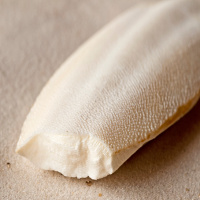
- The bone of the cuttlefish is known as the cuttlebone.
- It is made of aragonite and is unique to the cuttlefish.
- The shape, size, and pattern (ridges/texture) vary in each of the species of cuttlefish.
- It is used as a calcium supplement for birds, turtles, chinchillas, reptiles, and hermit crabs.
- It is also used as a mold in jewelry making.
Body
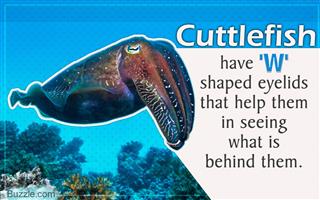
- Instead of a tail, a cuttlefish has a rippling fin that runs all the way around its body. This fin gives it very precise control over where it goes.
- To escape danger, a cuttlefish uses jet propulsion. It squeezes water through its mantle (the main body) and out through a tube called a siphon. This shoots it backwards very fast.
- Most cuttlefish are between 15 and 25 cm long (5.9 to 9.8 inches). The largest species, Sepia apama, can reach 50 cm (20 inches). The smallest, the Stumpy-spined cuttlefish (Sepia bandensis), is just 7 cm. It lives in the Alas Strait in Indonesia.
- A cuttlefish has eight arms and two extra-long tentacles. Both tentacles have toothed suckers that grip prey tightly.
Skin and Camouflage
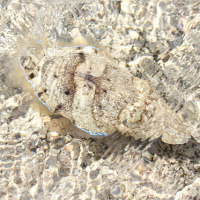
- Cuttlefish are called the 'chameleons of the sea' because their skin can change color in an instant.
- They use this color change to hide from predators or to sneak up on prey.
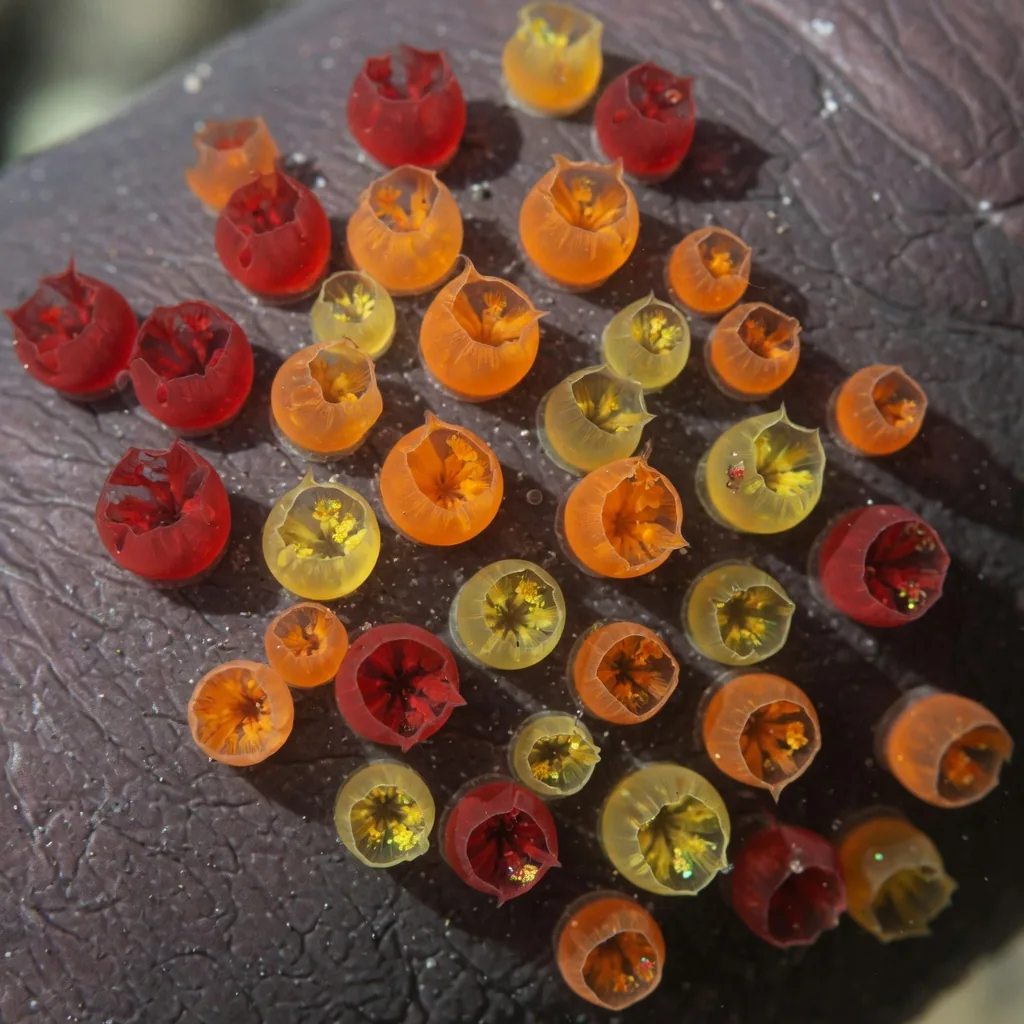
- The color changes are powered by tiny cells called chromatophores, each one is a sac of pigment (red, yellow, brown, or black) that can expand or shrink in a fraction of a second.
- Color cell layers in the skin:
- Yellow chromatophores (xanthophores), nearest to the surface
- Red and orange (erythrophores), just below
- Brown or black (melanophores), above the iridophore layer
- Iridophores (plates of chitin or protein), reflect blue and green light
- All these cell types can work together in any combination, creating a huge range of patterns.
- Cuttlefish can also detect the polarization of light. They use this to send hidden signals to other animals that can see polarized light.
- A cuttlefish quickly reads its surroundings and changes its colors to match, even in pitch darkness.
Eyes
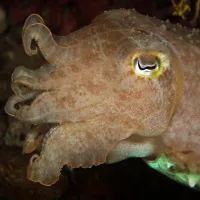
- Unlike human eyes, cuttlefish eyes have no blind spot. That is because their optic nerve sits behind the retina, not in front of it.
- Even though cuttlefish are colorblind, their eyes are very advanced. Scientists believe they start watching the world while they are still inside the egg.
- The pupil of a cuttlefish's eye is shaped like a 'W', one of the most unusual pupils in the animal kingdom.
- Although they cannot see color, cuttlefish can detect the polarization of light and react to it.
- To change focus, a cuttlefish moves its entire lens forward or backward. Mammals, by contrast, squeeze and stretch the lens to do the same thing.
Circulation
- Cuttlefish blood is blue-green. The reason is the protein hemocyanin, which carries oxygen using copper atoms instead of iron. (Human blood uses iron, which makes it red.)
- A cuttlefish has three hearts: one main heart pumps blood around the body, and two smaller branchial hearts each pump blood to one of the gills.
- Blood flows through a cuttlefish's body faster than in most other animals. This is because hemocyanin carries less oxygen per pump than hemoglobin, so the heart must work harder.
Frequently Asked Questions
Is a cuttlefish actually a fish?
No, the cuttlefish is a mollusk in the class Cephalopoda, related to squids, octopuses, and nautiluses.
Why does cuttlefish blood look blue-green?
Cuttlefish blood uses the protein hemocyanin, which contains copper instead of iron. Copper-based blood turns blue-green when oxygenated.
Can cuttlefish change color even though they are colorblind?
Yes. Cuttlefish cannot see color wavelengths but can perceive polarized light, which they use to produce their stunning color-change displays.
How many hearts does a cuttlefish have?
Three, one main heart and two branchial hearts that pump blood to each gill.
What is a cuttlebone used for?
In cuttlefish, the cuttlebone controls buoyancy. Dried cuttlebones are also sold as calcium supplements for pet birds, reptiles, and hermit crabs.
Take the Cuttlefish Challenge Quiz!
5 quick questions about the ocean's most mysterious mollusk.
Ink and Toxicity
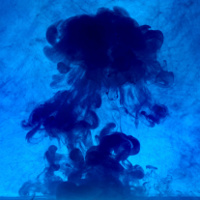
- For centuries, artists used real cuttlefish ink to make the warm brown color called "sepia." Today, a synthetic version has replaced it.
- When threatened, a cuttlefish squirts a cloud of ink into the water. This confuses the predator and gives the cuttlefish time to escape.
- All cuttlefish produce neurotoxins in their saliva. These toxins are made by bacteria living inside them. However, most species are not dangerous to touch or eat.
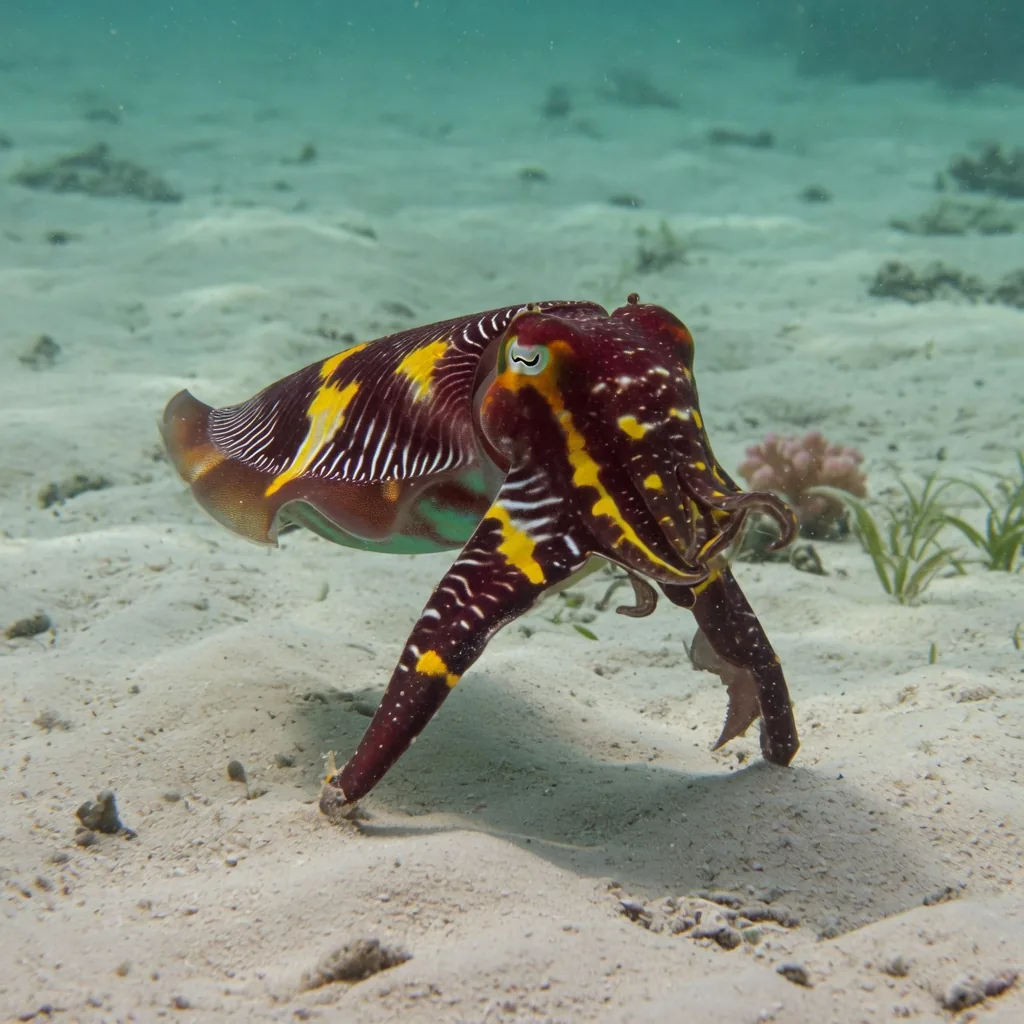
- One exception is the flamboyant cuttlefish (Metasepia pfefferi). Its toxins are as lethal as those of the blue-ringed octopus.
- The flamboyant cuttlefish is the only known cuttlefish species whose flesh is poisonous.
Ecology
Diet and Habitat
- Cuttlefish eat newly hatched shrimp, crabs, and small fish.
- They use their camouflage to creep close to prey without being spotted.
- They can also blast jets of water into the sand to flush out hidden prey, then snatch it with their tentacles before it can escape.
- Once caught, prey is paralyzed by the cuttlefish's venom and then eaten.
- Cuttlefish prefer shallow tropical and temperate seas.
- They are found in the Mediterranean Sea, the Baltic Sea, and the shallow waters off South Africa, Australia, Malaysia, the Philippines, and the English Channel.
Mating
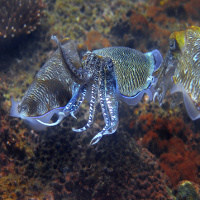
- During mating season, male cuttlefish compete fiercely for females.
- Most rivalries are settled by displays rather than fighting. Two males will flash threatening color patterns at each other until one backs down and swims away.
- Sometimes, when a large male is challenged, real fighting does break out.
- Competition is intense because roughly four or five males may chase a single female at the same time.
- Cuttlefish grow fast, so a larger male has a better chance of winning a mate than a smaller one.
- Smaller males have a clever trick: they disguise themselves as females by changing to a female color pattern and hiding their extra arms, or even pretending to carry an egg sac.
- In this disguise, a small male can slip past the guarding male and secretly mate with the female.
- During mating, the male uses a special tentacle to place sperm sacs near the female's mouth opening.
- Once the eggs are laid a few hours later, the male stands guard over the female and her eggs.
Predators and Human Use
Sharks, monkfish, and swordfish all prey on cuttlefish, but the biggest predator of all is humans. People catch cuttlefish for food, keep them in aquariums, and harvest their ink and cuttlebone.
Around the world, cuttlefish end up in dishes like black risotto (the dark sauce is their ink), fried snacks, deep-fried cuttlefish, and fish stews.
Scientists also study cuttlefish to understand their camouflage, and to see if the same trick can be copied for use in technology. Cuttlefish are not endangered, but learning about them helps us protect the ocean ecosystems they call home.
Explore More Animals
 Squid vs. Octopus: What's the Difference?Squid or octopus? Both are clever cephalopods with three hearts and blue blood, but their bodies, homes, and habits are different. Here's a clear side-by-side
 What Do Squid Eat? The Diet of One of the Ocean's Deadliest HuntersSquid are fierce hunters with a parrot-like beak and three hearts. Discover exactly what squid eat (from tiny plankton to whales and sharks) and how they catc
 Amazing Facts About the Mimic OctopusThe mimic octopus was first found in Indonesia in the early 90s and can impersonate more than a dozen sea creatures. Discover amazing facts about Thaumoctopus m
 Interesting Facts About the Beautiful Blowfish (Puffer Fish)Also known as puffer fish, blowfish can inflate themselves to scare away their predators, hence the name. They are believed to be the second most poisonous vert

 Fun fact for today!Cuttlefish are colorblind, yet they produce the most dazzling color-change displays in the animal kingdom!