

Sponges are aquatic animals that mostly live in the sea. A few species are also found in freshwater lakes and rivers. In the Animal Kingdom, sponges belong to phylum Porifera. Because of this, they are also called ‘poriferans’.
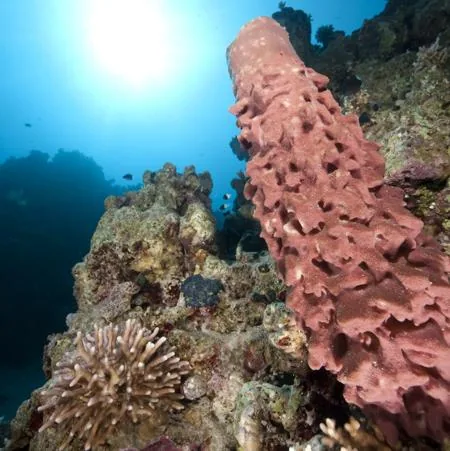
Sponges do not have a fixed shape. Their body is soft and filled with mesohyl, a jelly-like substance. Because they live in water, sponges can absorb water, oxygen, and food quite easily. They look a lot like plants, but they are actually animals.
One interesting thing about sponges is that they have no proper digestive system, no circulatory system, and no nervous system. They get their food by pulling water into their body through pores. Sponges need to grip onto a surface — like a rock — to stay in place. Because they cannot move around, they are called sessile creatures. There are more than 7,000 species of sponge in the world, and scientists are still finding new ones. Most sponges take one of four basic forms: flat crusts, rounded mounds, tubes, or upright sheets.
Sponges mostly feed on bacteria. In some cases, tiny microbes live inside a sponge’s body as endosymbionts — organisms that live in harmony inside another creature. Where food is hard to find, some sponges even turn carnivorous.
Scientists sort sponges mainly by their internal structure. One of the key features they look at is the spicule — a tiny needle inside the sponge’s body. Spicules stiffen the mesohyl and help give the sponge its shape. The type of spicule tells scientists which class a sponge belongs to.
Calcarea or Calcareous Sponges
Calcareous sponges get their name from the material their spicules are made of: calcium carbonate. These needle-like spicules form a simple skeleton inside the sponge. Calcareous sponges are small — only about 10 cm in length. Despite their small size, they come in several different body plans:
- Asconoid (no fixed shape)
- Syconoid (a tube-shaped body)
- Leuconoid (a body with flagellated chambers that push water through)
Demosponges
Demosponges also have spicules, but theirs are made of fibers from a protein called spongin. They are the largest group of sponges and make up about 90% of all sponge species. Demosponges live in both warm and cold parts of the ocean. Some reproduce sexually, while others reproduce without a mate.
This group shows an amazing variety of shapes and sizes — far more than any other sponge class. They can reproduce without mating by making gemmules (internal buds) or by budding off pieces of their own body. A gemmule is like a tiny survival pod. It stays dormant until conditions are right, then grows into a new sponge. According to scientist Gordon Love from the University of California, demosponges first appeared about 635 million years ago, during the Neoproterozoic era.
Glass Sponges
Glass sponges make up the class Hexactinellida. They are rare and live mostly in very deep water — between 450 and 900 meters below the surface. Their body is cup-shaped, and their spicules are built from siliceous compounds (silica — the same material as glass). Glass sponges can live for 15,000 years, which puts them among the longest-living creatures on Earth. For comparison, the longest-living organism of all is Posidonia oceanica, a seagrass that can survive for about 200,000 years. Glass sponges are also very sensitive to disturbances around them — they react quickly by sending electrical impulses through their bodies.
Glass sponges can also be sorted by one extra feature: whether or not they build reefs.
Reef-Building Sponges
Reef-building glass sponges grow into funnel shapes. The Heterochone calyx, also called the Finger Goblet Sponge, reaches up to 1.5 m tall and comes in shades of yellow and white. Two other reef-builders are Aphrocallistes vastus (the Cloud Sponge), which has a distinctive mitten-like outgrowth and grows up to 2 m tall, and Farrea occa — the biggest reef-building sponge of all, which can reach a height of up to 15 m.
Non-reef Building Sponges
There are four species of non-reef-building glass sponges. All four are white and grow up to 50 cm tall. They are: Staurocalyptus dowlingi, Acanthascus platei, Acanthascus cactus, and Rabdocalyptus dawsoni.
Frequently Asked Questions
What phylum do sponges belong to?
Sponges belong to the phylum Porifera, which means 'pore-bearer'. They are also called poriferans.
How many types of sponges are there?
There are more than 7,000 known species of sponge, sorted into three main classes: calcareous sponges, glass sponges and demosponges.
What is the biggest type of sponge?
The giant barrel sponge can grow up to 1.5 meters tall, big enough for an adult person to fit inside its barrel shape.
Are sponges animals or plants?
Sponges are animals, even though they look like plants and cannot move from place to place.
How long can a glass sponge live?
Glass sponges are among the longest-living animals on Earth, some may live for around 15,000 years in the deep sea.
Take the Super Sponges Quiz!
5 quick questions on the strangest, oldest, filter-feeding animals in the sea. How many can you get?
Sponges of Common Occurrence
Vase Sponge
Vase sponges are mostly found around the Caribbean islands and the coast of Florida, USA. They can grow to 40–60 cm in diameter and come in shades of brown, red, and purple. Their scientific name is Ircinia campana.
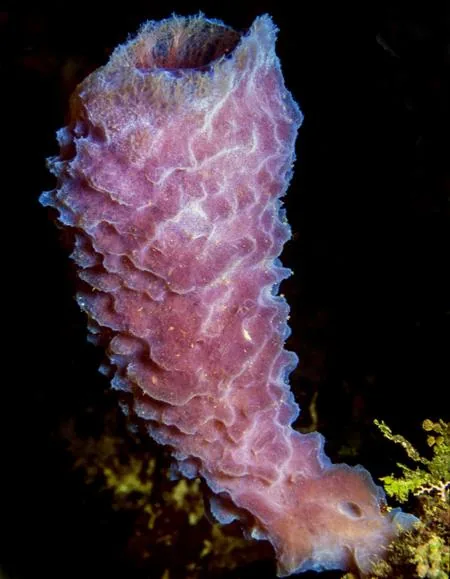
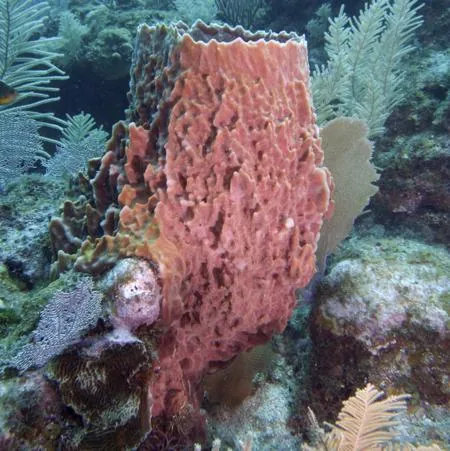
Azure Vase Sponge: This sponge has a tube-like, vase-shaped body. Its outside surface is covered with small pits and a network of grooves. Azure vase sponges grow up to 30 cm long. The pits on their surface are between 0.5 and 1 cm across.
Strawberry Vase Sponge: These sponges also live around the Caribbean islands. They are found at depths of 15–40 meters below the surface.
Barrel Sponge
The barrel sponge is one of the largest sponges in the sea. It can grow up to 1.5 m tall — big enough for an adult human to fit inside. It goes by several names, including the Volcano Sponge, Siliceous Sponge, and Great Barrel Sponge. One of its most eye-catching features is the deep ridges that run down its outside.
📏 Up to 1.5 m tall — about the height of a fridge.
Tube Sponge
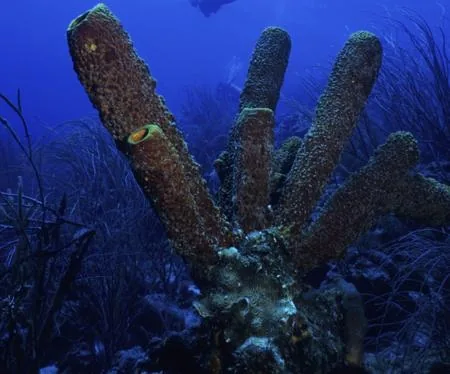
Tube sponges are made of thick-walled hollow tubes that all join together at the base. They grow up to 1 m long. One well-known tube sponge is the stovepipe sponge. Its tubes grow up to 150 cm tall and form a structure that looks like a cluster of tall chimneys — all connected at one narrow base. Tube sponges release toxic chemicals to warn off predators.
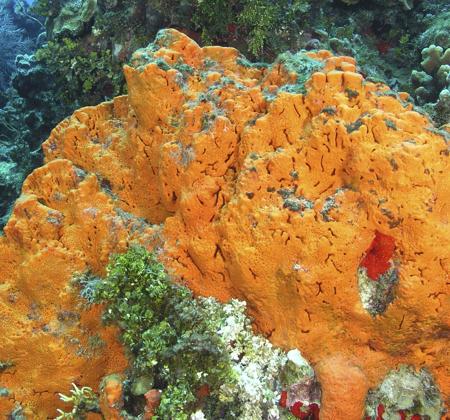
Orange Ear Elephant Sponge
This demosponge lives around the Caribbean islands, Florida (USA), and the Bahamas. Its outer surface is a reddish orange. Beneath the surface, the color is paler. The orange ear elephant sponge can also show shades of brown and red. Its body is lobate to rounded in shape, and its width ranges from 5 to 30 cm.
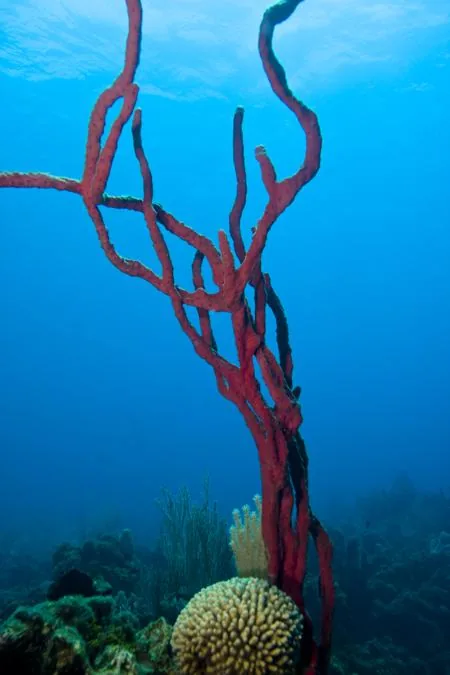
Row Pore Rope Sponge
The scientific name of this sponge is Aplysina cauliformis. It comes in a range of shades — brown, purple-violet, cream, green, and cinnamon-tan. The row pore rope sponge is mainly found in the Bahamas, near islands such as Cat Island, Little Inagua, Great Island, and San Salvador.
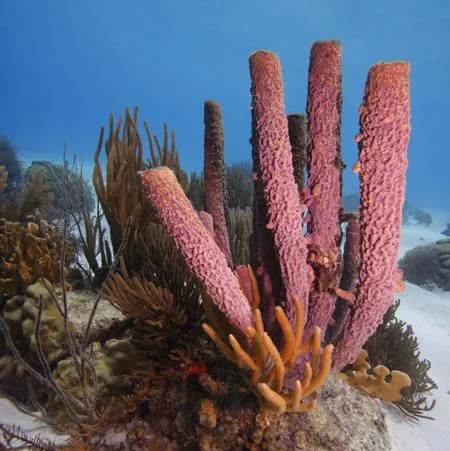
A Gallery of Reef Sponges
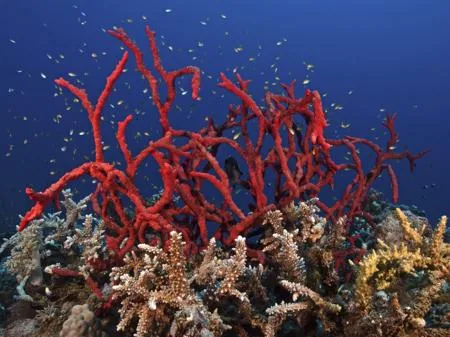
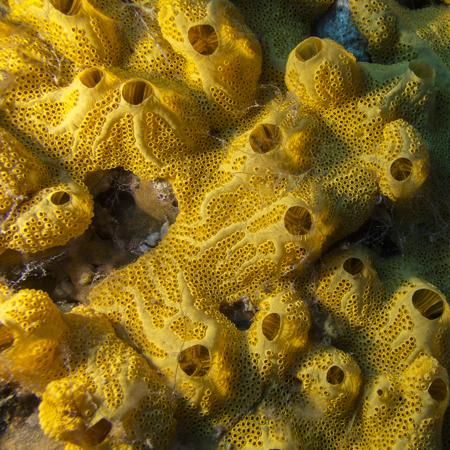
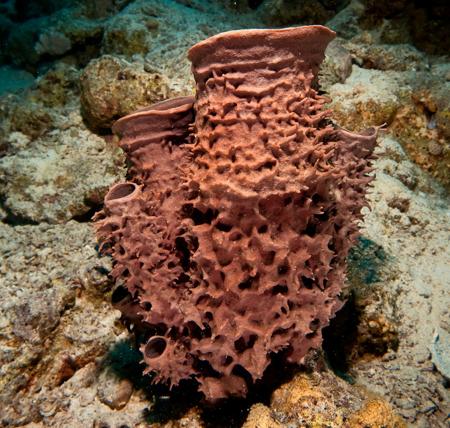
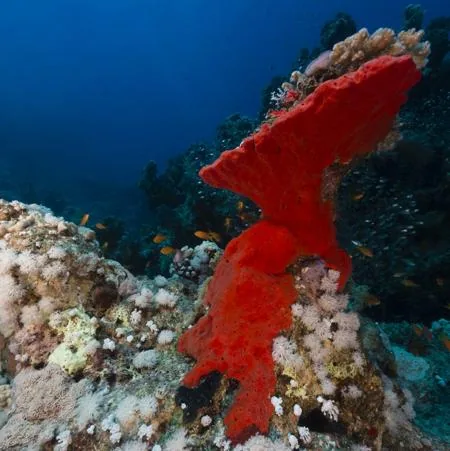
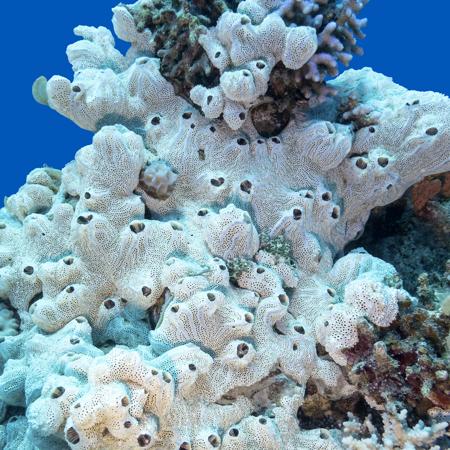
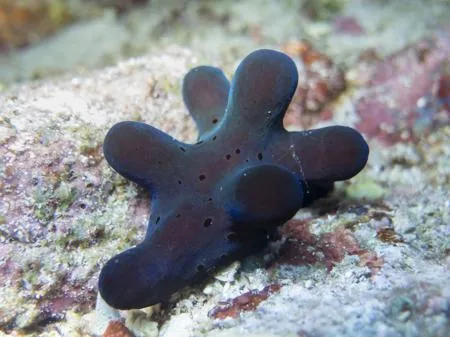
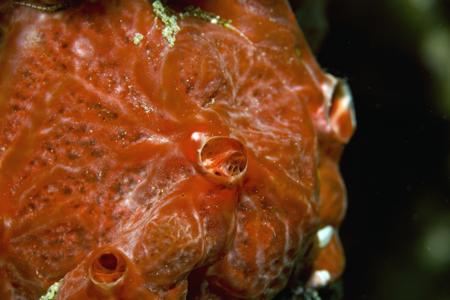
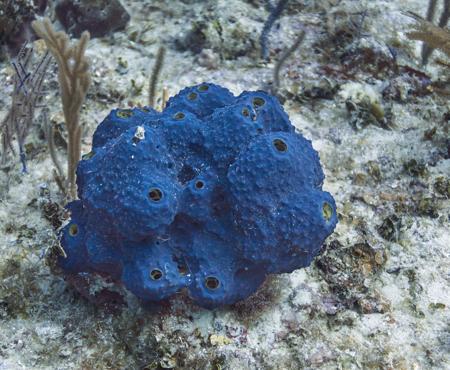
Coral reefs are home to a whole rainbow of sponges, living alongside corals, fish and sea anemones. Here are more of the colorful varieties you might spot on a dive, each one a different shape, color and size:
Explore More Animals
 Types of JellyfishJellyfish are mysterious ocean creatures, a complete kids' guide to the most popular types, plus how jellyfish live, eat, sting, and survive. From the deadly S
 Types of Frogs and Toads: A Complete Picture GuideFrom the tiny Paedophryne to the giant goliath frog, discover all the main types of frogs and toads, with pictures, quick facts, and a quiz for kids.
 Marine Animals: The Complete Guide to Ocean LifeThe exhaustive list of marine animals begins with microscopic zooplanktons and ends with extremely large whales. In between them, lie millions of species, each
 Types of FishThere are over 32,000 species of fish, more than all other vertebrates combined. Discover how fish are classified by species and habitat, plus the fish we keep
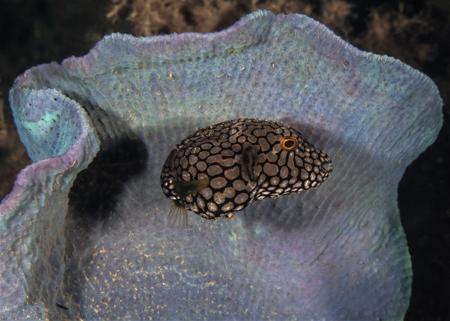

 Fun fact for today!A sponge has no brain, no heart and no stomach — yet it is a real animal that pumps thousands of liters of seawater through its body every single day!