

Dumbo octopuses are pelagic animals that can flush the transparent layer of their skin, whenever they wish to.
Octopuses belonging to the genus Grimpoteuthis are known as Dumbo octopuses, and are one of the rarest species. They are bathyal sea creatures living at extreme ocean depths, and are therefore hard to spot. Dumbo octopuses are members of the umbrella octopus family Opisthoteuthidae. This family is known for its unique swimming pattern, they swim with an umbrella-like shape to their mantle. They are also called jellyhead, or winged octopus, probably due to their unusual fins that protrude from the top of their mantle.
Scientific Classification
Kingdom : Animalia | Phylum : Mollusca | Class : Cephalopoda | Order : Octopoda | Family : Opisthoteuthidae | Genus : Grimpoteuthis | Species : 14
Physical Features
Dumbo octopuses can grow up to 8 inches (20 centimeters) in length, and their eyes measure around 12 mm in diameter.
The largest Dumbo octopus ever found weighed about 13 pounds and measured around 6 feet in length, although the size of most species of this octopus is generally smaller.
This octopus has a soft, semi-gelatinous body, which helps it adapt to its deep-water habitat. Besides, it also allows the octopus to move freely.
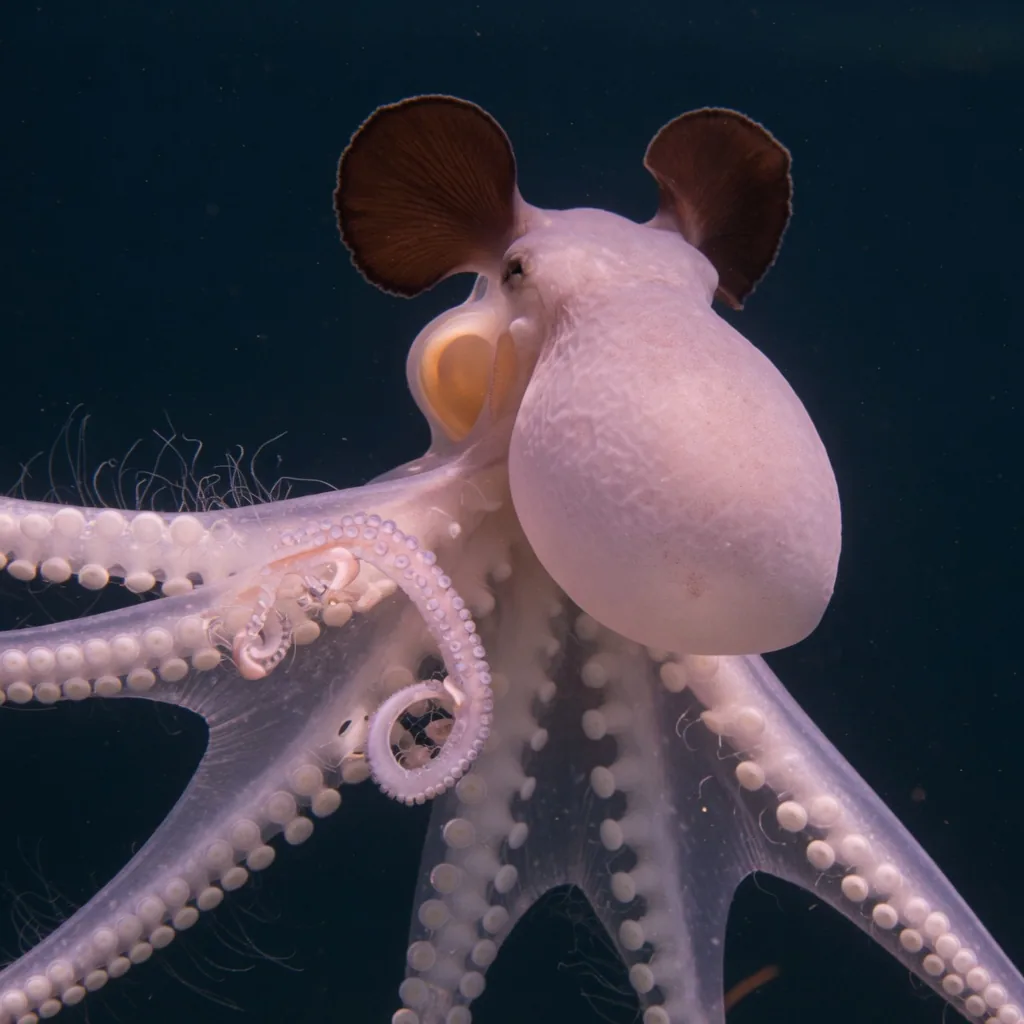
They have eight tentacles that are connected to each other by 'webbing'.
They are cirrate octopuses, a type of octopus adapted to deep-water life. They have two fins and an internal shell made of cartilage (a tough, flexible material inside the body), shaped like a 'U' or 'V'. Their fins are dark brown in color.
They have one single row of suckers on each arm, as well as bristle-like hair called 'cirri', generally one pair for each sucker, which help in searching for prey. The 'bristles' also help the octopus in catching the food. The suckers are brown in color with a hint of yellow.
Unlike other octopuses, Dumbos do not have ink sacs (which are used to expel a cloud of dark ink for confusing the predators).
The males and females differ not only in their size, but also in their sucker patterns.
Behavior
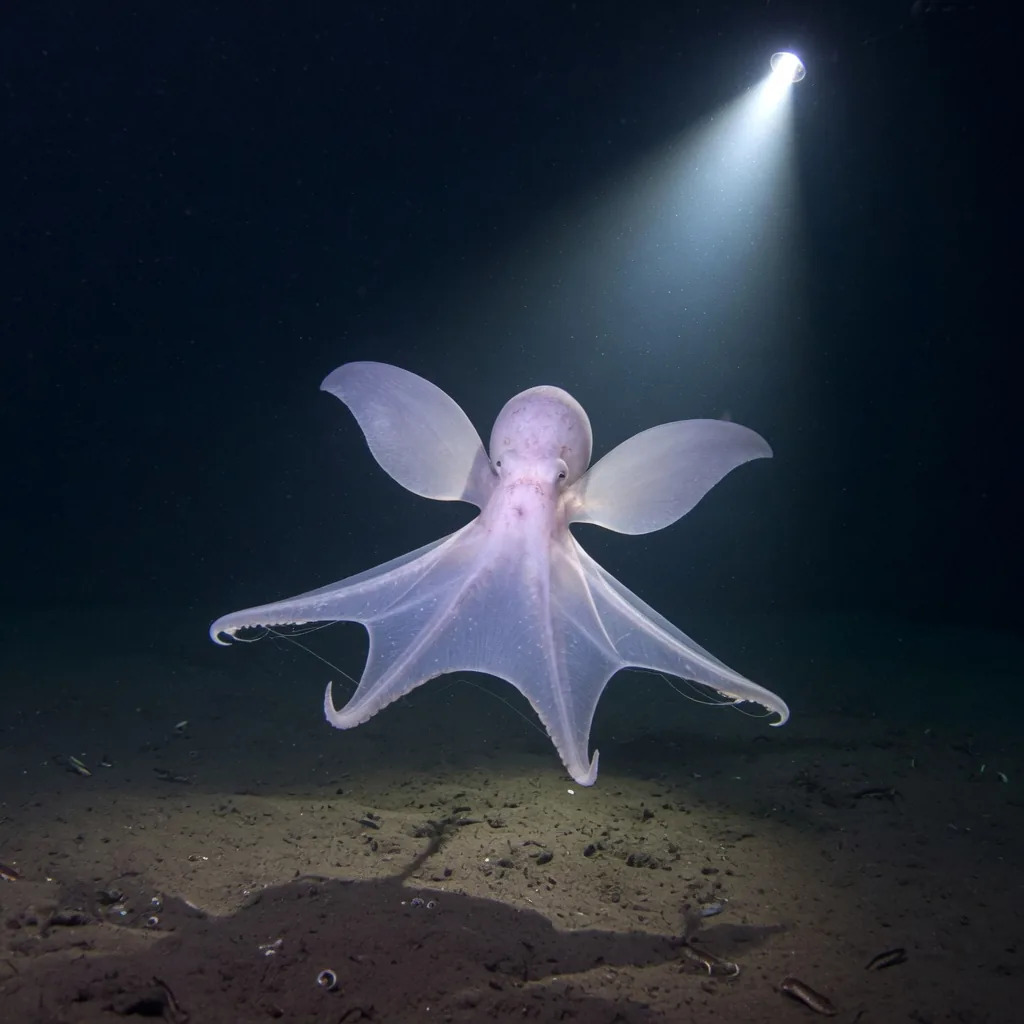
Dumbo octopuses have several means of locomotion. They are graceful swimmers and move through the water by flapping their two ear-like fins, or throbbing their webbed tentacles. They also expand and contract their webbed arms, or squirt water through their funnels to propel, or escape from predators. They use these methods simultaneously, or one at a time.
Since sunlight doesn't reach the deep ocean layers, it is believed that Dumbo octopuses have poor eyesight, and can recognize only bioluminescent flashes.
Take the Dumbo Octopus Quiz!
5 quick questions. How deep does your knowledge go?
Habitat
Not much is known about the habitat of this octopus. As mentioned, they are pelagic animals, i.e. they live in the pelagic oceanic zone, which means open sea. They live deep down in the ocean at depths ranging from 3,000 to 4,000 meters, with some living as deep as 7,000 meters below the surface of the ocean, close to the hydrothermal vent fields or geyser.
Diet
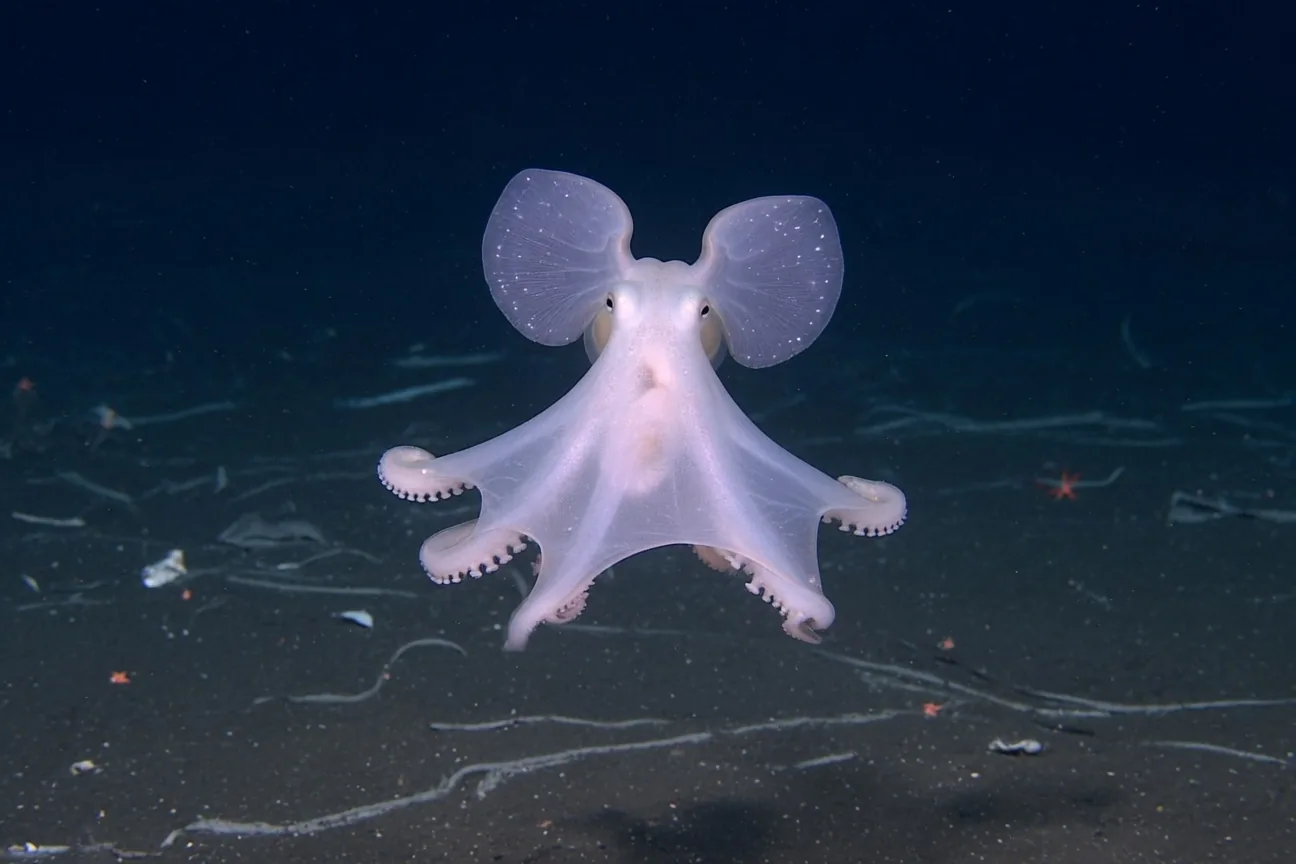
The food they consume is found on the ocean floor. Their diet comprises marine creatures like shrimp, crabs, worms, bivalves, snails, pelagic copepods, small fish, and other crustaceans.
Unlike other cephalopods, this deep-sea octopus swallows its prey, as it does not have a radula (which is a hard, toothy tongue used for scraping or tearing prey.)
Frequently Asked Questions
Why is the Dumbo octopus called Dumbo?
Because its two ear-like fins on top of its mantle look just like the big ears of Dumbo, Walt Disney's flying elephant.
How deep do Dumbo octopuses live?
Between 3,000 and 7,000 meters below the ocean surface, making them one of the deepest-living octopuses known.
Do Dumbo octopuses have ink sacs?
No. Unlike most octopuses, Dumbo octopuses have no ink sacs.
What do Dumbo octopuses eat?
Shrimp, crabs, worms, bivalves, snails, pelagic copepods, small fish, and other crustaceans found on the ocean floor.
How many species of Dumbo octopus exist?
More than 14 species of Dumbo octopus have been identified so far.
Reproduction
Because of their extreme habitat, not much is known about their reproductive cycle. Some reports say that, the females have laid eggs during different stages of development. This led to the conclusion that they can lay eggs throughout the year with no specific breeding season.
The male octopus has an enlarged segment on one of its arms which transfers sperm into the mantle cavity of the females, during copulation.
The eggs are comparatively larger and have a casing, which hardens in water. The females lay their eggs underneath the shells or rocks.
As mentioned earlier, very little is known about this fascinating octopus that dwells in the deepest parts of the ocean. Researchers find it challenging to study them because of the remoteness of their habitat. More than 14 species of the Dumbo octopus have been identified so far, with some reports saying they are bioluminescent, meaning they emit light or glow in the dark. We hope researchers come up with a better way to study these exclusively winged creatures and publish more such interesting facts about them, at the earliest.
Explore More Animals
 Octopus Facts for Kids: Eight Arms, Blue Blood, and Big BrainsThe octopus is an intriguing creature of the seas that derives its name from a Greek word which means eight-footed. Discover fascinating octopus facts for kids:
 Gulper Eel FactsThe gulper eel hides miles below the ocean surface, with a jaw one-fourth the length of its body, a stretchy stomach, and a glowing tail tip that lures prey in
 Amazing Facts About the Mimic OctopusThe mimic octopus was first found in Indonesia in the early 90s and can impersonate more than a dozen sea creatures. Discover amazing facts about Thaumoctopus m
 17 Facts About the Dwarf LanternsharkThe dwarf lanternshark is one of the smallest species in the world, and makes an appearance only when caught by fishermen by accident. Discover 17 fascinating f

 Fun fact for today!Dumbo octopuses can flush the transparent layer of their skin whenever they wish to!