

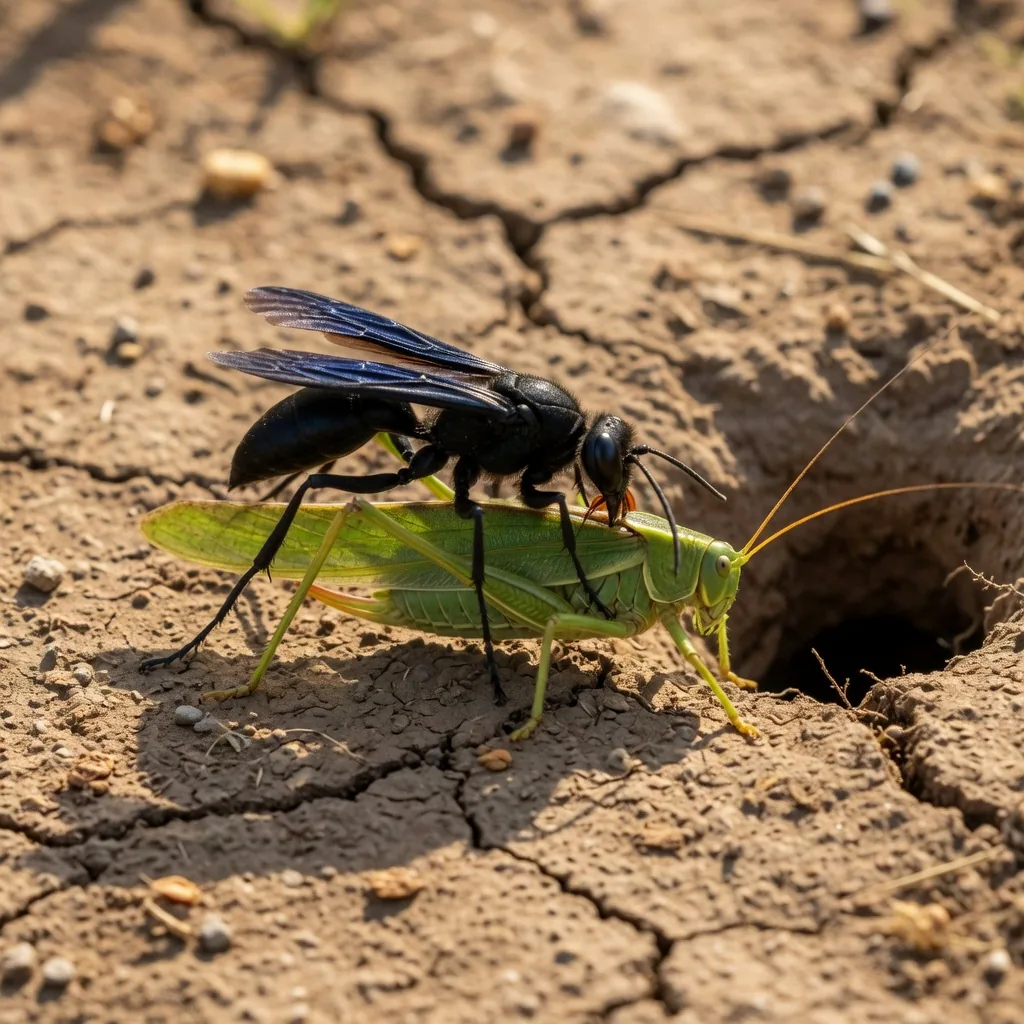
Great black wasps are called "katydid hunters." Adult females paralyze large, green, long-horned grasshoppers called katydids, then carry them underground to feed their larvae.
The Great Black Wasp gets its name from its large size and jet-black body, which has no other markings or patterns. Adult females are slightly larger than the males, measuring anywhere between 1 to 1½ inches in length. You can spot them in fields and meadows from mid to late summer across most of the United States, except the Northwest. This species belongs to the Hymenoptera order, which includes bees, wasps, ants, and sawflies. It sits in the Sphex genus (digger wasps) and the Sphecidae family (thread-waisted wasps).
The word "Great" in their name has nothing to do with being aggressive. These wasps are actually solitary and calm. Only females can sting, and they only do so when provoked or if they sense a threat to their nest. Their sting can cause pain, but it does not swell. Anyone allergic to wasp stings should keep a safe distance.
Classification of the Great Black Wasp
Kingdom: Animalia. Phylum: Arthropoda. Class: Insecta. Order: Hymenoptera. Suborder: Apocrita (Wasps, ants, and bees). Superfamily: Sphecoidea (Vespoid wasps). Family: Sphecidae (Digger wasps). Subfamily: Sphecinae (Thread-waisted wasps). Genus: Sphex. Species: Sphex pensylvanicus.
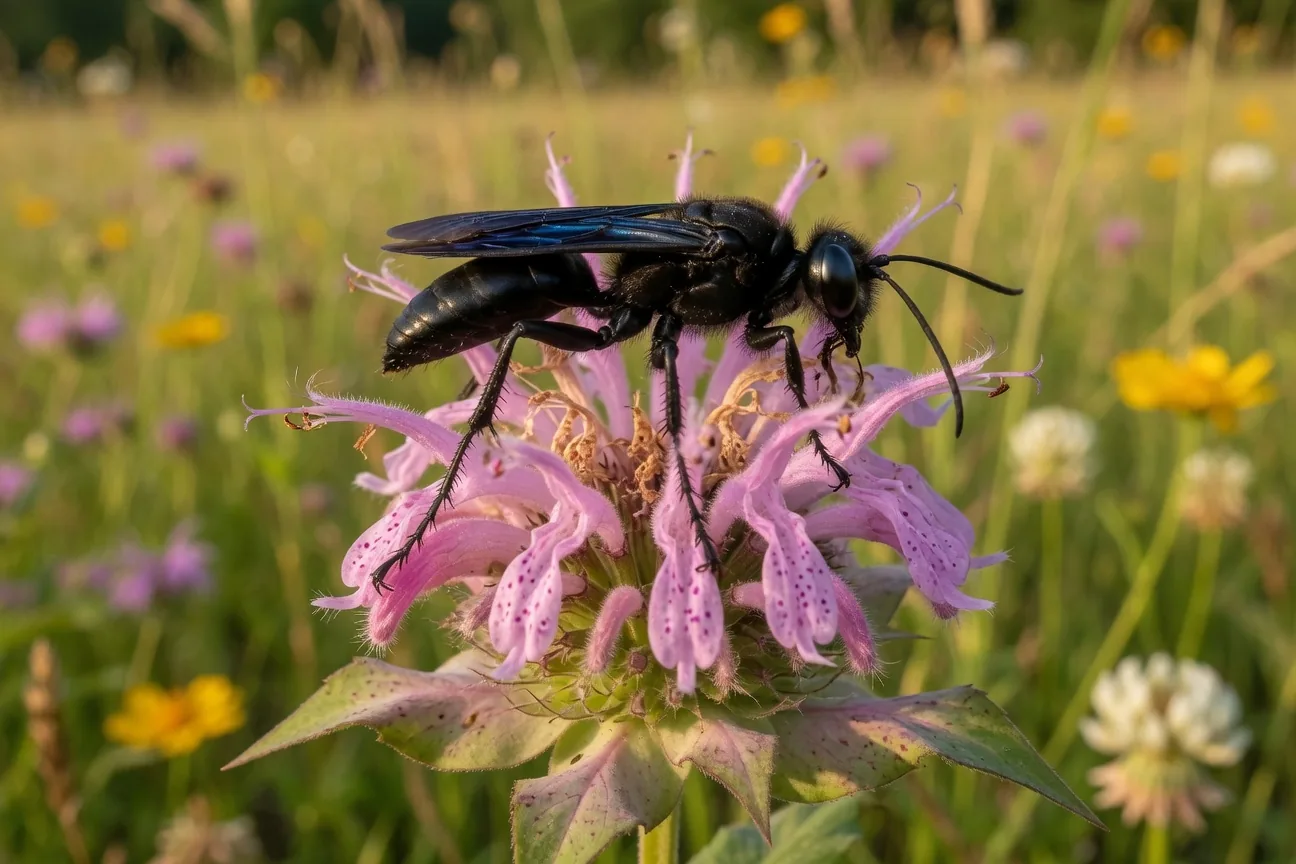
Great black wasps are "thread-waisted," meaning they have an elongated petiole (a narrow waist) that connects the thorax to the abdomen. Their body is completely black. Their smoky black wings show a beautiful blue iridescence. The wings are often folded flat over the abdomen.
Diet, Pollination and Physical Details
Great black wasps love the nectar of Spotted beebalm (Monarda punctata). While they feed, pollen collects on their backs, and when they visit the next flower, that pollen rubs off. This makes them great cross-pollinators. Males measure 19 to 28 mm in length, while females are larger, ranging from 25 to 34 mm. They are especially good pollinators of mountain mint, common milkweed, and swamp milkweed. Look for them in meadows, gardens, or pastures wherever flowering plants grow.
Their legs are long and spiny, and their mandibles (mouthparts) are large and strong. Great black wasps have a short pronotum, the exoskeletal plate on the upper side of the first thorax segment. On each side of the pronotum there is a rounded lobe, but it does not extend as far as the plate at the wing base. The mesonotum (the upper surface of the middle thorax segment) lacks distinct lengthwise grooves, and the lower plate of the mesothorax has no forked process.
Adult females eat nectar and pollen, but they also hunt to feed their larvae. Using their strong mandibles, they catch grasshoppers and katydids and carry them back to the nest. The female paralyzes her prey by stinging it once in the neck and twice in the thorax. She then uses her mandibles to carry the still-living prey home. Sometimes a bird (such as a house sparrow or gray catbird) swoops in and steals the prey before she reaches the nest. Importantly, the prey is not killed; it stays alive and paralyzed inside the nest.
Hunting and Nesting Behavior
The female lays eggs on the underside of the paralyzed prey. The eggs are 5-6 mm long and 1 mm wide. Once the eggs hatch, the larvae feed on the living prey inside the nest. When fully fed, the larvae enter the pupal stage, the in-between step that separates the larva from the adult wasp.
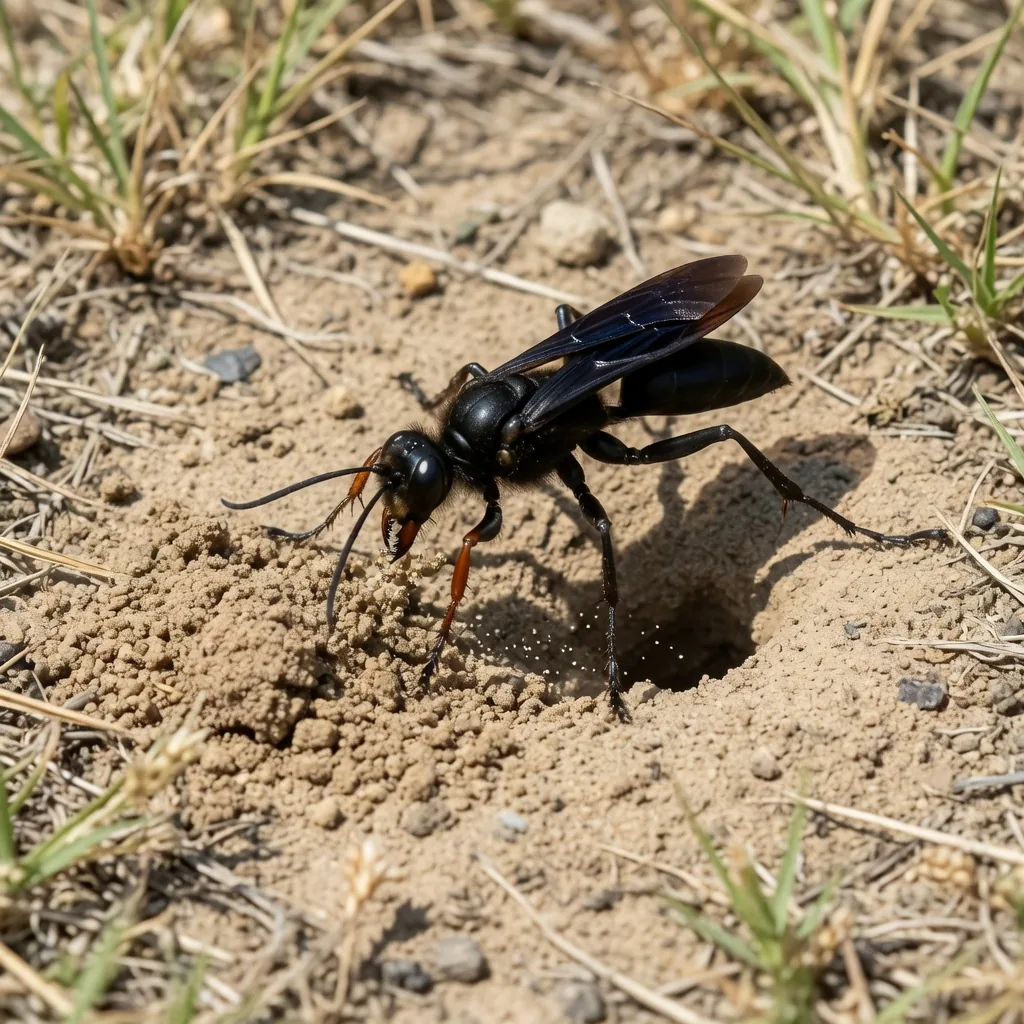
Female great black wasps dig their nests in the ground, using their mouthparts and legs to carve out a burrow. Into each long egg chamber, she places 2 or more grasshoppers, locusts, or cicadas. Then she lays a single egg on the prey. She may build several chambers side by side. To close each chamber, she uses her head to press down the soil, sealing in everything the larvae will need.
Great black wasps are not aggressive. They are unlikely to sting. Just take care not to provoke them, they may sting if they feel their nest is being threatened. Males exist only to mate; they play no role in building the nest or raising the young. Only females can sting, because the stinger is a modified version of the egg-laying ovipositor.
Take the Great Black Wasp Quiz!
5 quick questions. How much do you know about this remarkable katydid hunter?
Stings and Aggression
Great black wasps only sting when provoked. They are also effective pollinators and help keep the population of grasshoppers in check, grasshoppers can cause real damage to crops and plants. So there is hardly any reason to destroy them. Anyone who is allergic to wasp stings should still take the usual safety precautions around them.
Explore More Animals
 Grasshoppers: Habitat, Facts, Anatomy & Life CycleThe complete kids' guide to grasshoppers: where they live, what they eat, their 5 eyes and no ears, super-tough mandibles, record-breaking jumps, singing, and w
 3 Defining Stages in the Life Cycle of WaspsThere are thousands of wasp species. Discover the 3 stages of the social wasp life cycle, from the queen's first nest to the colony's end-of-year collapse.
 Facts About the Tiger Beetle You Need to Read Right NowDespite their small size, tiger beetles possess some really interesting characteristics. Find out some amazing tiger beetle facts by reading this post.
 Mysteriously Amazing Facts about Hummingbird MothsYou saw a hummingbird fly past you, or at least you think you did. In fact, what you may have seen could have been a hummingbird moth that looks a great deal li

 Fun fact for today!The great black wasp is completely harmless to gardeners, it rarely stings unless directly provoked!