

A Dual-Purpose American Classic
The Plymouth Rock is a friendly, dual-purpose breed. That means it is kept both for eggs and for meat. It is popular in the U.S., Australia, and UK. People often call the Barred Rock "the Plymouth Rock," but that is just one variety of the breed. Other varieties include White, Buff, Partridge, Silver-penciled, Blue, Black, and Columbian.
The breed was developed in America in the middle of the 19th century. It was first exhibited as a breed in 1869. It quickly became popular all over the world because it is cold-hardy, calm, and a great egg and meat producer.
The breed is named after the town of Plymouth, where it was developed. The very first Plymouth Rocks had a barred pattern. The other color varieties came later.
Color and Size
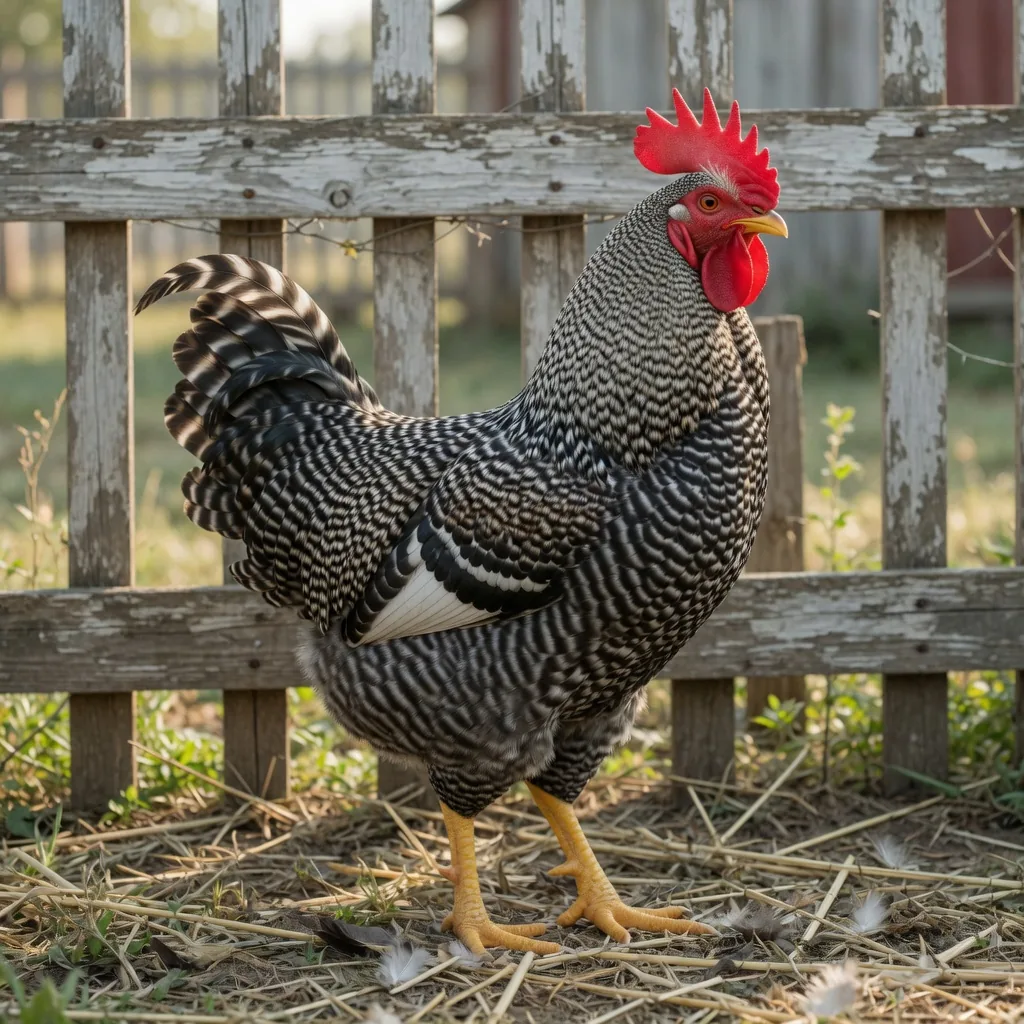
Standard colors in the UK, America, and Canada include Barred, Columbian, Silver Penciled, White, Buff, Partridge, Black, and Blue. Chick down can be light or dark gray. In Australia, the Australian Poultry Standard also recognizes Silver Penciled Rainbow. All Plymouth Rocks have a single moderate-sized comb, yellowish skin and legs, and a bright yellow beak.
The barred pattern on Barred Rock roosters comes from a dominant sex-linked gene. Because of this, males are usually lighter in color than females. The eggs are large and brown, they can range from light to medium brown, sometimes with a pinkish tinge.
Plymouth Rocks have a long, broad back and a full, deep breast. A hen with a deep, full belly is usually a good egg layer. They have a red face, red ear lobes, and bay-colored eyes. According to the American Poultry Association, standard weights are: cock, 7.5-9.5 lb (3.4-4.3 kg), hen, 6.6-7.5 lb (3-3.4 kg), cockerel, 8 lb (3.6 kg), and pullet, 5-6 lb (2.3-2.7 kg). Bantam roosters are much smaller, at about 3.09 lb (1.4 kg), and Bantam hens weigh about 2.65 lb (1.2 kg).
Temperament and Lifestyle
Barred Rocks are large, vigorous, friendly, and cold-hardy. They handle both hot and cold climates well. They keep laying eggs through winter without needing heat lamps. They are easy to tame and make wonderful pets for children.
Until World War II, no chicken breed was as popular as the Barred Plymouth Rock. It is one of the foundation breeds for the broiler industry. Even today, White Plymouth Rocks are the female breeders of 95% of the world's table birds. They are the female side of the commercial broiler cross.
Barred Rocks are not strong fliers, so you do not need high fencing to keep them in. They love to roam freely and are excellent free-range birds. They also do well when kept in a coop. They are good foragers and do not need a huge amount of space. Both roosters and hens are calm and quiet. They get along well with children, people, and pets.
Their feathers are short and loosely held, with very soft silky down at the bottom. Hens are good mothers. They will go broody if conditions are right, so collect eggs regularly to stop this. Hens stop laying while they molt, and egg numbers can also dip a little in winter.
Take the Plymouth Rock Chicken Quiz!
5 quick questions, how well do you know America's favorite farm bird?
Egg Production
The number of eggs depends on the strain of the bird. On average, Rocks produce about 200 eggs per year, that is roughly 4 eggs a week. White Rocks start laying at about 5-6 months after hatching, making them one of the earliest-maturing laying hens.
Chickens that gain weight quickly cost less to raise, because older birds need more feed per pound of body weight. Broilers and fryers are usually butchered at 3.5-5 lbs, while roasters go at 6-8 lbs. The Cornish Rock cross (a cross between Cornish and Plymouth Rock) puts on weight very fast. By 6-8 weeks old it can weigh about 5-6 pounds. That speed makes it profitable to raise, though these birds are prone to leg problems.
Frequently Asked Questions
What is the most popular variety of Plymouth Rock chicken?
The Barred Rock, so popular it is often simply called 'the Plymouth Rock'.
How many eggs does a Plymouth Rock lay per year?
About 200 eggs per year, or roughly 4 per week.
Are Plymouth Rock chickens good for beginners?
Yes, they are docile, cold-hardy, easy to tame, and tolerate poor management systems.
What is flip-over disease in White Rock chickens?
A form of Sudden Death Syndrome caused when the bird's cardiovascular system cannot keep pace with its dramatically increased growth rate.
The White Rock's Dramatic Growth Story
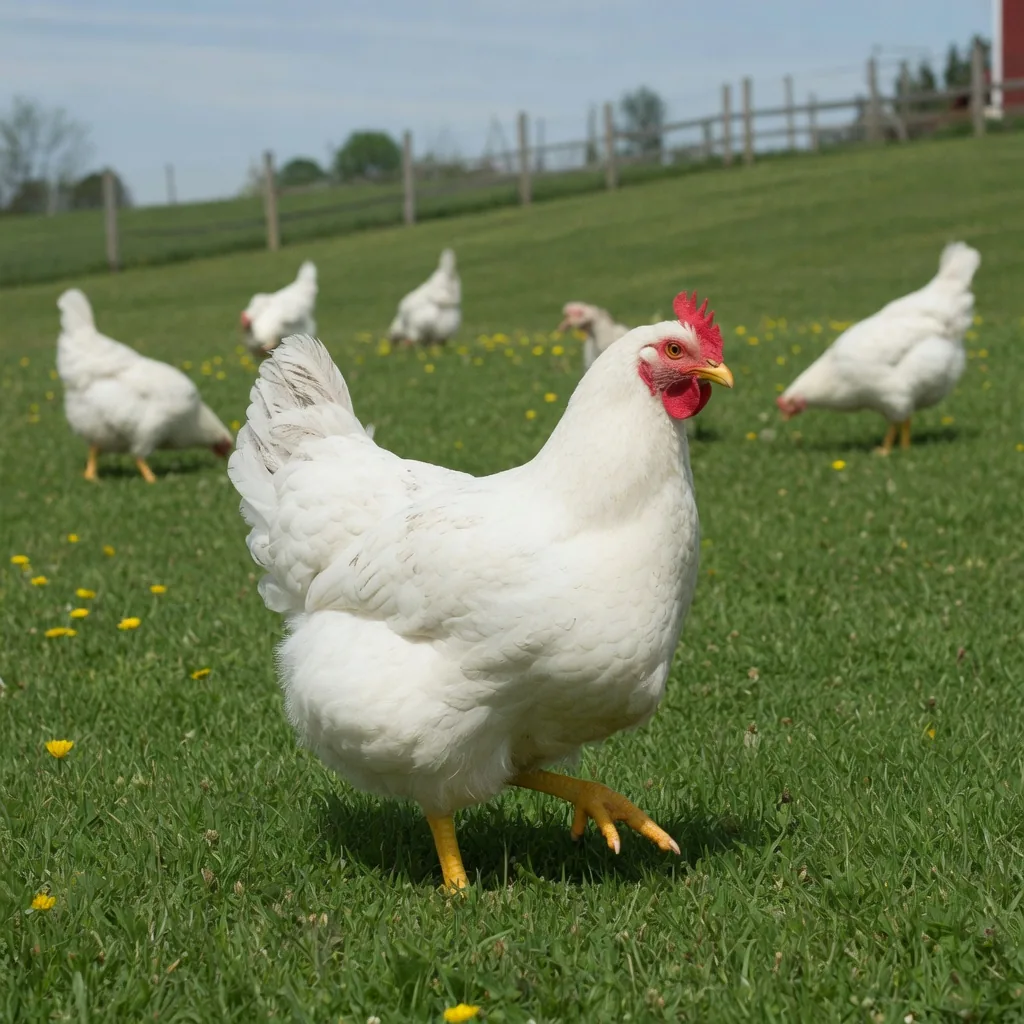
Over the decades, breeders have dramatically increased the White Rock's growth rate through selective breeding. Their easy-to-pluck feathers and golden yellow skin make them popular for meat. But the bird's heart and legs have not kept up with how fast the rest of its body grows.
The numbers tell the story. A White Rock at 7 weeks of age weighed 2 lb in 1957, 4.5 lb in 1986, 6.3 lb in 1999, and 6.8 lb in 2009. That is a dramatic jump in just over 50 years.
The downside is serious. Because they grow so fast, more and more White Rocks suffer from flip-over disease (also called Sudden Death Syndrome), a heart attack triggered by the strain of rapid growth. They also develop ascites, which is a build-up of fluid in the body caused by right heart failure. The biggest, healthiest birds (especially males) are often found lying on their backs. This can happen as early as 3 days old. Because these birds are already under stress from growing so quickly, they are much more sensitive to any extra environmental stress than other breeds, making them harder to raise.
Free Range and Health
Barred Rocks are valued for both their meat and their eggs. When raised free-range, birds can roam as they please. They may grow a little more slowly when they exercise, but they tend to be healthier. The Plymouth Rock has stayed popular for nearly 150 years because it adapts well to many different climates. It is an ideal breed for beginners, and a flock of white or barred Rocks is a beautiful sight. With proper care, you can expect low mortality and fewer health problems.
Explore More Animals
 How to Tell a Barred Rock Rooster from a HenAlthough Barred Rock roosters and hens look similar, there are a lot many distinctions. We'll discuss the major differences between the male and female Barred R
 Golden Comet Chicken BreedThe Golden Comet is one of the best egg-laying breeds for beginners. Learn about their appearance, temperament, egg production, coop setup, and breeding.
 Life Cycle of a Chicken: Egg, Chick, and Chicken ExplainedThe life cycle comprises three basic stages: egg, chick, and chicken. Chickens may be raised for their meat, eggs, or both on local as well as commercial farms.
 An Awesome List of Different Types of Chickens With PicturesChickens are one of the most popular domesticated animals in the world. There are many different breeds of chickens with interesting characteristics.
Glossary: Plymouth Rock Terms
| Term | Meaning |
|---|---|
| Dual-purpose breed | A chicken breed raised both for eggs and for meat, rather than specializing in just one. |
| Cockerel | A mature male chicken that is less than one year old. |
| Pullet | A young female chicken less than one year old that has not yet reached peak egg production. |
| Broody | A hen that has a strong instinct to sit on eggs and hatch them; she stops laying while broody. |
| Flip-over disease | Also called Sudden Death Syndrome (SDS), a heart attack triggered by extremely fast growth rates in modern broiler breeds. |
| Bantam | A miniature variety of a chicken breed, Bantam Plymouth Rocks are roughly one-third the weight of standard birds. |

 Fun fact for today!White Plymouth Rocks are the female breeders of 95% of the world's table birds!