

Triceratops evolved towards the end of the Mesozoic Era (Age of Reptiles). They were found in large numbers mostly in North America. They existed until the Cretaceous-Paleogene extinction event, which is believed to have brought about the mass extinction of plants and animals; predominantly, the non-avian dinosaurs.
Earlier, after finding sixteen different kinds of skeletal remains, paleontologists believed that there existed as many as sixteen species of Triceratops. After further studies and research though, they concluded that these remains belonged to one of the two Triceratops species, Triceratops horridus and Triceratops prorsus.
Scientific Classification
Kingdom: Animalia
Phylum: Chordata
Class: Archosauria
Order: Ornithischia
Suborder: Marginocephalia
Infraorder: Ceratopsia (Ceratopia)
Family: Ceratopsidae
Tribe: Triceratopsini
Genus: Triceratops
Type Species: T. horridus
Species: T. horridus
Discovery
The first ever remains of Triceratops were discovered in 1887, near Denver, Colorado by John Bell Hatcher. The specimen that was found was a pair of horns that were attached to a skull roof.
Hatcher worked along with another famous paleontologist, Othniel Charles Marsh, who coined the name Triceratops for these horned dinosaurs.
Largest Ceratopsians
Ceratopsids are 'horned dinosaurs', characterized by huge fringes or bony ridges at the back of their skull.
Triceratops were the largest Ceratopsians.
Other ceratopsids include Psittacosaurus, Centrosaurus, Protoceratops, Pachyrhinosaurus, Leptoceratops, Styracosaurus, and Montanoceratops.
Size
A fully grown Triceratops weighed no less than 12 tons (approximately 26,000 lbs), measured almost 30 feet (approximately 9.15 meters) in length, and stood at least 10 feet (approximately 3.1 meters) tall.
To put that in perspective: an average human is only about one-third the height of a Triceratops!
Skull
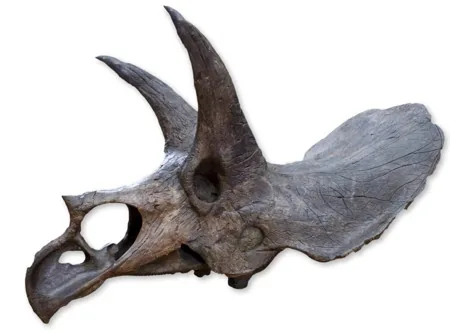
Triceratops' head is believed to be the largest head ever measured among all terrestrial animals.
The largest Triceratops' skull specimen on record is 8 feet (2.5 meters) in length. It has three distinct horns, a bony frill that covers its neck completely, and a sharp, pointed beak.
Triceratops' skulls were bony, and fossilized relatively quickly and easily. Paleontologists have managed to unearth many invaluable skull specimen in one piece; all of which have been auctioned at high prices.
Three Horns
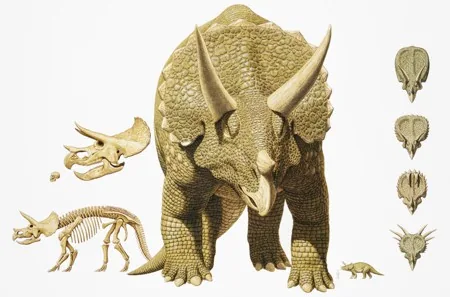
Two of the three horns on a Triceratops' head are found directly above its eyes and the third horn is found on its snout. The brow horns were capable of growing up to 3 feet! It has been suggested that they used their horns to display dominance and strength, and also as weapons of attack.
Take the Triceratops Quiz!
5 quick questions. How much do you really know about Earth's most famous horned dinosaur?
Anatomy
Triceratops were quadrupedals (walked on all fours). They had shorter three-hooved forelimbs and comparatively longer four-hooved hind legs.
It is believed that Triceratops were slow moving reptiles. They were extremely heavy and thus, their relatively smaller limbs made it difficult for them to run or move fast.
Habitat
Triceratops were found in regions where low-lying vegetation was aplenty. Majority of their population resided in the areas which are now the states of Montana and South Dakota.
Paleontologists also discovered Triceratops remains and fossils in modern-day eastern and western Wyoming, northwestern Dakota, central Colorado, eastern Montana, and the Canadian provinces of Alberta and Saskatchewan.
Diet and Social Behavior
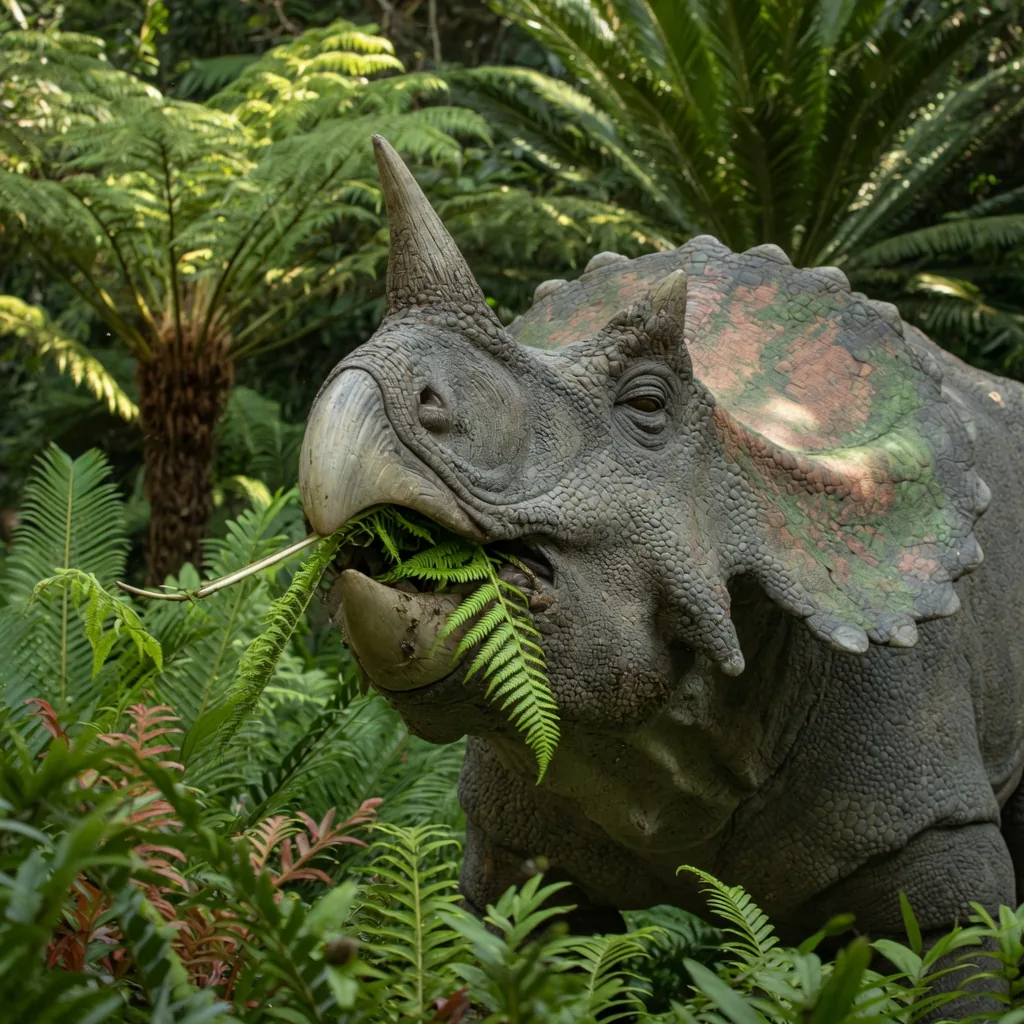
Although huge and strong, Triceratops didn't eat meat, they were strict herbivores. They fed mainly on grass, shrubs, and low-lying plants, using their stout bodies to push through thick vegetation.
Cycads, stout plants characterized by a hard-wood trunk and stiff palm-like leaves, formed a major part of their diet.
Based on the marks found on their beaks, jawline, and teeth, it is evident that they chewed on sharp and thorny plants.
Whether Triceratops lived alone or in groups is still debated. Many lone skeletal remains suggest they may have been solitary. However, a Triceratops bone bed (a fossil deposit dominated by a single species) was found in southeastern Montana. That discovery made paleontologists reconsider, and many now think Triceratops may have lived in herds at least some of the time.
Frequently Asked Questions
What did Triceratops eat?
Triceratops were strict herbivores. They fed on grass, shrubs, and cycads, tough, palm-like plants.
How big was a Triceratops?
Fully grown Triceratops weighed up to 12 tons, measured almost 30 feet in length, and stood at least 10 feet tall.
What was the frill on a Triceratops for?
The large bony frill acted as a shield in fights, was used to scare predators, attracted mates, and may have helped regulate body temperature.
Did Triceratops and T. rex live at the same time?
Yes, paleontologists strongly believe Triceratops and Tyrannosaurus rex co-existed during the same Cretaceous period. Evidence including T. rex coprolites containing Triceratops frill bones confirms T. rex preyed on Triceratops.
Triceratops and Tyrannosaurus rex
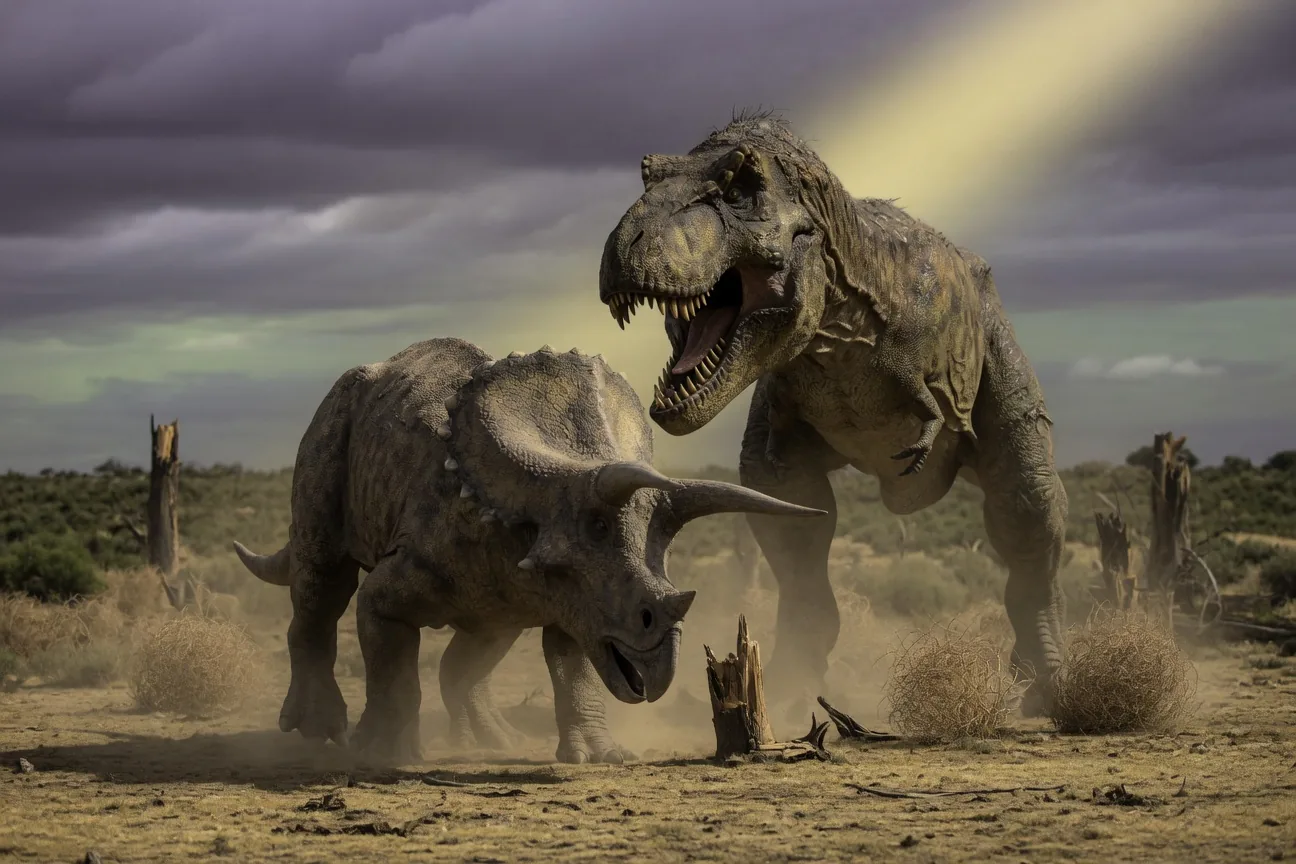
Paleontologists strongly believe that Triceratops and Tyrannosaurus rex co-existed for a long time.
The remains and fossils of the Triceratops and Tyrannosaurus rex have been studied. They date back to the same Cretaceous period of the Mesozoic era. It is also believed that the two were involved in many long-standing battles against each other.
That T. rex fed on Triceratops was proved by a team led by Karen Chin. They found a T. rex coprolite (fossilized dung) containing Triceratops frill bones in Saskatchewan, Canada.
The Frill
An average grown up Triceratops' frill spans almost 6 feet (approximately 1.8 meters).
It is an almost-circular, bony structure present at the back of the Triceratops' head, attached to its neck. It primarily acted as a shield for these dinosaurs during fights. Additionally, it was also used to scare away predators.
Other theories suggest that the Triceratops' frill acted as a display of sexual interest in the species to attract mates. Most recent paleontology theories suggest that the frill evolved to help the animal regulate its body temperature and adapt to the consequent changes in the environmental temperature.
Reproduction
Paleontologists are not sure about the reproductive methods of Triceratops. However, Fossilized eggs of these animals have led to speculation that they laid eggs and young ones were hatched from these.
Lifespan
Working out the lifespan of an animal extinct for over 65 million years is very hard. Paleontologists need a complete, well-preserved specimen to make a good estimate, and one hasn't been found yet. For now, no one really knows how long a Triceratops could live.
Explore More Animals
 Types of Dinosaurs: How Each One Got Its NameMeet the different types of dinosaurs and learn the clever way each got its name, from teeth and horns to feet, armor, places and people. A fun, fact-packed gu
 Long-Necked Dinosaur Species: An OverviewDinosaurs, the gigantic creatures that existed on Earth millions of years ago, have always fascinated us ever since we knew of their existence. AnimalSake prese
 Triassic Period AnimalsIf reading about prehistoric creatures fascinates you, then this article on the Triassic Period animals will definitely make for an interesting read.
 Where Do Crocodiles Live? Habitat, Species & Amazing FactsCrocodiles live near swamps, marshlands, brackish waters, lakes, and rivers across five continents. Meet all the species, learn where each one lives, and discov
Extinction
Triceratops were the last of the non-avian dinosaurs to have walked on the face of the Earth.
It is believed that the Cretaceous-Paleogene event (most likely triggered by a massive asteroid impact) brought about the extinction of all non-avian dinosaurs, including the magnificent Triceratops.
Triceratops were one of a kind dinosaurs. Their fossilized skulls have been used as decorative pieces in mansions and castles, and are extremely invaluable pieces of history. Their distinguished appearance led art and film directors to cast their dummies in movies and educational films, the most popular being the Jurassic Park series.
Due to their round and bulky appearance, Triceratops toys, figurines, and games are a rage amongst kids. Triceratops, being the last of their kind, did leave a very intriguing, exciting, and lasting impression on us.

 Fun fact for today!Triceratops were the last non-avian dinosaurs to walk the Earth before the great extinction!