

Like most 'flying' animals that aren't birds, flying fish don't actually fly, they glide on their long, wing-like pectoral fins. Flying fish evolved about 65 million years ago, but fossils show there was an even older, unrelated group of gliding fish that came before them.
Gliding out of the water is a defense trick against underwater predators. It does, however, make them easier targets for predators above the water, such as seabirds and humans. Still, the escape trick works well enough that they've kept it for millions of years.
Flight
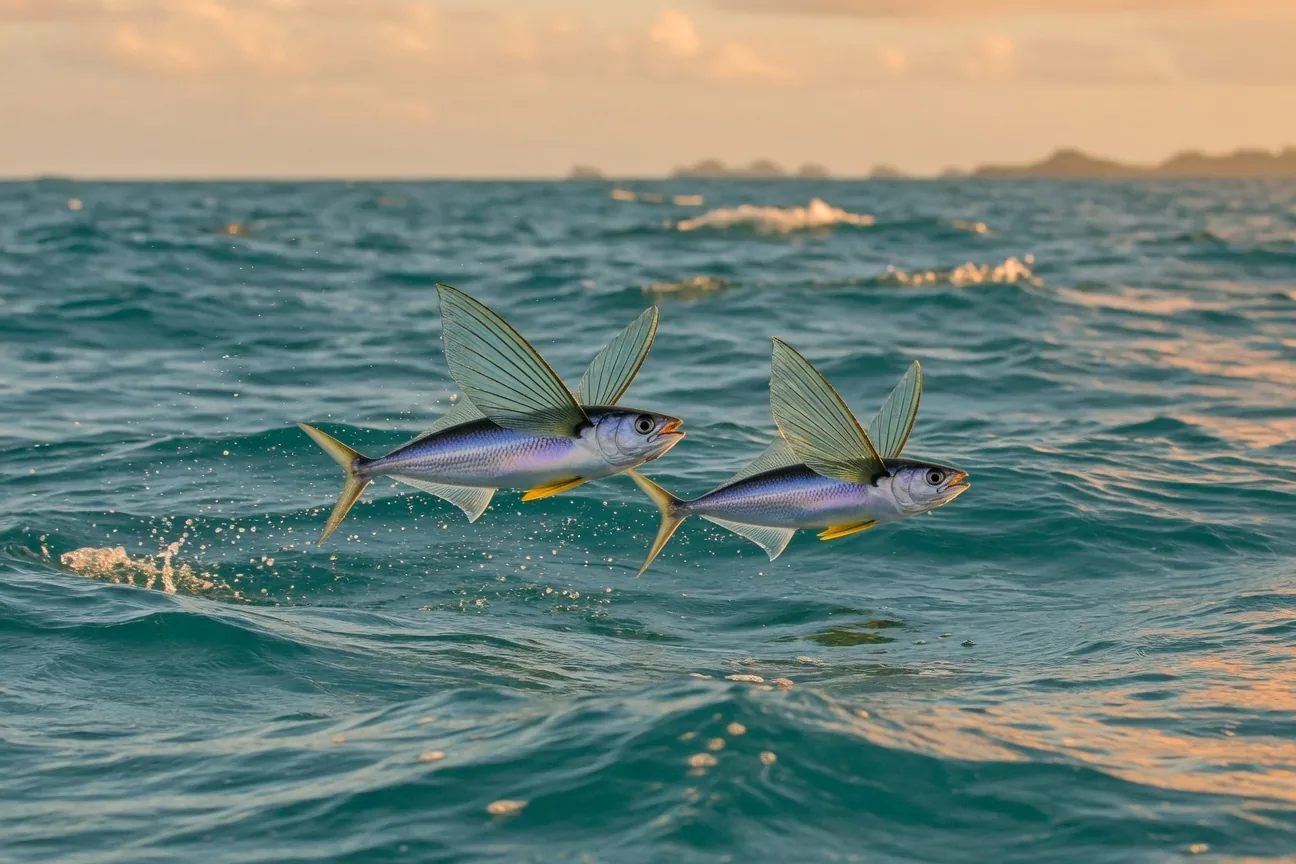
Flying fish have long, narrow bodies that are streamlined to cut through the water with very little drag. Their eyes are quite large for their body size, which gives them good vision both in and out of the water. While underwater, they always stay close to the surface, swimming deep would make it impossible to launch into the air.
When threatened, they use their tails to launch above the water. They beat their tails more than 50 times per second (up to 70 beats) to burst out of the sea. Once airborne, they spread their pectoral fins and glide for distances of more than 50 meters.
At the end of a glide, they can either fold their fins and drop back into the water, or touch the surface with their tail to push off again and keep going. They can leap to a height of 6 meters and glide for a maximum recorded time of 45 seconds! They reach speeds of up to 30 mph as they break the surface, but slow down during the glide because their tail can no longer push them through air.
Classification
Kingdom: Animalia
Phylum: Chordata
Class: Actinopterygii
Order: Beloniformes
Family: Exocoetidae
The family is divided into 7 genera (although other definitions may define 8 or 9 genera): Cheilopogon, Cypselurus, Exocoetus, Fodiator, Hirundichthys, Parexocoetus, and Prognichthys
These genera contain, according to different definitions, 45-64 species.
Global Distribution and Habitat
Flying fish are found all over the equatorial and temperate zones, living in warm waters around the world. They are found mainly in the Indian and the Atlantic oceans, and large stretches of the Pacific around Oceania. They stick to the pelagic zone (the uppermost layer of the ocean) and to shallow coastal waters. Staying near the surface means they can always launch into the air when danger strikes, and it also puts them right where their favorite food is.
Diet and Predators
Flying fish feed mainly on plankton and other algae, though some also eat smaller fish. Like small plant-eaters on land, they are hunted by a wide range of bigger animals. Their predators include dolphins and porpoises, tuna, squids, seabirds, swordfish, marlins, and pretty much any other carnivorous fish bigger than them. Humans also eat flying fish, they are considered a delicacy in China, Japan, both Koreas, Indonesia, Vietnam, India, the Caribbean (especially Barbados) and all across Oceania.
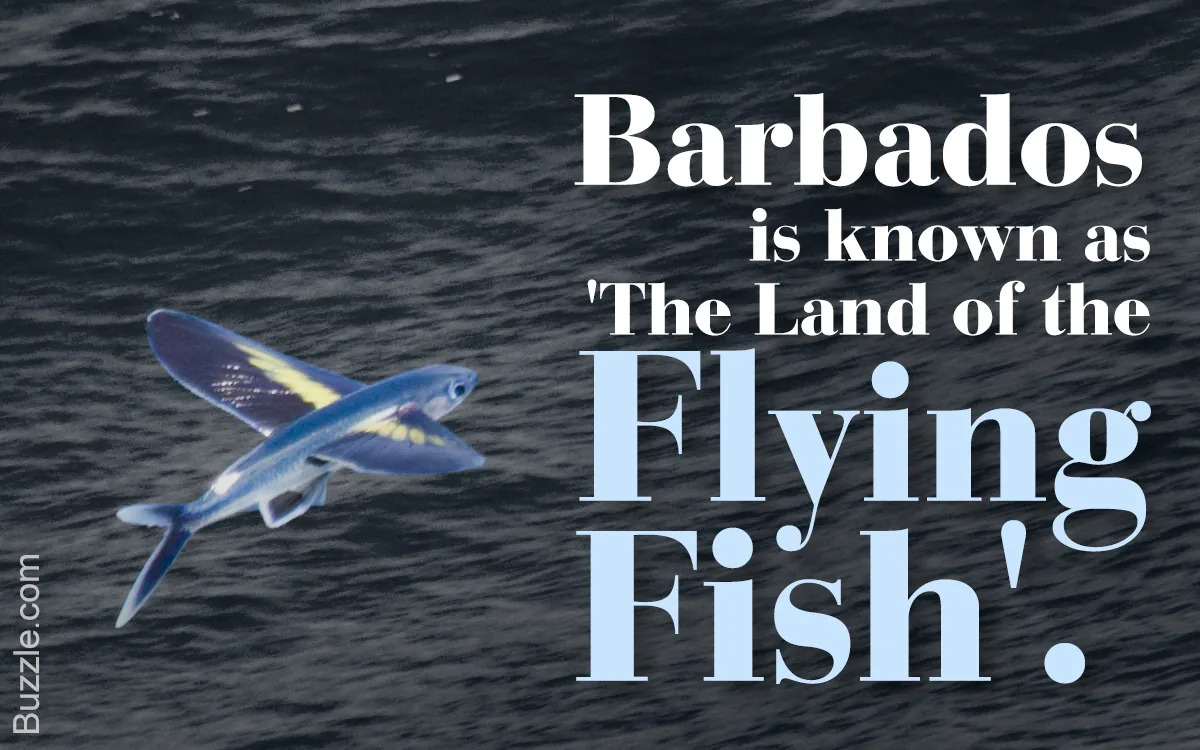
Barbados was once nicknamed 'the land of the flying fish', and this animal is very special there. It is the national animal of Barbados and a star of Barbadian cuisine. Although it is not as common around Barbados as it once was, it is still highly valued and important in Barbadian culture.
Frequently Asked Questions
Do flying fish actually fly?
No, they glide on wing-like pectoral fins after launching from the water with powerful tail beats.
How far can a flying fish glide?
Over 50 meters per glide, for up to 45 seconds in the air.
What eats flying fish?
Dolphins, tuna, swordfish, marlins, squids, and seabirds all prey on flying fish.
Which country has flying fish as its national animal?
Barbados, once nicknamed 'the land of the flying fish'.
How many species of flying fish are there?
Between 45 and 64 species, spread across 7 genera in the family Exocoetidae.
Take the Flying Fish Quiz!
5 quick questions. Test what you've learned about these ocean gliders.
Cuisine
The national dish of Barbados is a meal called cou-cou and flying fish. Beyond Barbados, flying fish is prized seafood along the eastern coast of Asia, and is commercially fished from Japan to India. Japanese cuisine uses dried flying fish and their eggs (roe) in a dish called tobiko, which you might recognize as the small crunchy orange eggs on sushi rolls. Flying fish is also a very important food in Taiwan, especially on Orchid Island, where it is a staple.
Explore More Animals
 A List of Different Types of Barracuda Fish, With PicturesThe barracuda is nicknamed the 'Tiger of the Sea'. Meet the Great, Yellowtail, Blackfin, Yellowmouth and Mexican barracuda, plus the full list of more than 20
 Why Do Pilot Fish Swim With Sharks?They are not the best of friends but co-exist with each other, the most dangerous predator at sea and a school of tiny fish tagging along wherever the predator
 Interesting Facts About Swordfish You Probably Didn't KnowThe swordfish is one of the ocean's fastest and most powerful hunters. Discover fascinating facts about its sword-like bill, brain heater, incredible speed, and
 Really Striking Facts About Herring FishHerrings are widely found in the shallow waters of the North Atlantic and North Pacific oceans. Discover fascinating facts about their hunting style, reproducti
Interesting Facts
The California flying fish is the largest flying fish; it tops out at 18 inches. Most other types grow to lengths of about 8-12 inches.
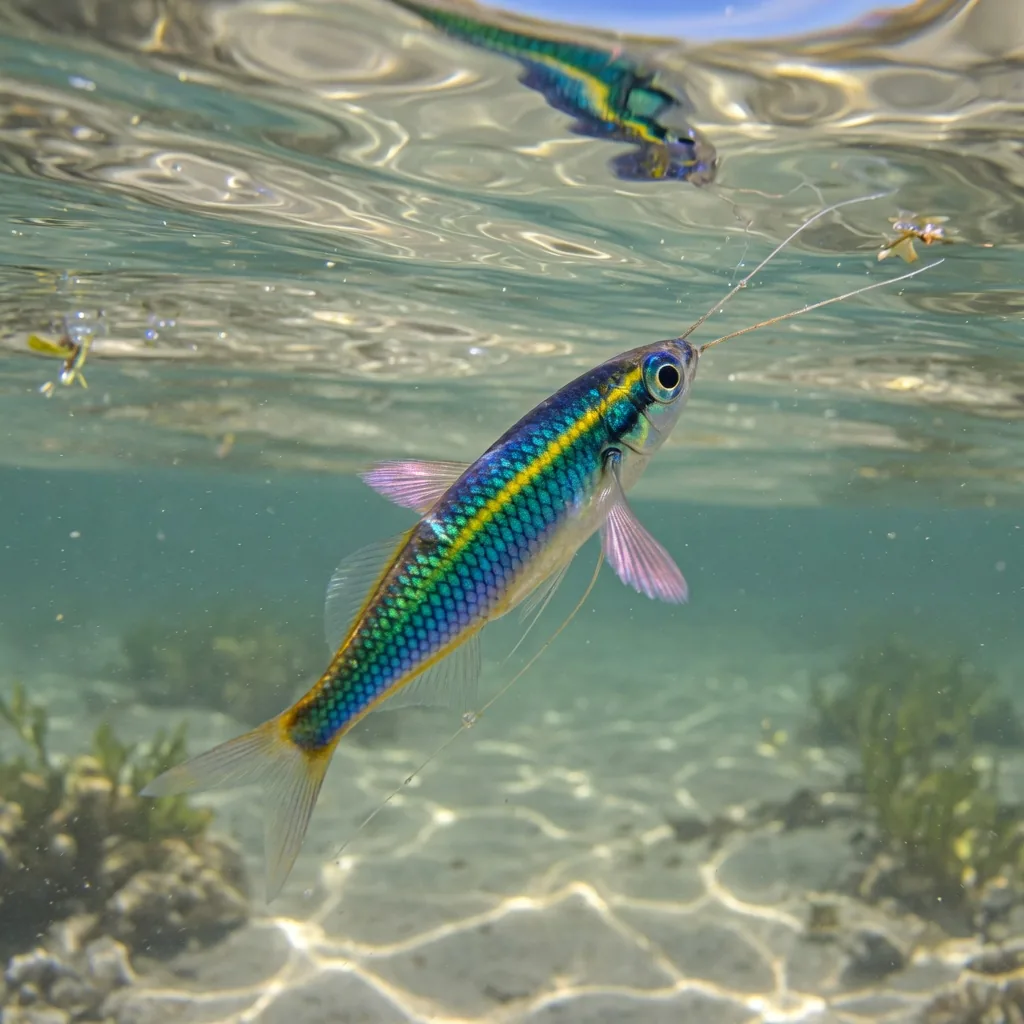
Young flying fish look very different from adults. Juveniles have a colorful, iridescent appearance and long whiskers at the sides of their mouth. They look so much like the flowers of the Barringtonia plant (also called cornbeefwood) that it gives them natural camouflage.
The eyes of flying fish are quite large and flat for their body size. This shape helps them see clearly both under water and above it.
This attraction to light makes flying fish surprisingly easy to catch at night. Fishermen in the Solomon Islands and other parts of the Pacific have used this trick for generations.
As well as their large pectoral fins (their gliding wings), flying fish have uneven tail fins where the lower lobe is longer than the upper one. That longer lower lobe is what lets them beat their tail while most of their body is still in the water.
Many species also have enlarged pelvic fins near the rear of their body. Because they have four wing-like fins instead of two, these are known as four-winged flying fish.
If you ever visit a tropical or temperate coast, go out to sea and keep your eyes on the surface, you just might see one of these amazing gliders launch into the air!

 Fun fact for today!Flying fish can remain airborne for more than half a minute!