

The giant panda is a cuddly and docile animal. It is recognized all over the world as an icon for endangered animals. Scientifically called Ailuropoda melanoleuca, the giant panda is one of the most fascinating species in the kingdom Animalia. It belongs to the bear family.
With its round, chunky body, a panda might look clumsy, but don't be fooled. It is actually quite nimble when protecting its territory from other animals or escaping from predators. It is the behavior of the giant panda that makes it stand out from other animals.
Are Giant Pandas Aggressive or Dangerous?
Giant pandas look like big, cuddly toys. But a panda is a real bear, and it is not as harmless as it looks. The good news is that pandas are shy and peaceful by nature. They would much rather eat bamboo and keep to themselves than bother anyone, and there is no record of a wild panda ever killing a person.
A panda likes to keep to itself and stay calm. That calm has nothing to do with being weak. A panda has powerful jaws and big molars for crushing bamboo stalks thicker than your finger. Those same jaws, plus sharp claws and the strength of a 200-pound bear, mean a frightened panda can defend itself very well. Experts at the Smithsonian's National Zoo warn that a giant panda can be just as dangerous as any other bear.
Mini activity
How Strong Is a Panda's Bite?
Tap each animal to compare. The longer the bar, the more powerful the bite.
These bars are rough comparisons, scientists' exact numbers vary.
Tap an animal to see how its bite compares.
So why do we almost never hear about panda attacks? Because pandas avoid trouble. In the wild they live far apart in thick, foggy bamboo forests and slip quietly away from anything strange. A panda that meets a person usually backs off instead of charging.
The few famous bites in history all happened at zoos. In each one, a person climbed over the barrier into the panda's space. A male panda named Gu Gu at the Beijing Zoo bit three different people between 2006 and 2009, including a visitor who jumped in to give him a hug. Every time, the keepers blamed the people who crossed the fence, not the panda. A panda bites only when it feels cornered or scared.
A mother panda shows just how much strength a panda holds back. When she plays with and trains her cub, she uses only a tiny bit of her power so she never hurts it. That care tells you how strong she really is when she needs to protect her baby.
So the smartest thing we can do is give pandas their space. A panda stays calm when it is left in peace, and even the most adorable wild animal deserves room of its own. That is why zoos keep their barriers up, to keep both the pandas and the people safe.
Mini activity
Cuddly or Cautious? Myth Busters
Tap each card to flip it over and find the real answer.
Tap each card to flip it and bust the myth.
Behavior of the Giant Panda
The giant panda is a very interesting animal to watch. It is usually solitary, it prefers to live alone. The only time giant pandas spend time together is during the mating season. Apart from that, the only other company a panda keeps is a mother with her cubs.
Habitat and Territory
Giant pandas live mainly in forests with rich bamboo growth. A panda loves to live near places with a clear running brook and plenty of bamboo. Pandas do not build homes or dens, except when a mother has cubs. As a land-living animal, the panda marks its territory by clawing trees and leaving its scent. It also sprays urine to show other pandas where its home area ends.
How Giant Pandas Communicate
For an animal that lives alone, the giant panda has a lot to say. Scientists have counted around eleven different panda sounds. The friendliest is a soft bleat that sounds more like a sheep or a goat than a bear. Mothers and cubs bleat to stay in touch, and a female bleats to let males know it is breeding season.
When a panda is annoyed or wants to warn another animal off, those gentle bleats turn into honks, huffs, barks, and growls. Cubs have their own tiny croaks and squeals when they want their mother.
Most panda messages are not spoken at all. Since pandas rarely meet face to face, they leave scent marks on trees, rocks, and trails using a waxy paste from a gland under the tail, along with urine. One quick sniff tells a passing panda who was there, whether it was male or female, and whether it is ready to mate. That way, pandas know who else is around even though they almost never bump into each other.
Male pandas have a funny trick for getting their message higher up a tree. A male will sometimes do a kind of handstand, walking his back legs up the trunk so he can leave his scent mark as high as possible. The higher the mark, the bigger and stronger he seems to any rival who sniffs it later.
Diet
The giant panda happily feasts on tender bamboo shoots, which is its favorite food, along with leaves, roots and tubers. Being omnivorous in nature, it also feeds on fish, rodents and insects as well. Occasionally, the giant panda may also eat flowers, green corn, tufted grass, honey and vines.
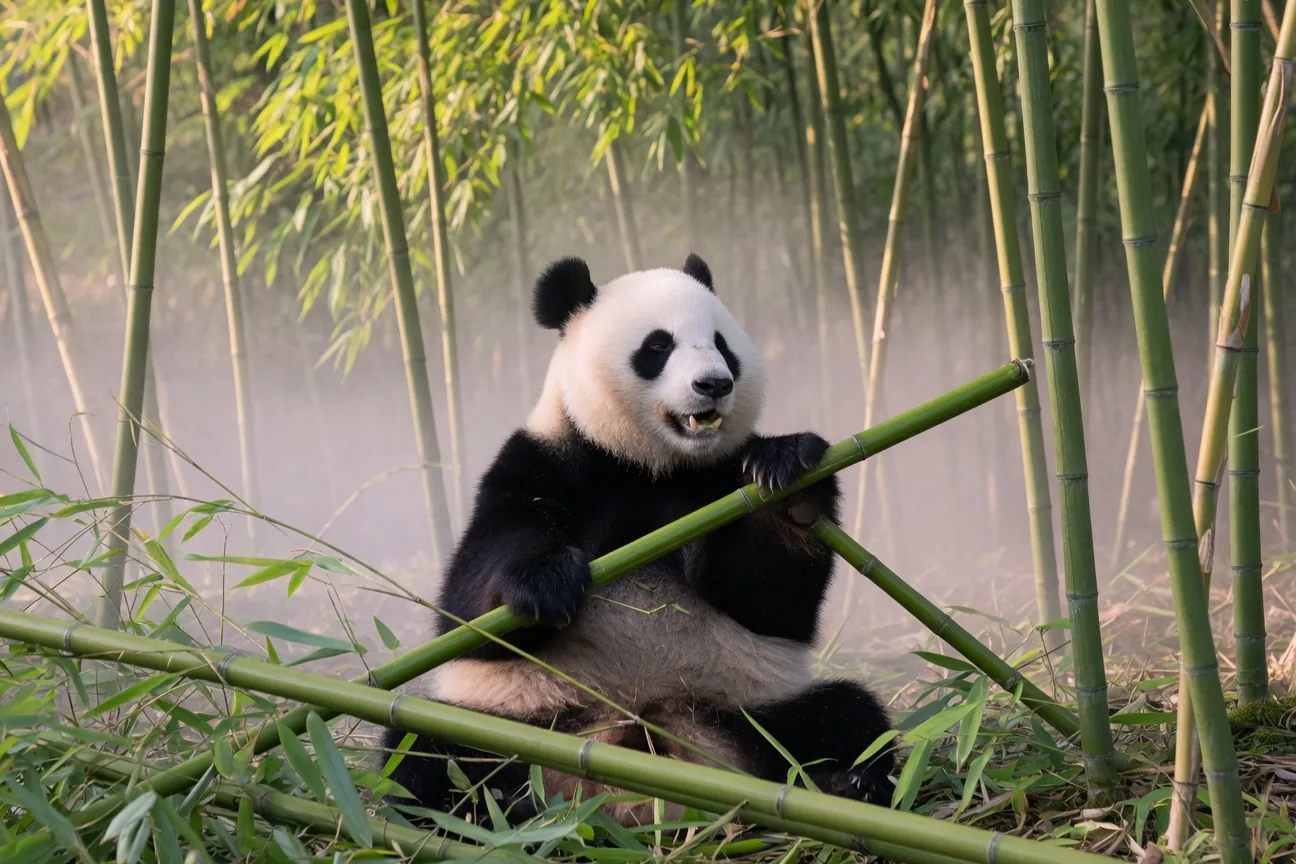
To handle all that bamboo, the panda has one of the strangest tools in the animal world: a sixth "thumb." It is not a real finger. It is a wrist bone that grew long and a little hooked, and the panda uses it like a thumb to hold a bamboo stalk steady while it strips off the leaves. Fossils show pandas have had this handy bone for six to seven million years, which makes it one of the oldest clues that pandas have always eaten bamboo. It never grew into a full thumb because the panda still walks on that wrist, so it stayed just the right size for the job.
When a panda settles down to eat, it sits up like a person, holds the stalk in its paws, and peels and munches one piece at a time. All that careful, two-handed eating is a big part of how a panda spends its day.
Social Life
Pandas prefer solitude over company and can be seen roaming around all alone. However, the only times when the pandas, especially the males, can be seen in groups is for mating. The female takes care of the cubs and once the cub turns 3 years old, it leaves the mother and fends for itself.
Take the Giant Panda Behavior Quiz!
5 quick questions. Find out what you know about these amazing animals.
A Panda's Day: Eating, Sleeping, and Saving Energy
A panda is busiest at dawn and dusk, when the air is cooler and it goes looking for food. It spends the rest of the day resting and sleeping. That might sound lazy, but it is really a smart way to save energy, since bamboo gives a panda so little to begin with.
Bamboo is almost all a panda eats, but it is poor food. A panda's stomach can only take a small share of the goodness out of it, so the animal has to eat a huge amount to get by. A wild panda spends somewhere between ten and sixteen hours a day eating, and gets through dozens of pounds of bamboo. Most of the hours that are left go to sleep.
To stretch its low-energy food even further, the panda's body runs slow. Its metabolism, the speed at which it burns energy, is much lower than you would expect for an animal its size. A slow body needs less fuel, which is a big part of how a panda survives on bamboo at all.
Slow pandas still know how to have fun. They are great climbers and swimmers, and cubs love to roll down slopes and play. A panda is careful with its energy, so it has plenty left for when it really needs it, like scrambling up a tree to get away from danger.
Mini activity
Build a Panda's Day
Drag to set the eating hours, then watch the rest of the panda's day fill in.
Eating 12h · Sleeping 10h · Active 2h
Drag to set how many hours a panda spends eating.
Why Giant Pandas Don't Hibernate
Unlike other members of the bear family, the giant panda does not hibernate. This is because the panda does not get enough nutrients from the food it eats and cannot store them in its body for later use. This makes it a poor candidate for hibernation. So during the cold winter months, the pandas move to lower altitude places where they can be warm. During the summers, they relocate to higher places to remain cool.
Giant Panda Behavior FAQ
Are giant pandas aggressive?
Not usually. Pandas are shy, solitary animals that avoid trouble, and no wild panda has ever been recorded killing a person. But they are real bears with powerful jaws, so they can defend themselves if they feel cornered or scared.
Do pandas attack people?
Almost never. The few famous bites all happened at zoos, when a person climbed into the panda's space. In the wild, a panda meeting a human will slip quietly away rather than attack.
Why do giant pandas eat bamboo all day?
Bamboo is low in nutrition, so a panda has to eat a lot of it to get enough energy. A wild panda can spend ten to sixteen hours a day eating.
How many hours do pandas sleep?
When they are not eating, pandas spend most of the rest of the day resting and sleeping. A slow, low-energy lifestyle helps them get by on bamboo.
Do giant pandas hibernate?
No. Unlike other bears, pandas cannot store enough fat from bamboo to sleep through winter. Instead they move down to warmer, lower slopes when it gets cold.
What sounds do giant pandas make?
Pandas make around eleven different sounds. The friendliest is a soft bleat that sounds like a sheep or goat. They also honk, huff, bark, and growl when annoyed.
Do pandas really have an extra thumb?
Sort of. A panda has a sixth "thumb" that is really an enlarged wrist bone. It uses this handy bone to grip bamboo while it strips off the leaves.
How big is a newborn panda cub?
Tiny. A newborn cub is pink, blind, and weighs about as much as a stick of butter, roughly nine hundred times lighter than its mother.
Breeding and Cubs
The breeding season of the giant panda is between the months of March and May. Following a gestation period of 3 to 5 months, the female gives birth to one cub, which is blind. Only after six or eight weeks can the cub open its eyes. In case of twins, only one cub survives. Once the cub becomes three months old, it begins to move around, along with its mother.
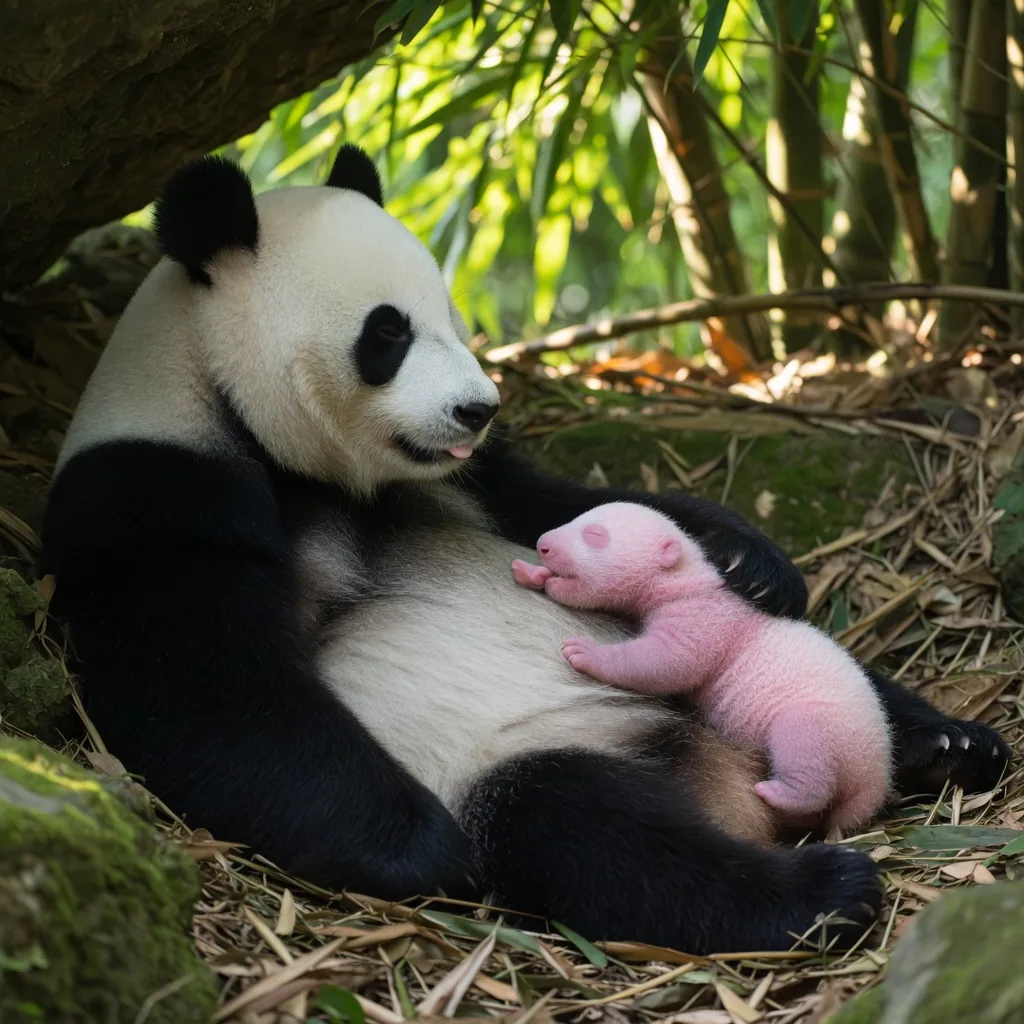
A Panda Cub's First Year
A panda cub grows up incredibly fast, faster than almost any other baby animal. Compared to its mother, a newborn is one of the tiniest babies of any animal on Earth.
- At birth: the cub is pink, blind, and almost hairless, and weighs about as much as a stick of butter. Its mother is roughly nine hundred times heavier.
- First weeks: the famous black patches start to show within a week, and the cub has its full black-and-white coat by about one month old.
- Six to eight weeks: the cub's eyes open, and by around three months it can wobble its first few steps.
- Six months: the cub has a mouthful of teeth and starts nibbling bamboo, though milk is still its main food.
- One year: that tiny newborn has grown into a sturdy cub of fifty to sixty pounds.
Even after all that growth, a young panda stays with its mother for up to three years, learning where to find the best bamboo before it heads off to live on its own.
Mini activity
Grow a Panda Cub
Drag the slider from newborn to one year old and watch the cub grow.
Drag the slider to watch a panda cub grow.
Predators and Self-Defense
The natural predators of the giant panda are wolves, leopards and jackals. Though on land, the panda may resemble a slow moving and clumsy animal, it can climb trees with precise dexterity when it feels threatened by enemies. It can quickly reach the top on all fours in swift movements.
Captive Pandas vs Wild Pandas
A panda you watch at a zoo does not behave quite like one in the wild, and the difference comes down to food and space. A wild panda roams a large patch of mountain forest, spends most of the day tracking down bamboo, and almost never lets a human see it. Most of what scientists know about wild pandas comes from tracking collars rather than from watching them.
In a zoo or breeding center the keepers bring the food, so a captive panda has hours to spare. It spends more time resting, playing with toys, and exploring, and it gets used to people being close by. That closeness is the real reason nearly every recorded panda bite has happened in captivity. Zoo pandas are not meaner than wild ones. They just live close to people, and wild pandas never do.
Breeding centers have an even bigger job than raising cute cubs. Young pandas have to learn how to find bamboo and care for babies of their own, so keepers teach those skills carefully, hoping that some pandas can one day be set free in the wild.
Explore More Pandas & Wildlife
More about giant pandas
 Giant Panda Facts: The Complete Kids' GuideDiscover the secret thumb and bamboo diet of Earth's cuddliest endangered bear!
 Where Do Giant Pandas Live? Habitat, Range & FactsPandas climb trees in misty bamboo forests! Discover where these endangered bears live.
 Red Panda Adaptations: How This Remarkable Animal SurvivesMeet the fire-colored cat with a secret thumb!
Other bears and big mammals
 Polar Bear Adaptations, How They Survive the ArcticSee how polar bears stay warm in freezing Arctic ice!
 Koala Bear Adaptations, How Koalas Survive in the WildKoalas sleep 18 hours a day to survive a toxic diet. See how they do it!
 Facts About Asian Elephants You Won't Believe You Didn't KnowDiscover why female Asian elephants have no tusks and other wild facts!
Hibernation and survival
 Utterly Incredible Facts About the Hibernation of BearsBears hibernate for 8 months without eating, drinking, or pooping!
 Animals That Hibernate: The Complete Kids' Guide to Winter SleepSnuggle into winter sleep with bears, bats, and frogs!
 Unbelievably Amazing Examples of Animal AdaptationsCamels, bears, and chameleons: Amazing animal survival tricks!
Endangered animals and conservation
 A List of Endangered Animals That'll Make You Stare in DisbeliefSpot endangered animals from every continent in this must-see wildlife list!
 Endangered Rainforest Animals That Will Really Shock YouShock! 80% of these amazing rainforest creatures vanished in just three generations.
 Do Zoos Do More Harm Than Good? The Pros and ConsAre zoos helping animals or hurting them? Find out the truth inside!
 A Really Stunning List of 20 Animals That are Black and WhiteSpot 20 black-and-white animals!
Conservation
The giant panda's mountain home has shrunk over the years as forests were cleared for logging and farming, breaking the bamboo it depends on into smaller and smaller patches. For a long time the panda was listed as Endangered. Then things started to get better. After decades of protected reserves and careful breeding, the giant panda was moved off the Endangered list in 2016, down to the lower "Vulnerable" level. That was a big win, but pandas still need our help.
Pandas are also tricky to save. They like to be alone, they have very few babies, and they can only live where bamboo grows. That is why protecting and reconnecting their forests matters so much, and why the giant panda became the world's best-known symbol for animals that need our help, even appearing as the logo of the WWF. Meet more species in the same fight in our list of endangered animals.
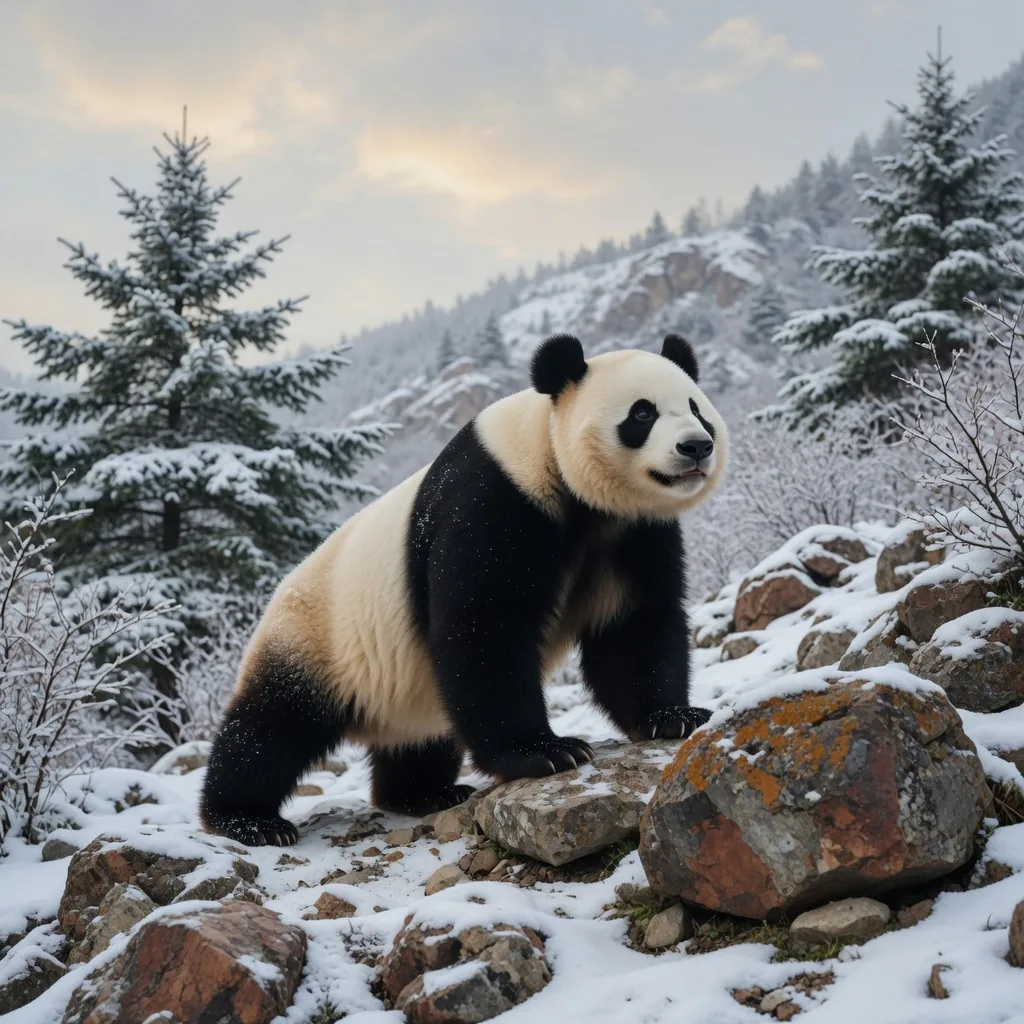

 Fun fact for today!Giant pandas eat bamboo for up to 12 hours a day, but they are still classed as omnivores!