

An African bush viper (Atheris squamigera) is found in central and western Africa. Its most noticeable feature is its rough scales on the back. Unlike a few other species, it does not make a hissing sound by rasping its tail scales. It can be found in varied colors, red, yellow, green, orange, or combinations of those colors. This species may also change its colors during its lifetime.
This snake goes by many common names: common bush viper, tree viper, leaf viper, rough-scaled bush viper, and green bush viper. The sections below give you a close look at this venomous species.
African Bush Viper Facts
Scientific Classification
- Kingdom: Animalia
- Phylum: Chordata
- Subphylum: Vertebrata
- Class: Reptilia
- Order: Squamata
- Suborder: Serpentes
- Family: Viperidae
- Subfamily: Viperinae
- Genus: Atheris
- Species: Atheris squamigera
Physical Features
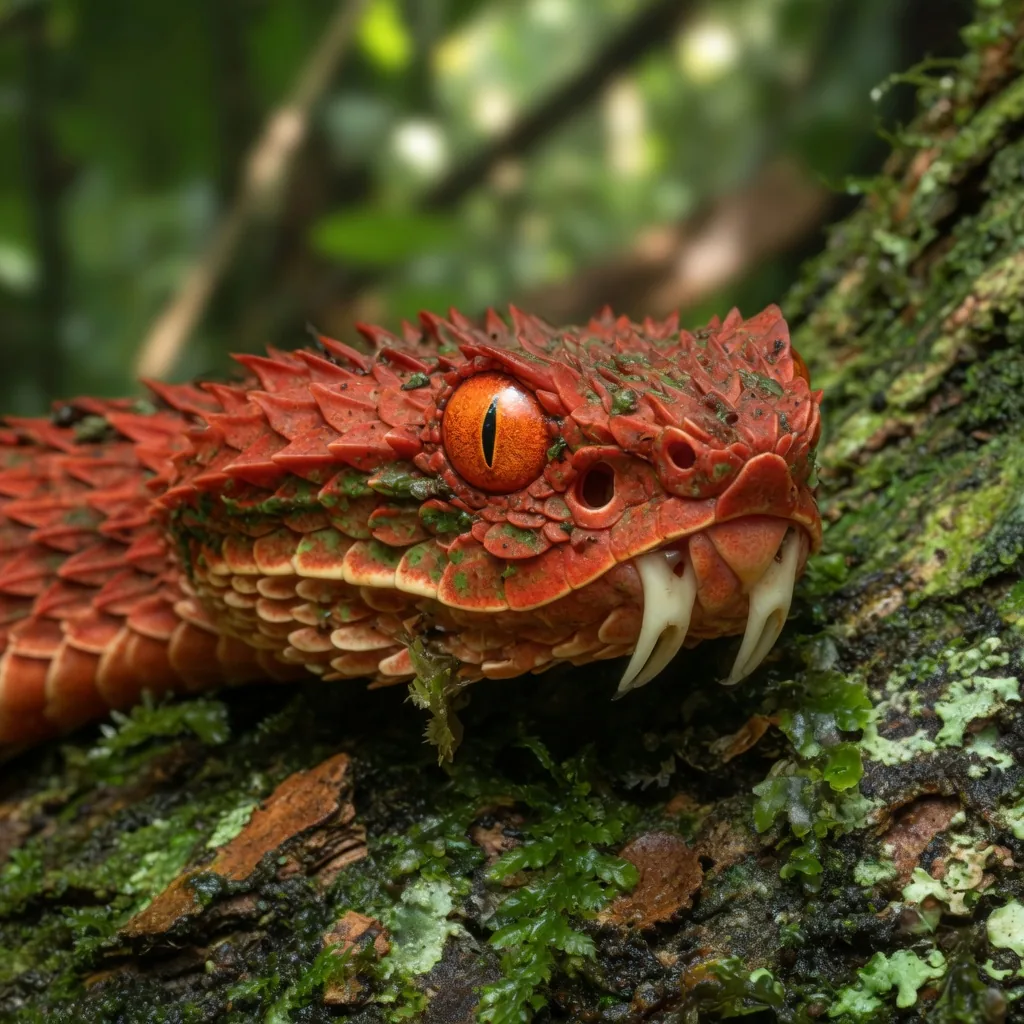
This viper grows up to 18-24 inches (46-60 cm). Its maximum length can reach 31 inches (78 cm). The female is usually larger than the male. The head is large, flat, and broad from the neck. Compared to other snake species, it has larger eyes with elliptical pupils. The nose openings are partly divided and sit at the sides. It has a gland on the upper jaw that supplies venom to its tubular, long, and hollow fangs. The body is covered by keeled, overlapping scales.
Habitat
This viper is mostly found in dense tropical forest areas that have enough rodents and other animals to prey on. It is most commonly found at altitudes ranging from 100 to 400 m. In general, it lives in terrestrial, arboreal, and moist habitats, meaning it is at home both on the ground and up in the trees.
Behavior
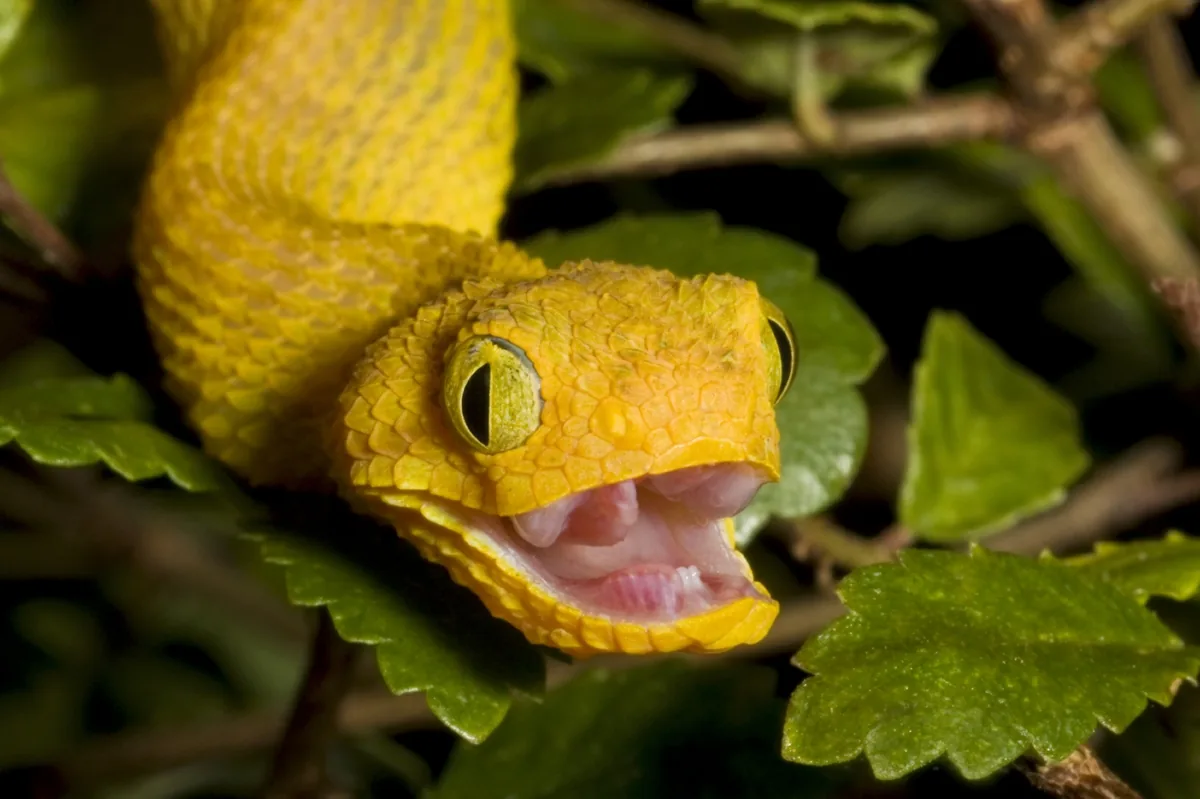
The African bush viper is nocturnal, active at night and usually inactive during the day. Like other vipers, it is an ambush predator. It can wait in the same spot for a very long time until prey enters its territory. Once prey is in range, it strikes very fast and with great accuracy. It has been observed hanging from tree branches while hunting.
It is mostly a solitary species, except during mating season. During that time, its behavior changes a lot to attract potential mates. When threatened, this snake raises the front part of its body.
Test Your African Bush Viper Knowledge!
5 quick questions. How much do you know about this colorful rainforest viper?
Feeding Habits
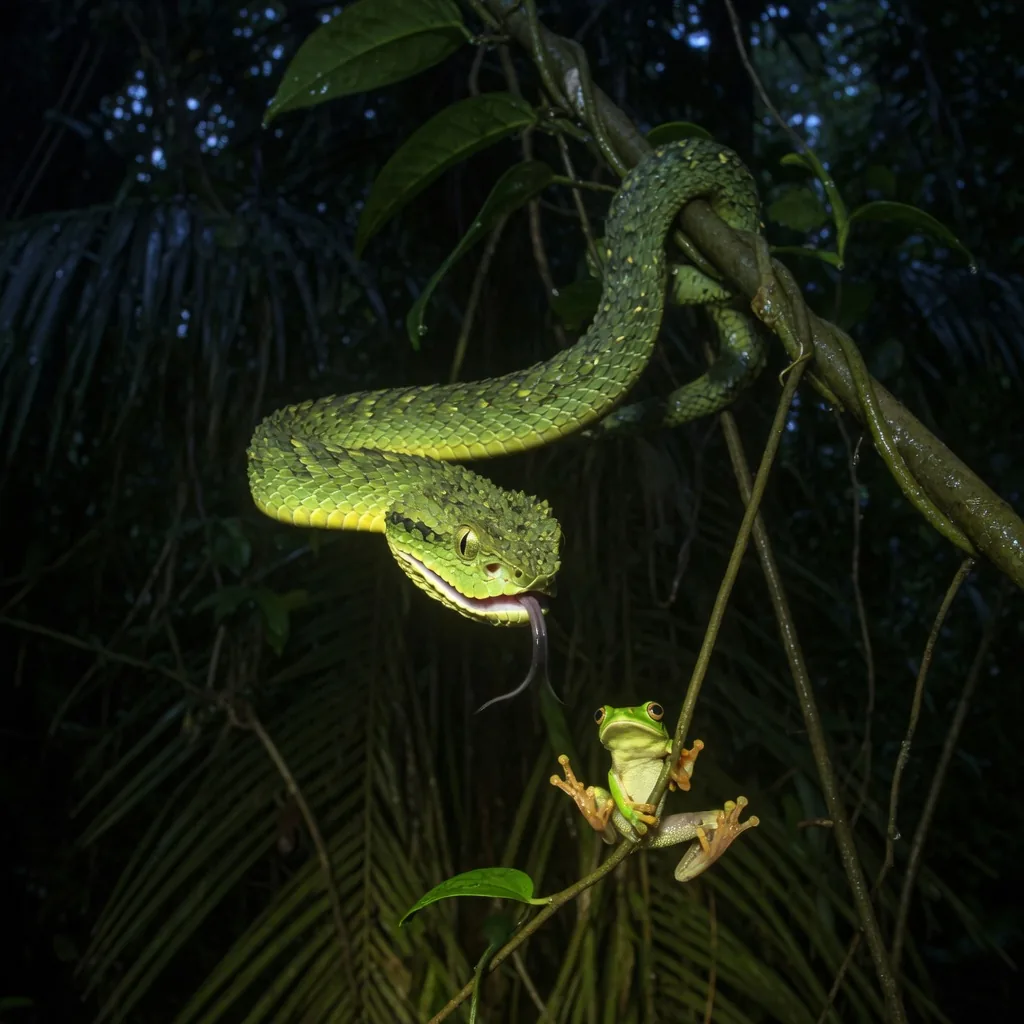
It hunts more often at night. It feeds on a variety of animals, birds, lizards, rodents, and even other snakes. It usually swallows its prey whole. Young vipers feed on reptiles more than adults do. Adults of this species can also prey on juveniles of their own species.
Breeding and Lifespan
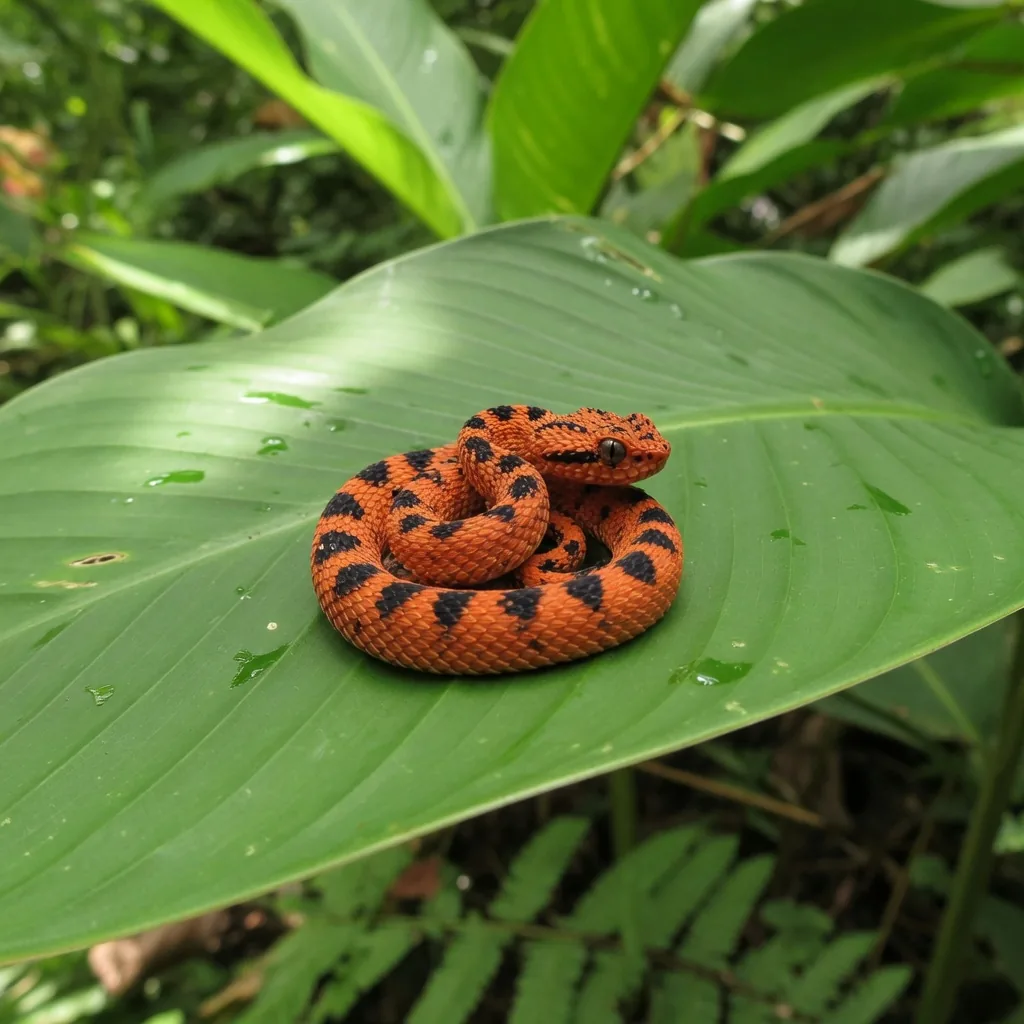
Vipers are said to be monogamous. When choosing a mate, the male sways its head from side to side to attract a female. Mating often occurs at night, between 6 pm and 2 am. The viper reproduces once a year, mostly during the rainy season. The gestation period lasts for 2 months. About 7 to 9 young ones are born per litter.
The juveniles are born venomous and are completely independent right after birth. They are left on their own and must find their own food from day one.
In this species, males can reproduce after 24 months, while females take almost 42 months. The lifespan of this species has not been fully documented. But most vipers live from 10-20 years in the wild. Captive bush vipers may live longer because of a controlled diet and less exposure to danger.
In Captivity
It is recommended that this species be kept in individual cages, because of instances of aggression and biting between individuals. It needs a spacious and preferably tall cage for its arboreal nature. A hiding spot (such as plastic leaves or a piece of tree bark) should be provided. A freshwater bowl should be kept in the cage and cleaned regularly.
Rodents of an appropriate size can be fed. This species can overeat, so portion sizes should be monitored. Juveniles can be fed more often, but feeding frequency should be reduced as the snake grows.
The numbers of this species have declined due to deforestation. However, it is not on any endangered species list. Like all snakes, it is best left undisturbed in the wild.
Explore More Animals
 Insanely Killer Facts about the Red Spitting CobraA brilliant display of colors is a characteristic feature of the red spitting cobra. However, be warned! When threatened, it spits venom which is aimed at the a
 A List of the World's Biggest Snakes With Stunning PicturesMeet the biggest snakes on Earth, from the record-setting reticulated python (and Medusa, the longest in captivity) to the heavyweight green anaconda and the b
 Types of Snakes With PicturesMeet every type of snake, from the deadliest venom-injecting cobras and vipers to record-breaking constrictors, tiny thread snakes, and ocean-going sea snakes.
 Things You Never Knew About Cobras, the Snakes with HoodsThe cobra is one of the most venomous snakes found in the world. Discover cobra pictures, detailed species information, hood anatomy, venom facts, and identific

 Fun fact for today!The African bush viper carries its babies inside its body before giving birth, it doesn't lay eggs!