

What Is a Manatee?
Manatees are big, gentle sea mammals. They are also known as sea cows. There are three living species, each with slightly different features. Scientists believe they evolved from four-legged, plant-eating mammals that lived on land about 60 million years ago. The closest surviving relatives of manatees are those belonging to the order Proboscidea (for example, elephants) and Hyracoidea (for example, the hyrax).
Classification
| Kingdom | Animalia |
|---|---|
| Phylum | Chordata |
| Class | Mammalia |
| Order | Sirenia |
| Genus | Trichechus |
| Species |
Trichechus manatus (West Indian manatee) Trichechus inunguis (Amazonian manatee) Trichechus senegalensis (African manatee) |
Physical Description
Manatees are either gray or grayish-brown in color. They have thick, wrinkled skin, and algae often grow on it. The skin on the head and face is more wrinkled than the rest of the body. They have two small eyes and whiskers on the snout. They use their large, flexible upper lip like a short trunk, both for gathering food and for communicating.
Although manatees don't have external ears, their hearing is sharp, and they can detect sounds across a wide range of frequencies. Their two forelimbs, called flippers, help them swim and glide through the current. They sometimes use their flippers to crawl in shallow water, though the flippers aren't strong enough to support them on land.
Their enormous body tapers into a flat, paddle-shaped tail that helps push them through the water. Their average body length ranges from 2.8 to 3.0 m, and their average weight is about 400-550 kg (900 to 1,200 pounds). Females are larger and heavier than males. Manatees are slow swimmers, moving at about 3-5 miles per hour. Since they can't breathe underwater, they come to the surface every few minutes for air.
Habitat
Manatees prefer shallow waters in rivers, estuaries, canals, and coastal areas. They can't survive in cold water. That's why they live in the Amazon Basin, Florida, West Africa, the Gulf of Mexico, and the Caribbean Sea. The water temperature must stay above 60°F (16°C). When temperatures drop in winter, they move to warmer spots. Even though manatees are huge, they have very little fat in their bodies, so they feel the cold easily.
Diet
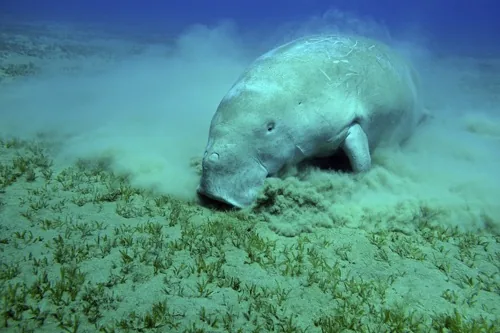
Manatees are herbivores, they eat a wide variety of algae and aquatic plants. Studies have found that they can feed on as many as 60 plant species. An adult manatee eats about 10 percent of its body weight every day, which works out to around 50 kg. They use their front flippers to dig through the river floor and scoop vegetation and roots into their mouths. Captive manatees are fed leafy greens such as lettuce. Their predators are rare and include humans, crocodiles, alligators, and sharks.
Reproduction
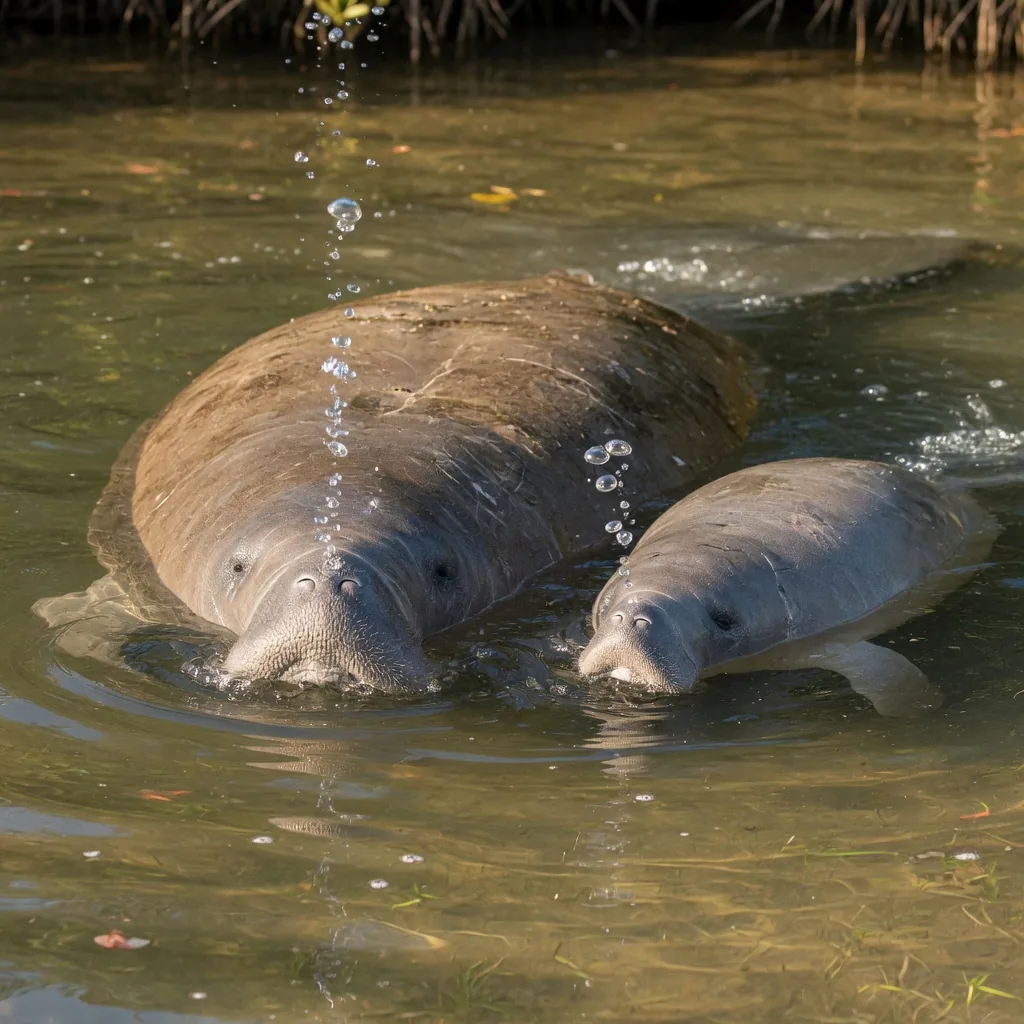
Manatees are solitary animals except during mating. Females become sexually mature at around five years old, while males are active by nine years old. They breed only once a year, but there is no set season. The female can mate at any time of year and has multiple partners. Males compete with each other to mate first.
The gestation period is 11 to 13 months, after which a single calf is born. The calf is born underwater and then pushed to the surface by its mother so it can take its first breath. At birth, a calf weighs about 30 kg (70 pounds) and is 4 to 5 feet long. The mother nurses it for anywhere between 14 and 24 months. The calf starts munching on plants just a few weeks after birth. Manatees are believed to reproduce every 2 to 4 years, and twins are very uncommon.
Take the Manatee Facts Quiz!
5 quick questions. How much do you know about these gentle sea giants?
Intelligence and Communication
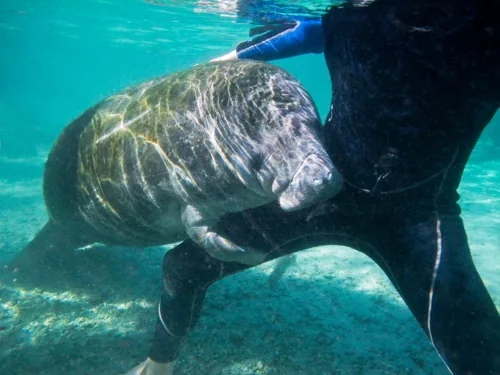
A manatee's brain has a smooth surface, unlike the human brain, which has many folds. Even so, these animals are considered quite intelligent. They have excellent long-term memory, which makes them easy to train. They can also tell colors apart, a skill that surprises many people. Manatees are friendly animals that regularly interact with snorkelers and divers.
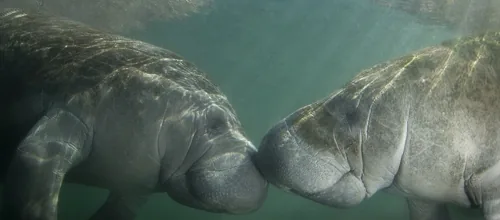
Manatees communicate through touch, sound, smell, taste, hearing, and sight. They express fear, playfulness, and anger, and the strongest communication is between a mother and her calf. They chirp, whistle, and squeak to send messages, and they can detect sounds over long distances as well as pick up vibrations in the water.
Population and Culture
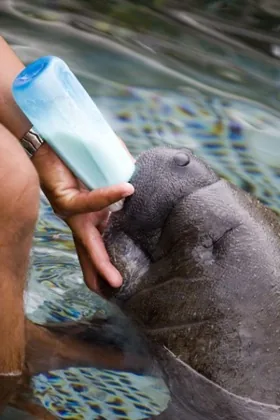
The largest population of manatees is found in Florida (approximately 3,000) making the manatee the official state marine mammal of Florida. Their overall world population is very low, however: fewer than 10,000. Manatees are rarely kept in captivity. When they are, it's usually for rescue and rehabilitation, or when an orphaned calf can't survive on its own. They usually go back to the wild unless carers are certain they won't make it alone. Although manatees adapt well, they are much better off in the wild, and the cost of keeping them is high.
Manatees have been studied extensively, especially the Florida population. They also appear in the folklore of many cultures. Western Africans consider manatees sacred animals, believing they evolved from humans, so killing them is forbidden by their traditions. Some indigenous people use manatee bones to treat ailments like asthma and earache.
Frequently Asked Questions
What are manatees most closely related to?
Elephants and hyraxes, not dolphins or seals.
How long can a manatee hold its breath?
About 15 minutes, though they typically surface every few minutes.
How many species of manatees exist?
Three: the West Indian manatee, the Amazonian manatee, and the African manatee.
Are manatees endangered?
Yes. All three species are listed as endangered on the IUCN Red List.
Threats and Conservation
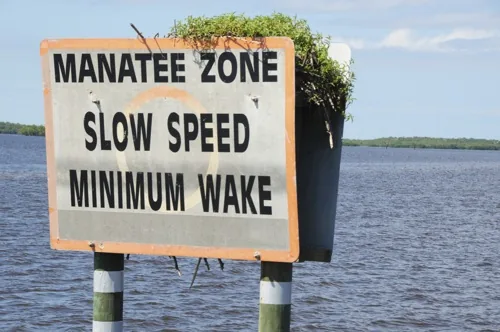
According to the IUCN Red List, all three species of manatees are endangered. Their biggest threat is loss of habitat. Because they swim slowly, they are easily injured by fast-moving boats and propellers. These wounds can cause deadly infections. This is why manatee-inhabited waterways require boats to slow down. Manatees are also naturally curious, they often swim up to investigate boats, which puts them at even greater risk.
Historically, manatees were hunted for their meat and bones, and their bones were used to make war shields, shoes, and boat equipment. Today, hunting and poaching manatees is banned under wildlife conservation laws. For example, the Endangered Species Act, 1973 makes it illegal to hunt, hurt, trap, or even harass a manatee.
Explore More Animals
 39 Seahorse Facts That Will Change Your Perception About ThemEvolution has caused several mind-boggling adaptations in the seahorse, which make us question the black and white findings of scientific research. Discover 39
 Stupefying Facts About Giraffes That Will Make You GawkWere you aware that each time a giraffe lifts up its neck, it lifts more than 550 pounds? Read on for fascinating facts about giraffes, their size, diet, lifes
 Facts About Asian Elephants You Won't Believe You Didn't KnowDid you know that female Asian elephants do not have tusks? And that only some male ones do? Here are some interesting facts about the Asian elephants.
 Polar Bear Facts for KidsPolar bears are some of the most majestic, beautiful, and dangerous creatures on Earth. The Inuits call polar bears, Nanook. Today, there are an estimated 20,00
Cool Facts
- The intestine of a manatee is more than 150 feet long!
- Their teeth are constantly replaced throughout their lives, just like elephants.
- Manatees are extremely sensitive to touch.
- Manatees have just 6 vertebrae, compared to 7 in most mammals, so they cannot turn their heads sideways.
- Despite their small eyes, manatees have excellent vision.
- Their lifespan is about 60 years.
- Manatees can hold their breath underwater for about 15 minutes.
- A male manatee is called a bull, a female is a cow, and a baby is a calf.
Manatees are fascinating creatures with a calm disposition and very endearing looks. That, combined with their docile and friendly nature, makes them all the more special. More effort is needed to protect these animals from extinction, losing them forever would be a great loss indeed.

 Fun fact for today!Manatees are called sea cows, but their closest living relatives are actually elephants!