

What Is a Swordfish?
The swordfish is a large, marine fish famous for its long, sword-like bill. It is also known as the broadbill or broadbill swordfish. In the scientific community, it goes by the name Xiphias gladius, in which the Latin word gladius means sword.
This fish belongs to a group called billfish, which also includes sailfish and marlins, all of which have an elongated jaw or bill. The swordfish is the only surviving member of the fish family Xiphiidae.
Although it is highly migratory, it can also be found near shores. It is sometimes confused with the marlin or the sailfish, but there are clear differences. The swordfish's bill is longer, stronger, and much flatter than either of theirs. Its dorsal fin is also much smaller, and adults completely lack scales or teeth. (The sailfish, for the record, holds the title of fastest fish in the ocean.)
The swordfish's unique way of catching prey (combined with its fierce fighting spirit) makes it a prized catch among fishermen. Its large size also makes it popular for steak and barbecues, and a whole range of recreational sports thrive on the challenge of catching this elusive fish.
Appearance
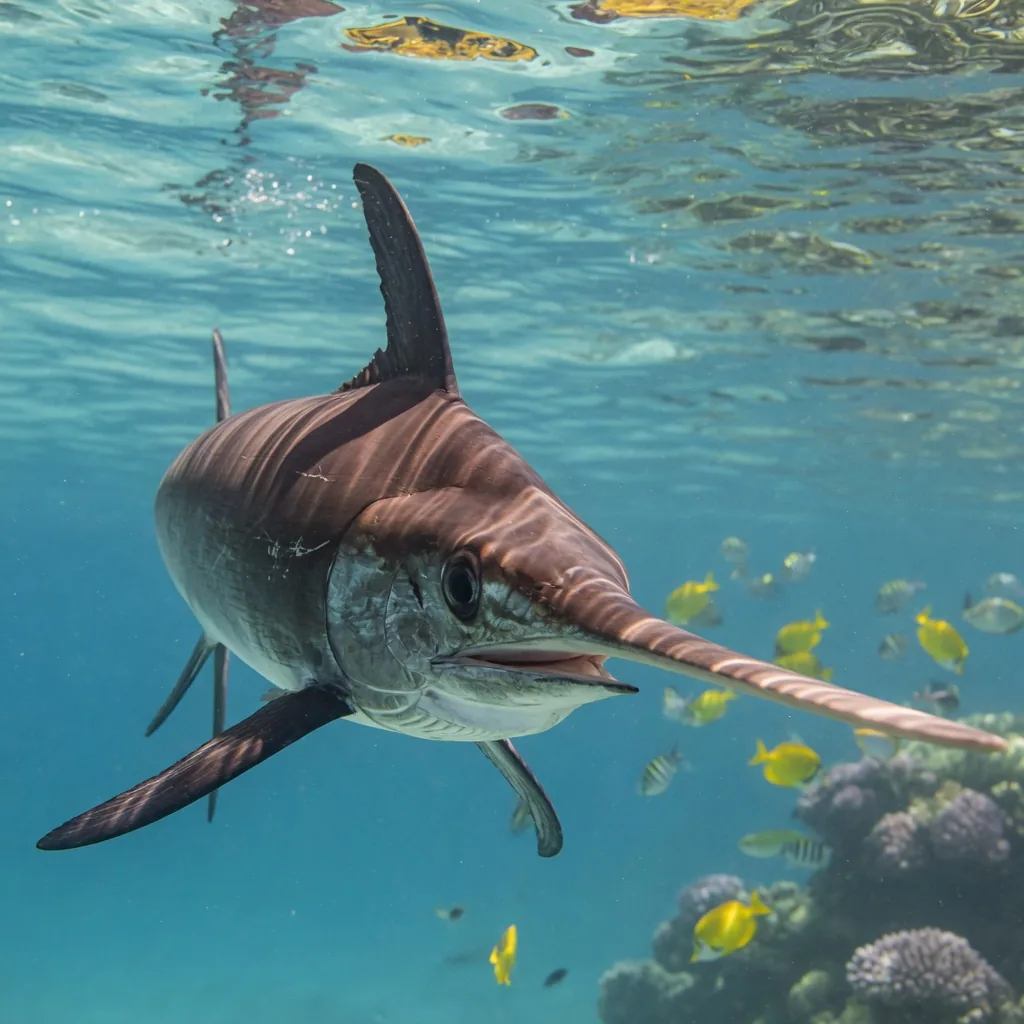
On average, swordfish are about 5 to 8 feet long. Some individuals may grow to 14 feet. Their weight usually ranges from 150 to 250 lbs, though some can reach as high as 1,000 lbs. The heaviest swordfish on record was caught in Chile in 1953 and weighed 1,182 lbs. Females are much larger than males.
The upper jaw grows long and flat like a sword, that's where the famous name comes from. When fully grown, the bill accounts for one-third of the swordfish's total length. It is used for both defense and catching prey.
The fish is brownish to bluish-gray on top, along its sides, and on its fins. Its underbelly is off-white. This coloring helps it blend in, whether viewed from above or from below.
The swordfish has two dorsal fins on its back, with the front one being much larger. It also has a pair of large pectoral fins, two pelvic fins (one large, one very small), and a crescent-shaped tail fin called the caudal fin.
Young swordfish look quite different from adults. Juveniles have teeth and scales, while adults don't. Juveniles start with equally-sized jaws, and the upper jaw slowly grows into the bill over time. The lateral line (the stripe running along each side) is visible in young fish but disappears in adults.
Habitat and Distribution
Swordfish live in both shallow water and at depths of up to 650 meters. They prefer warmer water in the range of 64 to 72°F, but they can tolerate temperatures between 41 and 81°F.
The swordfish is found in the Indian, Atlantic, and Pacific oceans, and even in some colder regions like the Mediterranean Sea, the Sea of Marmara, the Black Sea, and the Sea of Azov. The majority are found in the Pacific Ocean.
Diet
The swordfish is highly carnivorous and feeds on a variety of fish and invertebrates, mostly at night. Its preferred fish include rockfish, barracuda, mackerel, menhaden, silver hake, bluefish, herring, tuna, butterfish, sand lance, gadids, scombrids, and lanternfish. Among invertebrates, it preys on squids and octopuses.
Behavior
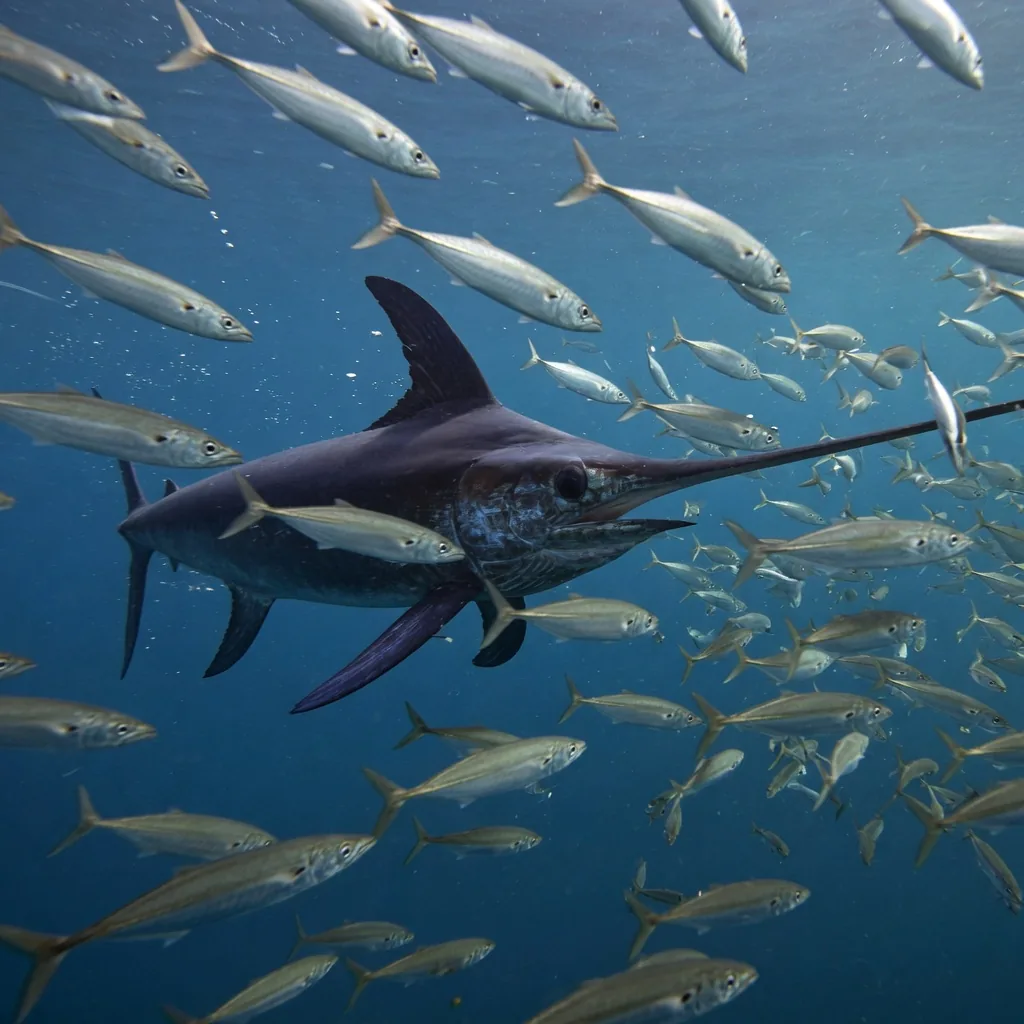
Swordfish can move as fast as 50 mph in sudden bursts, making them one of the top ten fastest fish in the ocean. While feeding, they use their bill to separate prey from a school of fish by injuring it, then swallow it whole. For larger prey, they slash it into pieces by moving their head from side to side. The sword also helps them cut through water more easily.
Contrary to popular belief, swordfish don't pierce prey or use their bill like a spear. Impaling a fish on a long bill would actually make it impossible to eat, since the prey would be stuck at the tip. Instead, they make fast slashing movements.
The bill is also used for defense. Swordfish use it to fight off killer whales, sperm whales, and sharks, some of the few animals that prey on them. In fact, mako sharks have been found dead with a swordfish bill lodged in their heads, showing just how dangerous attacking a swordfish can be.
Their bodies are made mostly of white muscle fibers, which are not built for endurance. Rather than swimming long distances on their own, swordfish let ocean currents carry them. They are highly migratory, moving to warmer water in winter, and sometimes heading to cooler regions in summer to spawn.
Swordfish travel alone rather than in shoals. At most, they may swim within 10 meters of another swordfish. They are strong, aggressive fighters. Some, after being caught on a fishing line, have pierced through the hull of a boat with their bill. Even more remarkably, when injured by fishermen, some have dived so fast that they plunged their beaks deep into the sea floor right up to their eyes.
Take the Swordfish Facts Quiz!
5 quick questions. How much do you know about the ocean's living sword?
Leaping and Basking
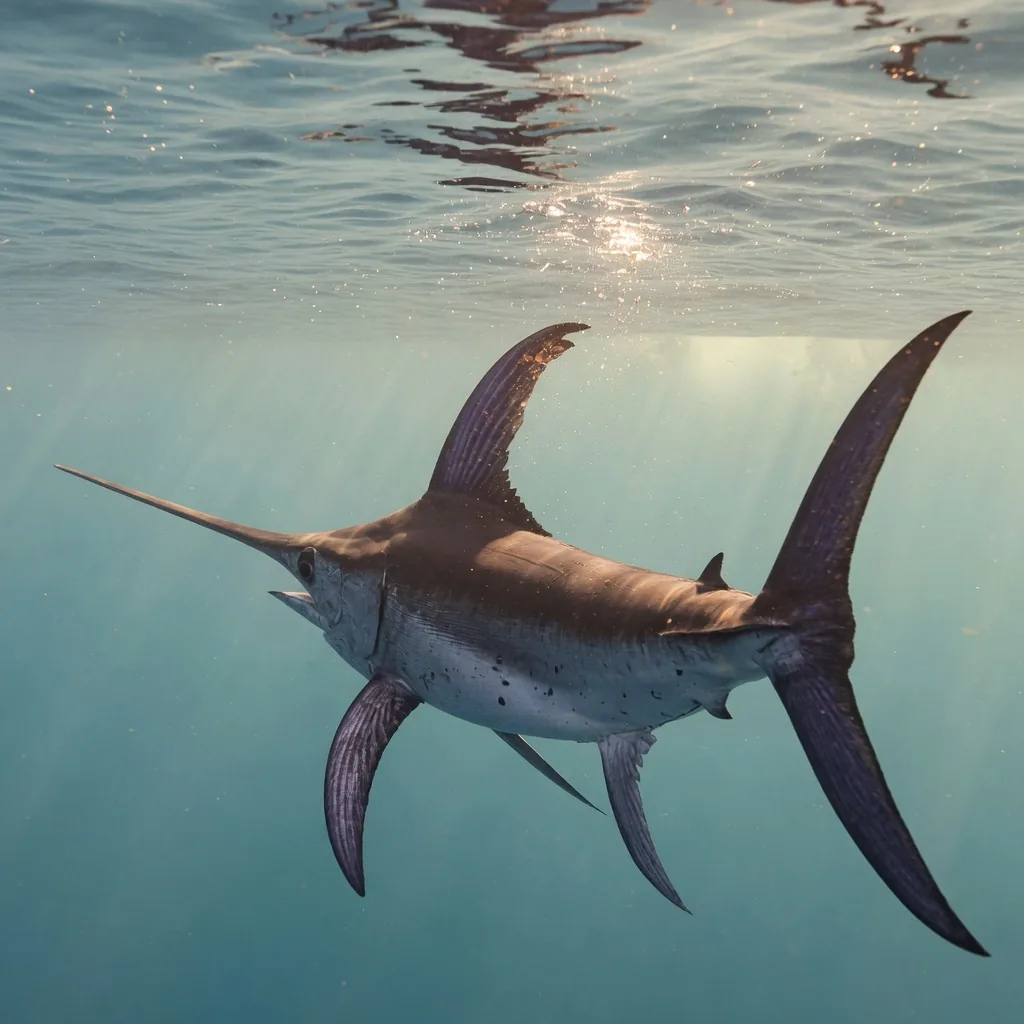
The swordfish's famous habit of leaping high out of the water is thought to help remove parasitic fish like lampreys from its body. It also basks in the sun near the surface, with its first dorsal fin held above the water, which makes for a dramatic sight.
Mating and Life Cycle
Swordfish become sexually active at the age of 5 to 6 years. Fertilization is external, the female releases her eggs into the water, which the male then fertilizes by releasing sperm nearby. Females can carry anywhere from 1 to 29 million eggs. Larger females carry more eggs than smaller ones.
Juvenile swordfish are preyed upon by many aquatic animals, including, in times of food scarcity, adult swordfish. A swordfish may live as long as 15 years, though the average lifespan is around 9 to 10 years.
Conservation Status
The swordfish is currently listed as a species of Least Concern on the IUCN's Red List, meaning it is not endangered. In 1998, declining populations led the US government to ban swordfish fishing in parts of the Atlantic. This ban led to a population recovery in the North Atlantic, though overfishing is still a concern in the Indian Ocean.
Frequently Asked Questions
How fast can a swordfish swim?
Swordfish can reach speeds of up to 50 mph in sudden bursts, making them one of the top ten fastest fish in the ocean.
What does the swordfish use its bill for?
The swordfish uses its flat, sword-like bill to slash through schools of fish, injuring prey. It does not spear prey, it makes slashing side-to-side movements. The bill also helps the fish defend itself from predators like sharks and killer whales.
How big do swordfish get?
On average, swordfish are about 5 to 8 feet long and weigh 150 to 250 lbs. Some may grow to 14 feet and over 1,000 lbs. The heaviest on record weighed 1,182 lbs and was caught in Chile in 1953.
Is the swordfish endangered?
The swordfish is currently listed as Least Concern on the IUCN Red List. In 1998 the US government banned swordfish fishing in parts of the Atlantic, leading to a population recovery in the North Atlantic. Overfishing remains a concern in the Indian Ocean.
Fishery and Human Use
The swordfish is a popular food in countries like Japan, Spain, the USA, Mexico, and Australia. Japan alone accounts for one-quarter of the world's total catch. "Swordfishing" has also become a popular recreational sport, driven by the fish's reputation for vigorously fighting back when hooked.
The swordfish is classed as an "oily" fish, which raises the risk of toxic chemicals like methyl mercury building up in its body. For this reason, pregnant women and children are generally advised not to eat it.
While its long sword and large size give the swordfish a formidable appearance, evidence suggests it has never attacked humans without provocation.
Explore More Animals
 Interesting Facts About the Beautiful Blowfish (Puffer Fish)Also known as puffer fish, blowfish can inflate themselves to scare away their predators, hence the name. They are believed to be the second most poisonous vert
 Truly Incredible Facts about CuttlefishThe cuttlefish is not a fish. In fact, it is a mollusk, and is well-known for its chameleon-like behavior. Discover the anatomy, camouflage, ink, diet, mating,
 Types of FishThere are over 32,000 species of fish, more than all other vertebrates combined. Discover how fish are classified by species and habitat, plus the fish we keep
 A List of Different Types of Barracuda Fish, With PicturesThe barracuda is nicknamed the 'Tiger of the Sea'. Meet the Great, Yellowtail, Blackfin, Yellowmouth and Mexican barracuda, plus the full list of more than 20

 Fun fact for today!The swordfish is one of the largest fish in the ocean, and one of the top ten fastest too.