

Where Do Lionfish Live?
The native habitat of lionfish spans the rocky crevices and reefs of the Indo-Pacific waters. These days, however, they can also be found along the eastern coast of America. It is not entirely clear how they arrived there, but the most likely explanation is that some specimens released by certain aquariums began to spread and breed in the warm Atlantic waters.
Lionfish belong to the genus Pterois, a group of venomous fish native to the Indo-Pacific region. There are nine different species in total. The most well-known ones are the red lionfish (Pterois volitans), the spotfin lionfish (Pterois antennata), the luna lionfish (Pterois lunulata), the frillfin turkeyfish (Pterois mombasae), and the clearfin lionfish (Pterois radiata).
What Exactly Is a Lionfish?
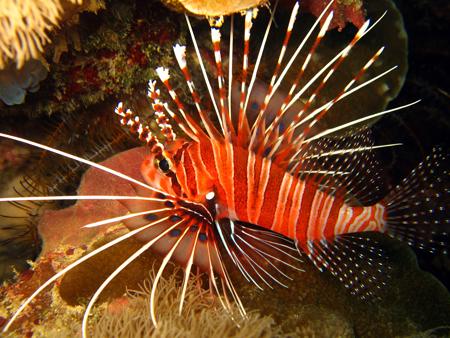
The beautiful, graceful swimmer (the lionfish) is also called the turkey fish, tragon fish, or even the scorpionfish. These are very attractive sea creatures, but they are aggressive predators too. They have stinging spines, and their fins are poisonous. They are known to corner their prey and stun them with their spines before swallowing them whole.
The lionfish is usually a slow swimmer, but it can make quick bursts of movement when needed. Those quick movements are what help it catch prey. When a predator gets close, the lionfish fans out its fins in a warning pose. If anything dares to come closer, it injects venom from its long spines.
The lionfish has really long, separated fins with a striped pattern on a white background. It has dorsal fin spines and enlarged pectoral fins that create a bold zebra-like pattern. Lionfish usually swim around in pairs.
Venom, Defenses, and Hunting
Although lionfish are spectacular to look at, they are also lethal. Their fins have spines as sharp as needles, which they use to inject a powerful venom into predators. This venom is a purely defensive weapon, lionfish only deploy it when they feel threatened. When it comes to catching prey, they rely instead on lightning-fast reflexes and camouflage.
Adult lionfish use their broad, fan-like pectoral fins to attract and corral prey. The moment a meal drifts within reach, the lionfish swallows it in a single, swift motion. This hunting style is especially effective in regions where lionfish are non-native, because the local fish have never learned to avoid such a trap.
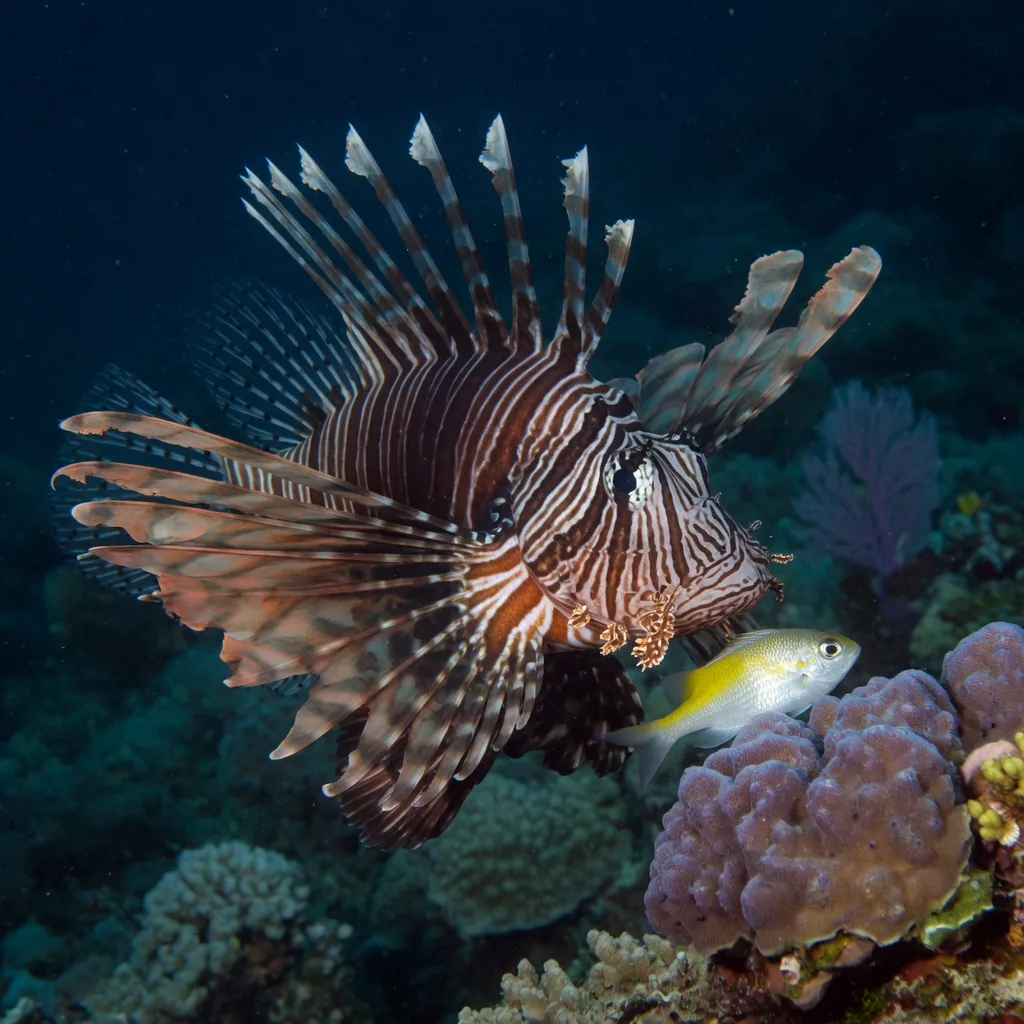
Although the lionfish is one of the most venomous fish in the world, it is not generally considered a serious threat to humans. People come into contact with them mainly while fishing or diving. While a sting is not fatal for healthy adults, it can cause extreme pain, breathing difficulties, nausea, vomiting, dizziness, and other unpleasant effects.
Size, Lifespan, and Behavior
The largest lionfish species can grow up to 16 inches (42 cm) in length, while the smallest measures just 2 inches (6.2 cm). On average, an adult lionfish is about 13 inches (38 cm) long and weighs around 1-2 lbs. Their lifespan in the wild averages around 15 years.
The clearfin lionfish, also called the radiata lionfish (Pterois radiata), lives in the Indian Ocean and western Pacific Ocean. It is the only lionfish whose spines lack the bold characteristic markings found on all other species.
Lionfish hunt mainly during the day. At night they retreat to small underwater caves and ledges. They feed mainly on crabs, shrimp, and other small fish, lying in wait and swallowing meals whole when they drift close enough.
Where Each Lionfish Species Lives
Lionfish live in warm waters. They are usually found in the Indo-Pacific region, and different species are seen across the world. Their habitat is made up of rocky areas under the water with plenty of plants and fish. That is why they are often found near coral reefs. They like to hide in holes, and under rocks and caverns. Let us look at the different habitats of the lionfish, by species.
Red Lionfish
The Red Lionfish has red and maroon stripes over its white body, and can grow up to about 17 inches in size. Its habitat consists of the coral reef regions of the Indian and Pacific oceans. Red Lionfish are also found off the east coast of Florida in the United States.
Black Lionfish
Black Lionfish are black and white striped fish with solid black spikes and fins. They are generally found in warm tropical waters.
Freshwater Lionfish
The Freshwater Lionfish has a natural beauty that makes it one of the most popular aquarium fish. They are actually toadfish that are completely harmless and non-poisonous. Their spines may cause only a slight pain due to their sharpness.
Their habitat consists of waters around the Indo-West Pacific, northwestern Australia, Thailand, the Arafura Sea, the Mekong Delta, Indonesia, and Papua New Guinea.
Dwarf Lionfish
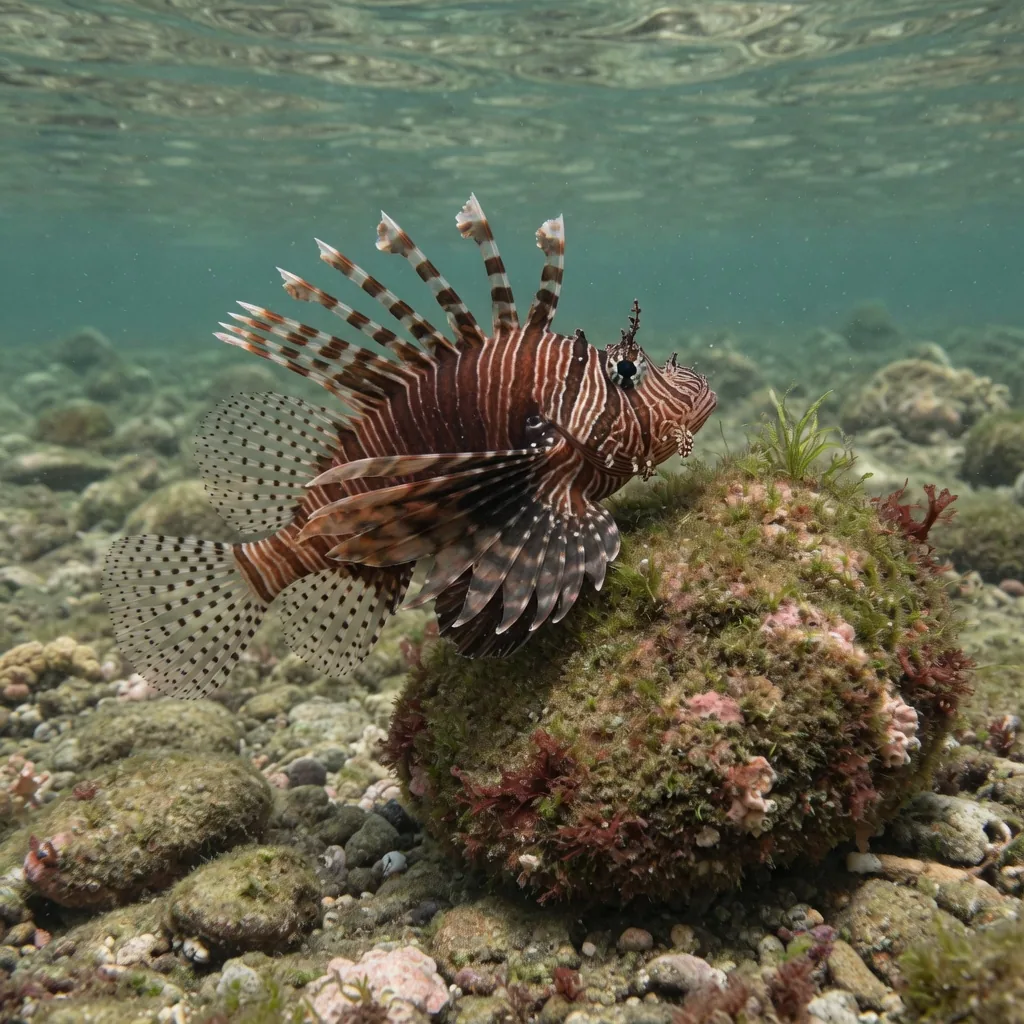
The Dwarf Lionfish looks similar to the red and black species, but it is a smaller version of the two. It is just about 15 centimeters long, and can come in different colors like red or brown. It has spotted bands on its back fins. Its habitat includes the Indo-Pacific waters, the Australian coastal reefs, and the estuaries of southwestern Australia, from the north and south to southern New South Wales.
The Dwarf Lionfish's range stretches from Samoa and Tonga to eastern Africa and the Red Sea. Basically, the Indo-Pacific is where this fish will be found. At the northern tip of its habitat, you will find the waters of southern Japan. The southern tip lies somewhere between Australia and New Guinea. Dwarf Lionfish love to be among rocks and corals wherever they are. That is where they feel most comfortable, in reefs or other shallow areas, or just about anywhere with weed-covered rocks.
Test Your Lionfish Knowledge!
10 questions, how much do you really know about these venomous reef fish?
Solitary Adults, Social Juveniles
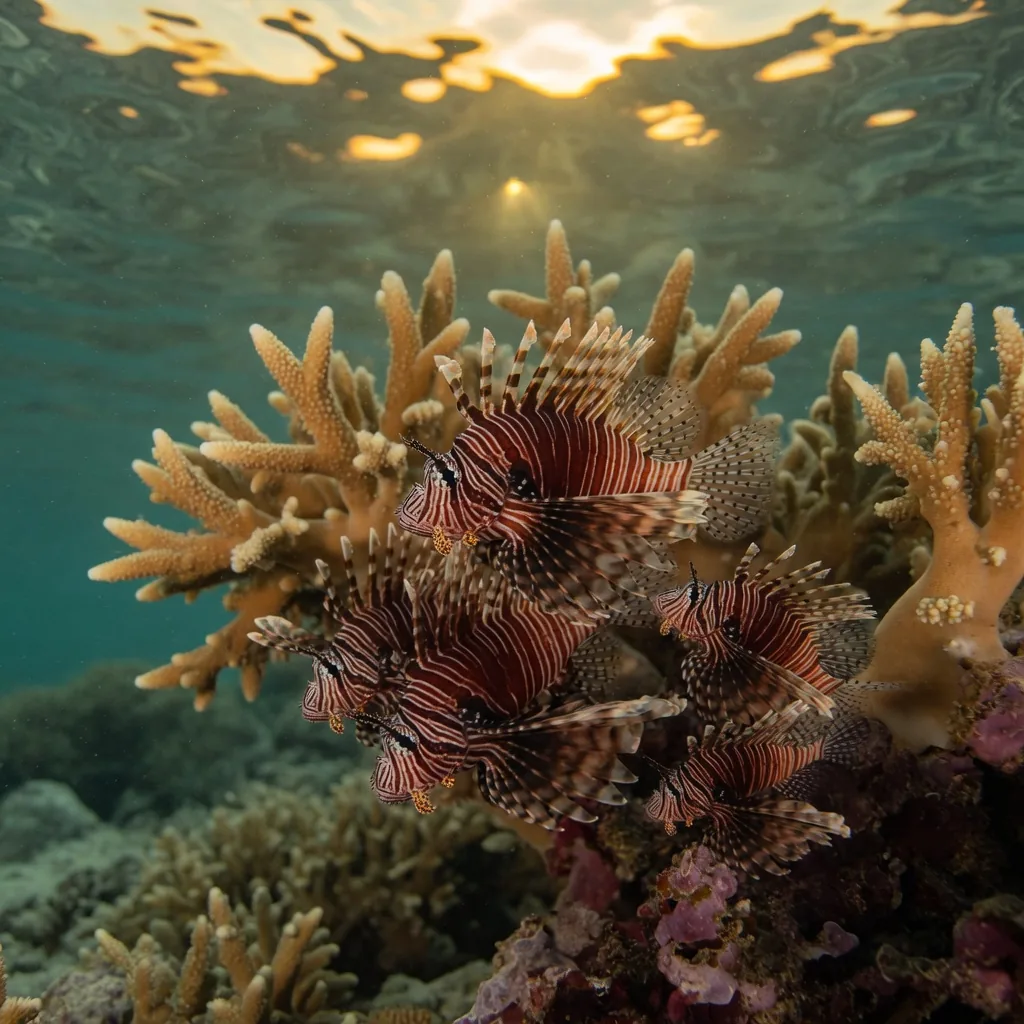
Adult lionfish are solitary creatures, but young lionfish are known to live together in groups. Over time they become highly territorial, and won't hesitate to fight other members of their group to claim or defend a patch of reef.
Frequently Asked Questions
Where do lionfish live?
Lionfish are native to the Indo-Pacific region, living around coral reefs, rocky crevices, and caverns in warm waters. They are now also invasive along the east coast of the United States.
Is a lionfish venomous or poisonous?
Venomous, it injects venom through sharp spines, but is not poisonous to eat once the spines are removed.
How big do lionfish get?
The largest species reach 16 inches (42 cm); adults average 13 inches (38 cm) and weigh 1-2 lbs. The Red Lionfish can grow up to about 17 inches, while the Dwarf Lionfish is only about 15 centimeters long.
Are lionfish dangerous to humans?
Their venom is not fatal to healthy humans, but a sting causes extreme pain, nausea, breathing difficulties and dizziness.
Are freshwater lionfish venomous?
No, freshwater lionfish are actually toadfish that are completely harmless and non-poisonous.
How long do lionfish live?
Around 15 years in the wild, on average.
Keeping Lionfish: Care in Aquariums
Even though lionfish are thought to be difficult to care for, many people love to have them in their aquariums. These fish are venomous and can pose health hazards. So, a certain level of understanding about their behavior and abilities is necessary before anyone considers keeping them as pets.
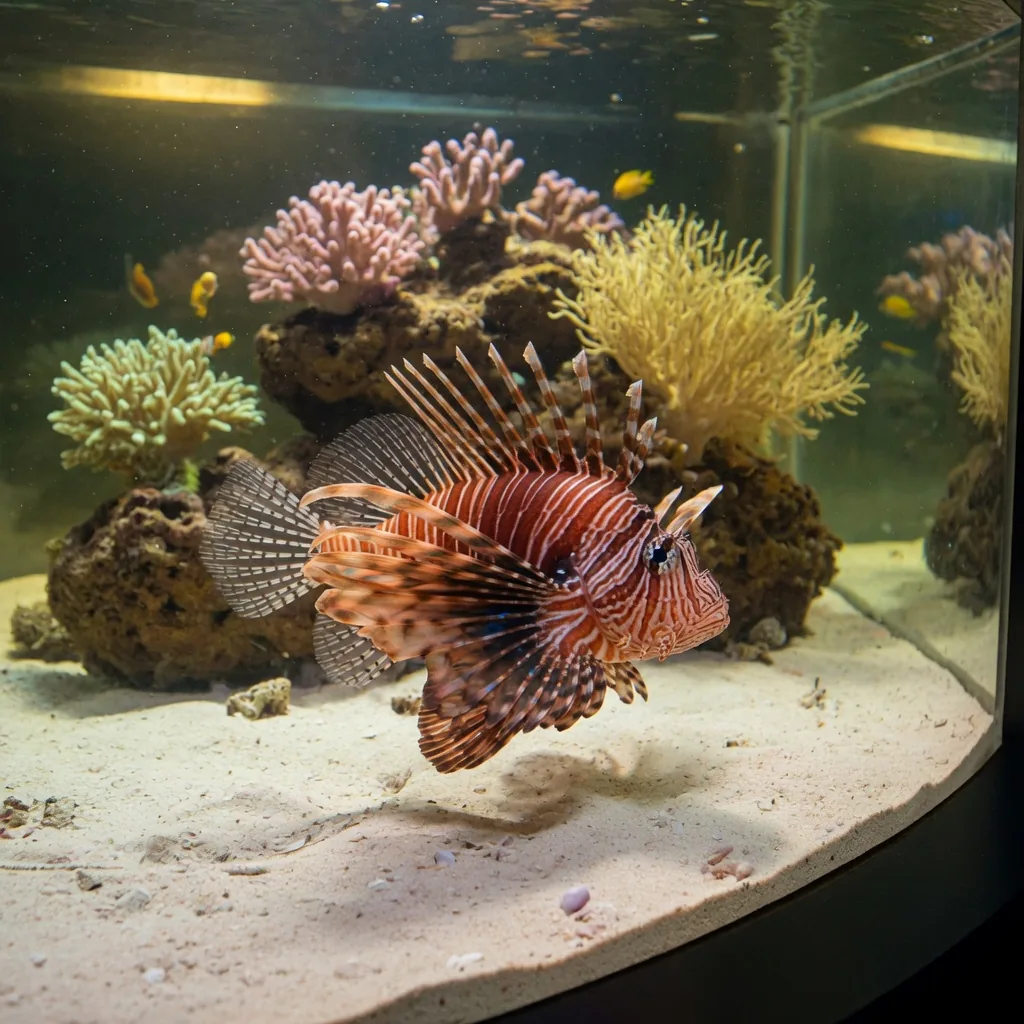
Lionfish are a hardy bunch, disease-resistant and adaptable to various water conditions. They can grow quite large, so you need to use a big aquarium to give them enough room to swim. You can keep more than one in a tank, but make sure each fish has enough individual space. They are slow and lazy during the day, and tend to just lie around.
You can also keep these fish in a reef aquarium. Make sure you do thorough research about compatible species before adding more fish to the tank. The lionfish is active mainly during feeding time, and will typically hang around the bottom during the day. So, choose a soft substrate so it does not injure itself. The diet of this fish consists of small crustaceans and fish. You can even feed them shrimp and worms during the dawn and dusk hours.
Explore More Animals
 Interesting Facts About the Beautiful Blowfish (Puffer Fish)Also known as puffer fish, blowfish can inflate themselves to scare away their predators, hence the name. They are believed to be the second most poisonous vert
 African Lion FactsThe numbers of African lions are sadly on a rapid decline. These vulnerable species face constant threat due to loss of habitat and poaching. Here are some inte
 Types of JellyfishJellyfish are mysterious ocean creatures, a complete kids' guide to the most popular types, plus how jellyfish live, eat, sting, and survive. From the deadly S
 Marvelous Facts About Lions That Kids Will Relish ReadingAnimals are getting extinct day by day. Knowing about them can help preserve what we have today. One such magnificent creature is the lion, king of his pride a
Invasion and Conservation Efforts
Although the lionfish is considered a delicacy in certain countries, it is also highly valued in the aquarium trade because of its spectacular appearance. Common types sold in shops include the radial lionfish and the volitan lionfish, with the volitan being the most popular species.
In its native Indo-Pacific habitat, the lionfish population is healthy and actually growing. Concern has been raised in the United States, however, where scientists worry that the spread of this non-native species could cause serious environmental damage and pose hazards to people. Organizations including the NOAA, USGS, and REEF are actively working on invasive lionfish removal.
Removing invasive lionfish is not easy. To encourage public involvement, environmental organizations hold lionfish removal contests. The contest for the most lionfish collected and turned in, organized by the Reef Environmental Education Forum (REEF) in Upper Keys, is one well-known example.
The lionfish swims its way around the world and makes for an interesting aquarium fish, but it should only be brought home after thorough research and preparation. In spite of being among the most venomous fish known, lionfish continue to fascinate researchers because of their unusual appearance and behavior.

 Fun fact for today!Lionfish don't use their venom to hunt. Those needle-sharp spines are purely for defense, they catch prey with speed and camouflage alone!