

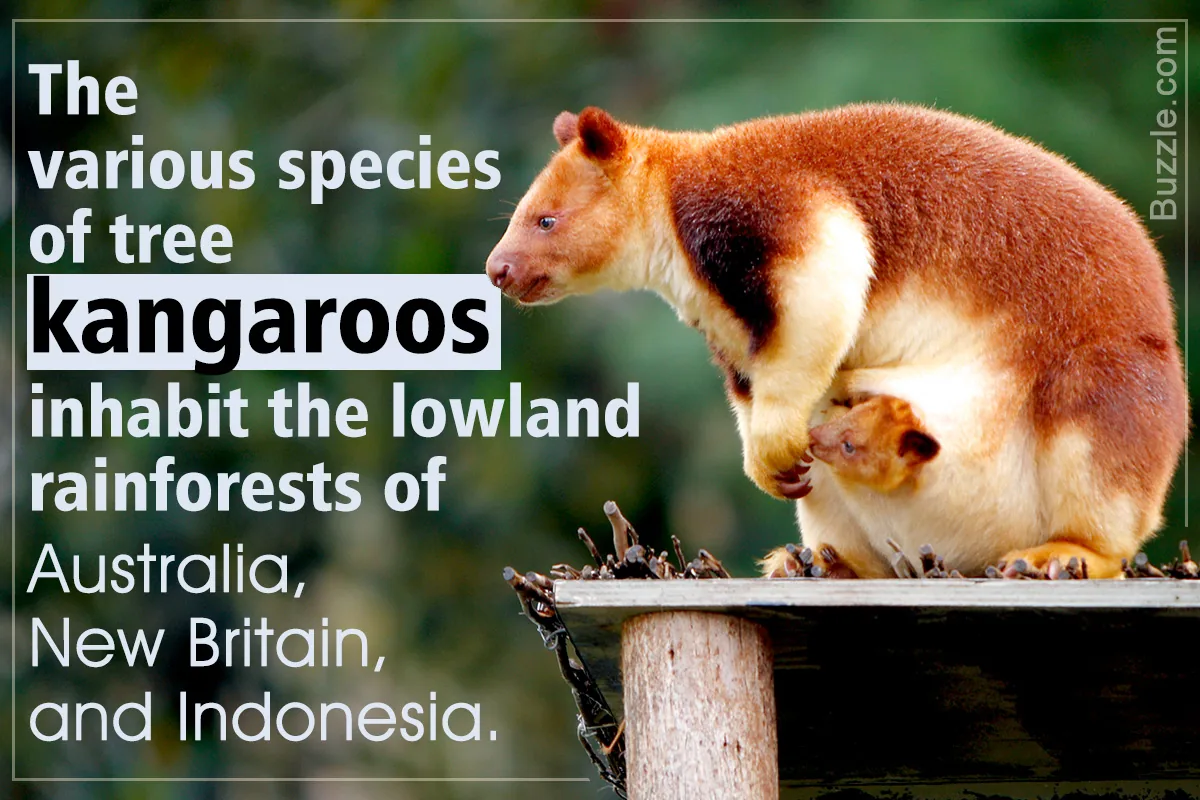
The various species of tree kangaroos live in the lowland rain forests of Australia, Papua New Guinea, Umboi, New Britain, West Papua, north-east Queensland, and parts of Indonesia. Some species of these canopy-dwelling macropods live in mountainous rain forests at altitudes up to 11,000 feet.
The tree kangaroo is an arboreal mammal and marsupial, which carries its underdeveloped young one in its pouch (marsupium). Here is the scientific classification for these animals, followed by some fascinating facts.
Scientific Classification
| Phylum | Chordata |
|---|---|
| Class | Mammalia |
| Infraclass | Marsupialia |
| Order | Diprotodontia |
| Family | Macropodidae |
| Subfamily | Macropodinae |
| Genus | Dendrolagus |
The Species of Tree Kangaroos
There are 13 recognized species. Each species varies in color, pelage (fur), and size.
- Grizzled Tree-kangaroo, Dendrolagus inustus
- Ursine Tree-kangaroo, Dendrolagus ursinus
- Matschie's Tree-kangaroo, Dendrolagus matschiei
- Doria's Tree-kangaroo, Dendrolagus dorianus
- Seri's Tree-kangaroo, Dendrolagus stellarum
- Goodfellow's Tree-kangaroo, Dendrolagus goodfellowi
- Golden-mantled Tree-kangaroo, Dendrolagus pulcherrimus
- Lowlands Tree-kangaroo, Dendrolagus spadix
- Dingiso, Dendrolagus mbaiso
- Tenkile/Scott's tree-kangaroo, Dendrolagus scottae
- Lumholtz's Tree-kangaroo, Dendrolagus lumholtzi
- Bennett's Tree-kangaroo, Dendrolagus bennettianus
- Wondiwoi Tree-kangaroo, Dendrolagus mayri
Anatomical Facts
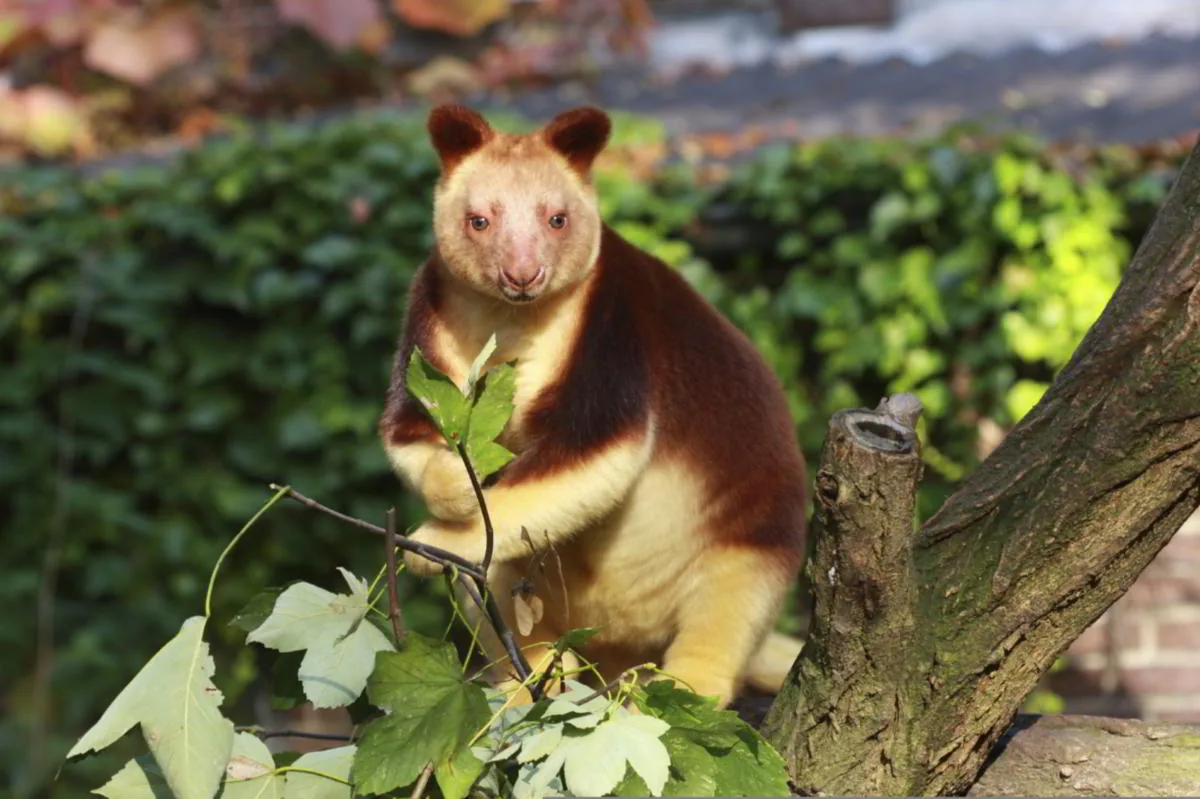
Tree kangaroos are slow and clumsy on the ground, they tend to walk awkwardly. Their tails are heavy, so they hold their tails up while hopping and walking on flat ground. On trees, however, they are amazingly agile and fast.
These macropods have shorter and wider feet with long claws, which allow them to move quickly on trees. They have big hind legs and small forelimbs, which makes climbing easy for them.
The tree kangaroo has very sharp, curved, and large claws that help in gripping tree bark while climbing and staying put. The hands have individual fingers that move independently, which gives them greater dexterity and grip.
Compared to other macropods, tree kangaroos are the only ones able to move their hind limbs independently while walking, instead of moving them in the typical synchronous manner.
The length of the tail equals the length of the body. Their long tail gives great support and balance while moving and allows them to jump from one tree to another.
These kangaroos have rubbery soles that help them climb trees quickly.
Tree kangaroos are excellent leapers and can jump up to 9 m (29 feet) from tree to tree. They can even drop from 18 m (60 feet) and land safely on the ground.
Take the Tree Kangaroo Quiz!
5 quick questions. How much do you know about these amazing tree-climbers?
Some Fun Facts
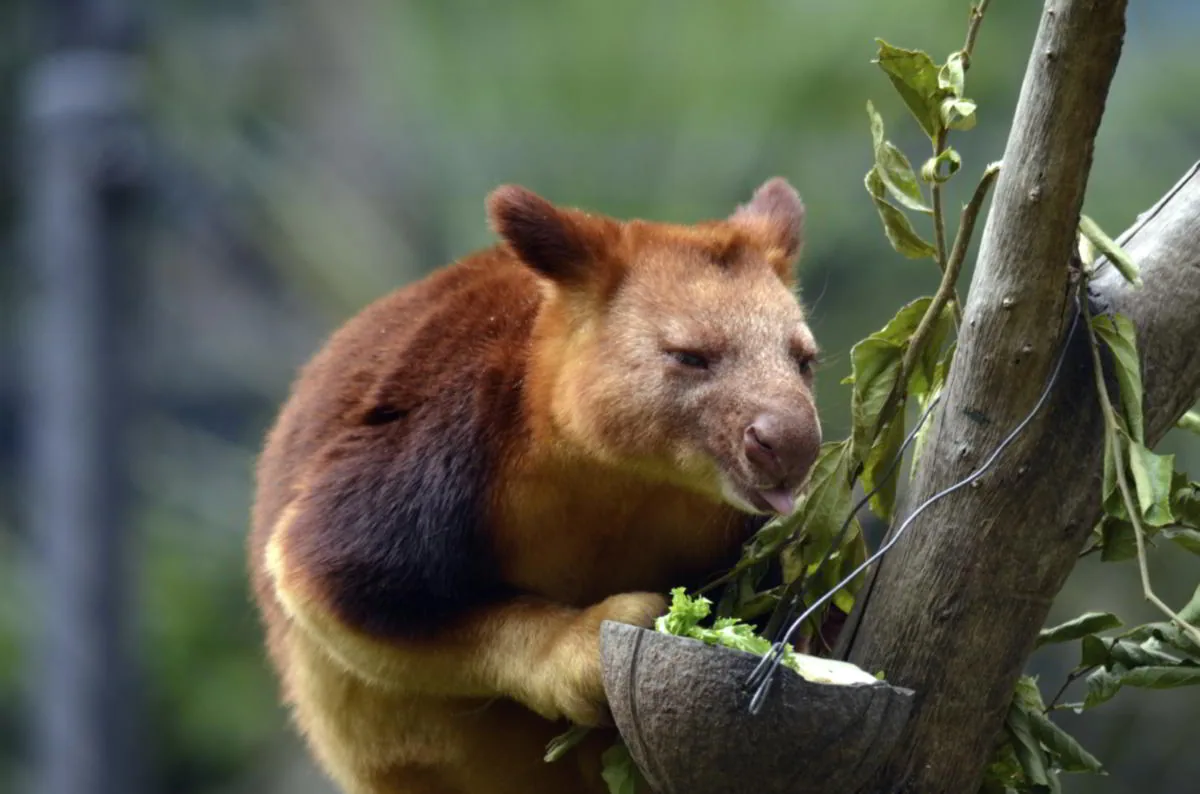
Tree kangaroos are Australia's largest arboreal animals.
An adult male and female weighs approximately 15-30 pounds.
The average lifespan of these animals can reach up to 20 years in captivity.
Tree kangaroos have small teeth used for feeding on leaves, flowers, fruits, tree bark, eggs, small birds, ferns, sap, and grass shoots.
The pelage (fur) of tree kangaroos grows in whorls that help shed rainwater. In some tree kangaroo species, these hair whorls grow from the neck onto the head. In other species, whorls grow on the back, shoulders, or the tail base.
These macropods lick themselves to keep cool during hot weather.
Tree Kangaroo Reproduction Facts
Tree kangaroos are mostly solitary animals that come together only for mating.
Female tree kangaroos reach sexual maturity by the time they are 2½ years old, whereas males mature at 4.6 years.
There is no specific mating season for these animals.
A female tree kangaroo can give birth to only one joey (baby kangaroo) per year.
Male tree kangaroos are polygamous and can mate with several females within their home range. While females and males set up their homes independently and away from one another, the home of a male tree kangaroo is always close to several female settlements.
That said, male tree kangaroos do not form harems and prefer living in isolation.
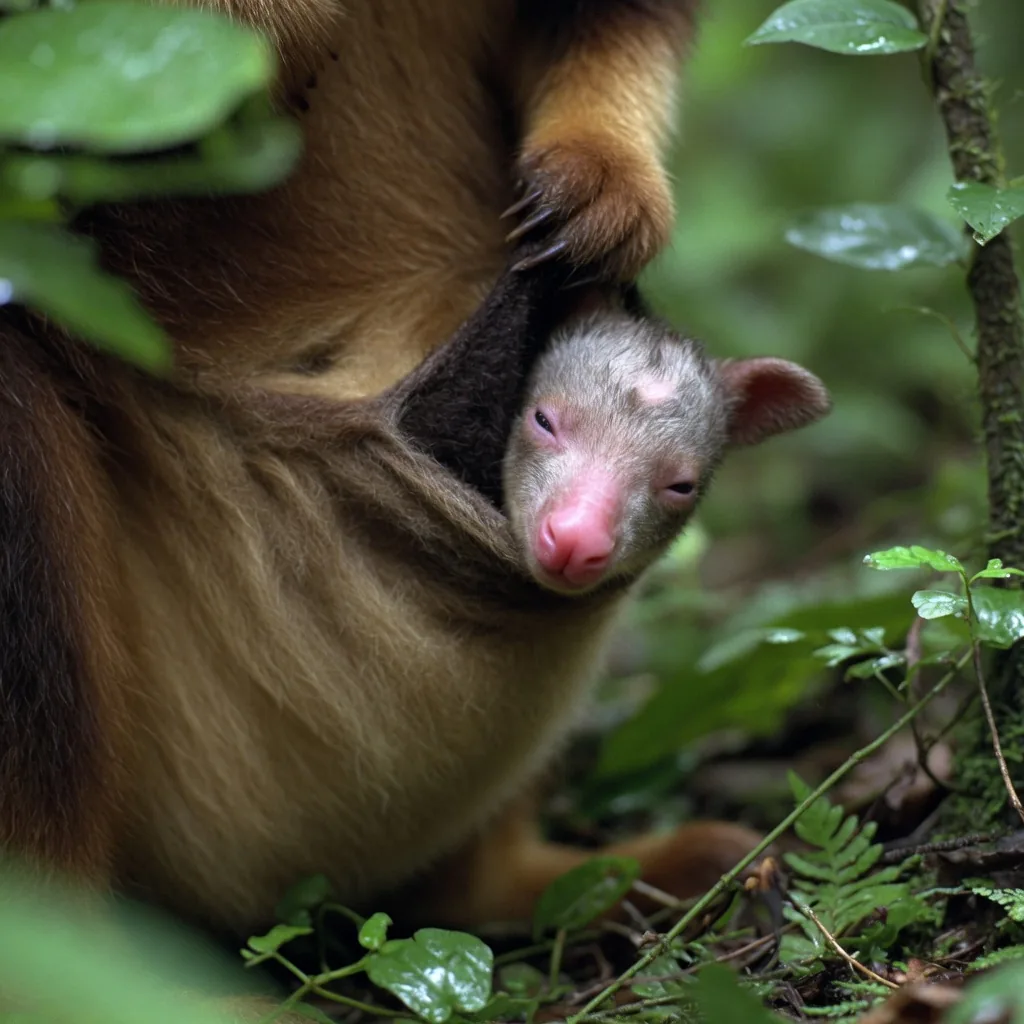
The gestation period lasts 44 days, after which the female gives birth to an underdeveloped joey. The newborn joey is almost fetus-like and crawls up to its mother's pouch, where it attaches itself to a teat for feeding.
The joey stays in the pouch until it develops fully. Pouch life lasts approximately 9-10 months, but the young kangaroo continues to feed on its mother's milk for the next 3-4 months.
The young one stays with its mother until it is approximately 18 months old and strong enough to look after itself in the wild.
Why Are Tree Kangaroos Under Threat?
Tree kangaroos have been listed as 'Critically Endangered' by the International Union for Conservation of Nature (IUCN). This listing means they are at risk of imminent extinction.
Among the threatened species, the Wondiwoi tree-kangaroo and the Golden-mantled tree-kangaroo are critically endangered. Apart from the Lumholtz's tree-kangaroo, the Lowland tree-kangaroo, and Bennett's tree-kangaroo, all other species have been listed as either endangered or vulnerable by the IUCN.
Hunting by humans and habitat loss have caused the ongoing decline of tree kangaroo populations. A large number of these animals are run over by vehicles, killed by dogs, or lose their habitat because of deforestation, logging, human encroachment, farming, factories, and roads.
These animals continue to be poached for their meat and fur by indigenous communities.
Certain conservation programs are working to protect these species and safeguard their dwindling populations.
Explore More Animals
 Marsupials List: 334 Pouched Mammals of the WorldFrom the red kangaroo to the tiny long-tailed planigale: meet the marsupials, the pouched mammals. A photo guide plus a full list of 334 species with ranges and
 Facts About SquirrelsSquirrels are small tree animals, with a very cute bushy tail and sharp teeth. They are fast, really intelligent, and always alert! It is fun to watch them and
 Mesmerizing Facts About the Australian WildlifeAustralia is one of the richest ecosystems on Earth. Discover the amazing mammals, birds, reptiles, amphibians, and fish that make this island continent unlike
 Jungle Animals ListAn A-to-Z list of jungle animals for kids: mammals, birds, insects, arthropods and reptiles that live in the world's jungles, each with a photo and fun facts.

 Fun fact for today!Tree kangaroos can leap up to 9 meters from branch to branch, and drop 18 meters safely to the ground!