

What Exactly Is a Seahorse?
Seahorses belong to the family Syngnathidae. That word combines two Greek roots: syn, meaning fused, and gnathus, meaning jaws. Belonging to the Hippocampus genus, the seahorse is closely related to the pipefish. The term hippos means horse and campus means sea-monster in Greek.
There was a lot of confusion surrounding seahorses in the early years of scientific research. Some books claimed these peculiar animals were insects, while others called them shellfish.
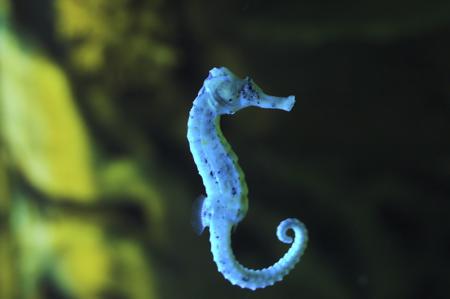
Today, seahorses are considered complete fish, with fins, gills, and a swim bladder. They look very different from other fish. With an equine head, a prehensile tail, a marsupial-like pouch, and independently moving eyes, the seahorse is truly a unique animal.
Scientific Classification
- Phylum, Chordata
- Class, Actinopterygii
- Order, Syngnathiformes
- Family, Syngnathidae
- Subfamily, Hippocampinae
- Genus, Hippocampus
Habitat and Feeding
The seahorse is elusive and seeks shelter among coral reefs, seaweed, mangroves, and estuaries. They are usually found in shallow tropical and temperate waters across the world. Their population is densest in coastal areas, especially where seagrasses like eel grass grow in abundance.
Seahorses are carnivorous and feed on small crustaceans including daphnia, cyclops, larvae, and mysids. They make a distinctive click while feeding, a sound you can also hear during territorial disputes between males and during courtship.
A two-week-old seahorse can consume 3,000 to 4,000 food items in a single day. An adult seahorse needs to feed 30-50 times a day to stay healthy.
Take the Seahorse Quiz!
5 quick questions. How much do you really know about the ocean's strangest fish?
Anatomical Facts
Seahorses can range from 0.6 to 14 inches (1.6-35 cm) in length. They have peculiar eyes that move independently of one another, giving them the ability to detect predators and food from the front and back at the same time.
Seahorses are bony fish with an exoskeleton and no scales. The ringed, interlocked plates on their body are covered by a thin layer of skin. The number of rings varies from one species to another. Unlike any other fish, seahorses also have flexible, long, and well-defined necks.
Seahorses cannot curl their tails backward, and they do not have caudal fins. Apart from razorfish, seahorses are the only other fish that swim upright and vertically. However, they are very poor swimmers and can easily die of exhaustion if caught in a strong current.
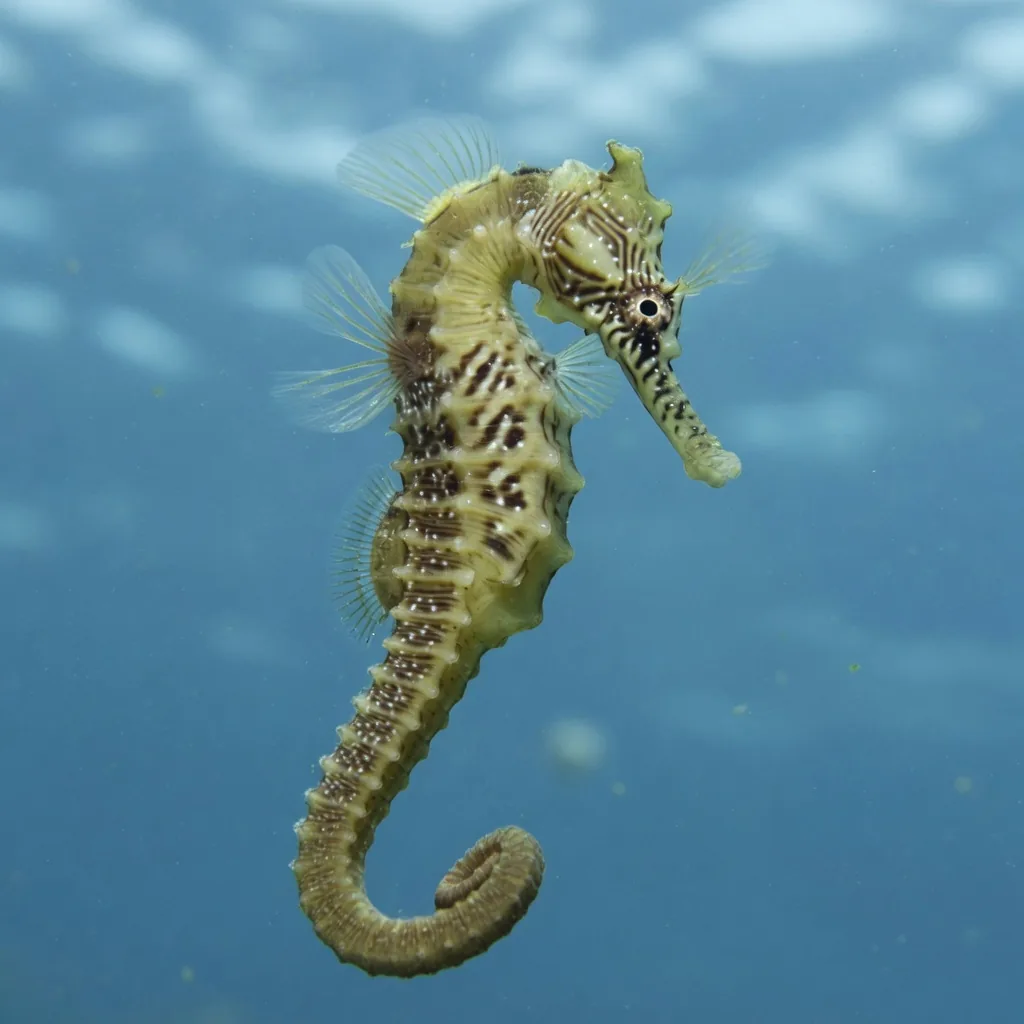
Seahorses beat their dorsal fins back and forth to propel themselves upright through the water. The pectoral fins handle steering and turning. They use their long snout to suck in food. Because they have no stomach and no teeth, everything passes rapidly through their digestive system, which is why they need to eat so constantly.
A seahorse's snout can expand to suck in prey that is slightly larger than the snout opening itself.
Reproduction Facts
Seahorses breed frequently and are not monogamous. While some species show more loyalty during a breeding season, others have no preference for one specific mate. Pairs come together for courtship, a process that can last several days.
Male seahorses prefer larger females and may abandon smaller or weaker mates if they find a bigger female to pair with.
The courtship ritual is sometimes called the "predawn dance." The two seahorses synchronise their movements, change color, twirl around with linked tails, and wrap their tails around a single strand of sea grass. This behavior is believed to help mature the female's eggs and prepare the male to receive them.
Mating takes place during the "true courtship dance." In this final phase, the male and female detach from the coral or grass blade and rise up together snout-to-snout. The male then puffs his pouch with water to show it is empty and ready for the eggs.
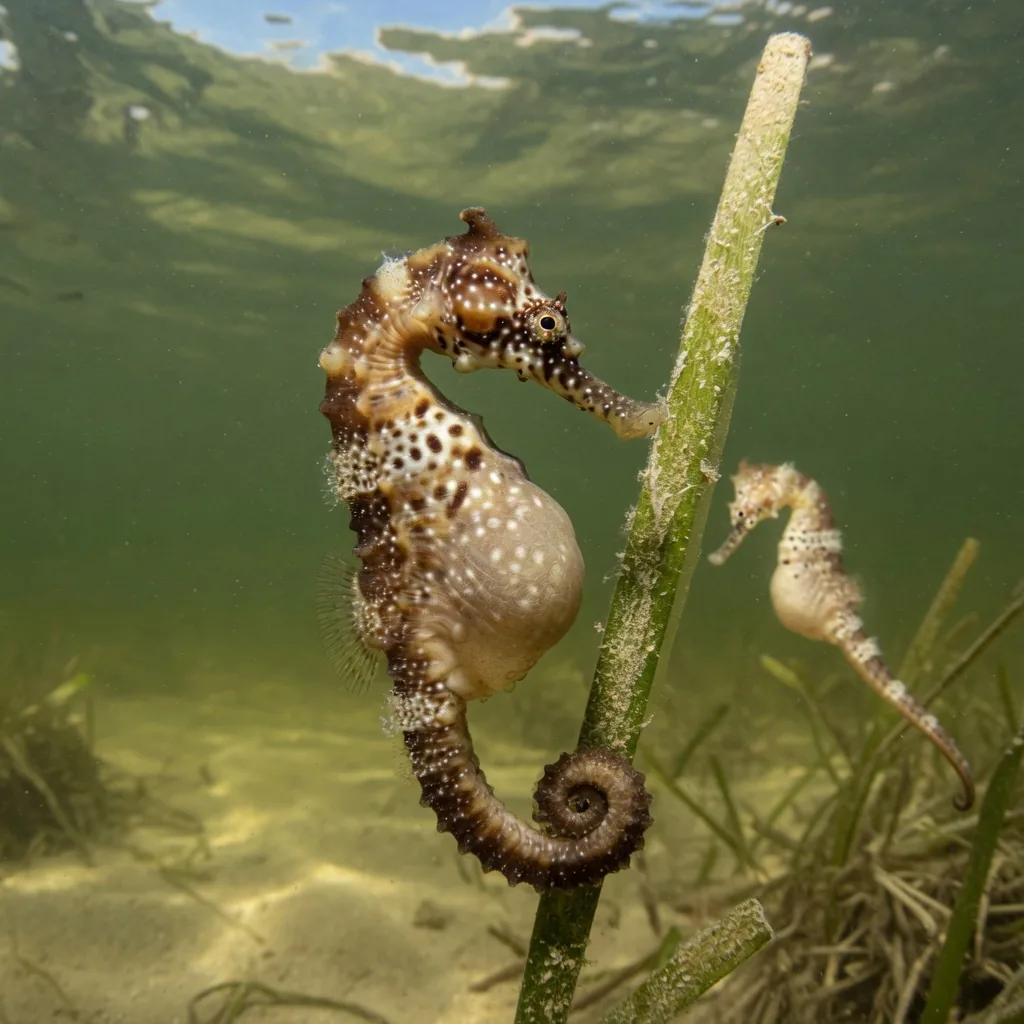
During mating, the female's ovipositor deposits thousands of eggs into the male's ventral brood pouch. This process usually lasts 7-8 hours. The male then releases sperm into the water around himself, which is quickly absorbed by the pouch to fertilise the eggs.
Once the eggs are deposited, the female shrinks in size while the male grows larger. The pair gently descend back into the corals, and the female returns to her own territory.
The fertilised eggs embed in the wall of the pouch, protected by a layer of soft tissue. The male provides the eggs with oxygen, the hormone prolactin, and incubation. During the 2-4 week gestation period, the female visits the pregnant male every morning and they meet for 5-10 minutes, intertwining their tails to greet one another.
Depending on the species, male seahorses give birth to an average of 100-1,000 fully developed young. Smaller species may give birth to only 5 young. The male gives birth through muscle contractions, always at night. Remarkably, he is ready to receive a new batch of eggs the very next morning.
It is the male seahorse that gives birth, making it the only species on Earth to do so.
After birth, the young seahorses receive no care from either parent and must fend for themselves immediately. They spend their first few weeks living and feeding among the plankton layer near the surface.
Frequently Asked Questions
Do male seahorses really give birth?
Yes, the male seahorse is the only animal on Earth where the male carries and gives birth to young.
What is the slowest fish in the world?
The dwarf seahorse, it can only cover 5 feet in 60 minutes.
How many seahorse species are there?
53 species have been acknowledged by the World Register of Marine Species.
What do seahorses eat?
Seahorses are carnivores that eat small crustaceans including daphnia, cyclops, larvae, and mysids.
More Seahorse Facts
International protection was granted to seahorses on May 15th, 2004.
Male and female territories overlap, so the two sexes interact regularly. Females, being generally larger, require a territory of about 1.5 square meters. Males get by in a territory of just 0.5 square meters.
The dorsal fin of a seahorse moves 30-70 times per second, fast enough that it appears as a blur to the human eye. Zebra stripes and spots are the only two patterns found on the various species of seahorse. A group of seahorses is known as a herd.
The average lifespan of a wild seahorse is estimated to be 1 to 5 years.
A fleshy appendage called cirri can grow on the skin of some species, acting as camouflage by resembling corals and weed. The pygmy seahorse (Hippocampus bargibanti) is a great example, it uses cirri to blend so perfectly into sea fans that it is almost impossible to spot.
Although new species continue to be discovered, 53 species have been acknowledged by the World Register of Marine Species.
More than twenty-five million seahorses are caught every year for food and for use in Asian traditional medicine. Their continued overfishing, combined with the destruction of coral reef habitats, has pushed many species close to extinction. Learn more about how habitat loss threatens animals around the world.
Explore More Animals
 Leafy Sea Dragon FactsThe leafy sea dragon is one of the most amazing marine fish in the world, with leaf-like protrusions all over its body. Discover how it lives, hides, and raises
 Interesting Facts About Manatees (Sea Cows)Manatees are docile sea mammals more closely related to elephants than dolphins. Discover their habits, intelligence, and conservation story, plus a quiz and g
 Truly Incredible Facts about CuttlefishThe cuttlefish is not a fish. In fact, it is a mollusk, and is well-known for its chameleon-like behavior. Discover the anatomy, camouflage, ink, diet, mating,
 Interesting Facts About the Beautiful Blowfish (Puffer Fish)Also known as puffer fish, blowfish can inflate themselves to scare away their predators, hence the name. They are believed to be the second most poisonous vert

 Fun fact for today!The dwarf seahorse is the slowest fish in the world, it can only cover 5 feet in a full 60 minutes!