

Australia formed from the ancient continental drift, and it is home to the most diverse terrain and the most unusual wildlife on Earth. One of its most remarkable animals is the Tasmanian devil, a carnivorous marsupial. It looks a little like a small dog, with dark fur and the ability to release a foul odor when frightened. Its howl is loud and unsettling, and it shows fierce aggression when eating. It feeds on members of its own kind and smaller animals, and it will also scavenge when food is scarce. These traits are exactly why it was given the name "devil." Today, the species is endangered because of a tumor disease that is spreading through the surviving population.
Characteristics and Habitat
The devil is Australia's largest surviving marsupial. Its body is stocky and low-slung, with a large head and a long, fat tail. The animal stores most of its body fat in its tail, much like a camel stores fat in its hump. Its forelegs are slightly longer than its hind legs, which allows it to run at speeds of more than 12 km per hour.
The devil's black fur is broken up by white patches on the chest and rump. Males are bigger than females. On average, a male devil grows to a body length of 652 mm, with the tail making up 258 mm of that total. Males weigh around 8 kg on average, while females weigh around 6 kg. Tasmanian devils live an average of six years.
Devils are found across all parts of Tasmania. They turn up most often along the edges of towns, in coastal woodlands, and in the dry, open sclerophyll forests of the island. They live on land, in trees, and near water. They do not form packs and tend to be solitary outside of feeding time.
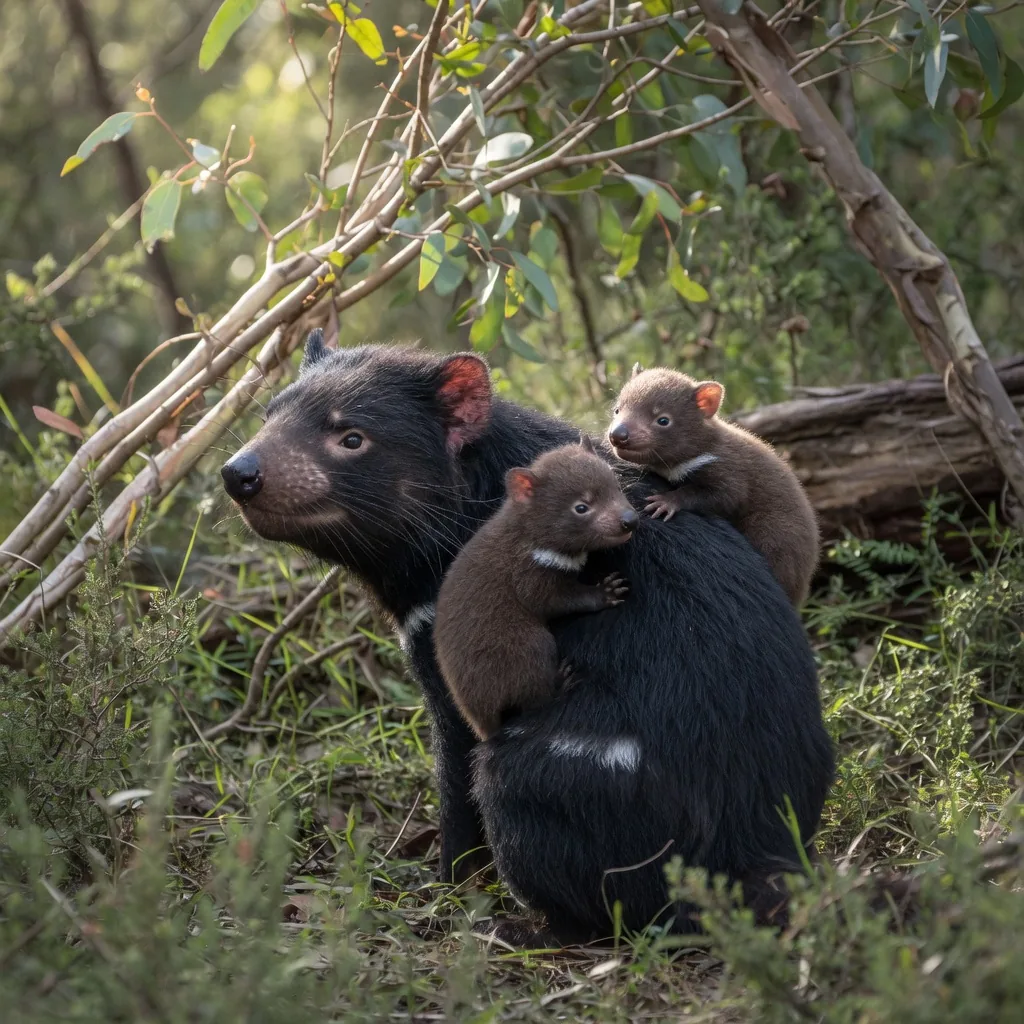
The devil eats rats, carrion, wombats, sheep, birds, insects, fish, and reptiles. It can detect prey in complete darkness using its long whiskers and the sensory bristles on its head. When it is frightened or upset, it produces a smell that rivals a skunk's. It has sharp hearing and a keen sense of smell, and (like many nocturnal animals) it is very good at spotting movement in the dark.
The Strongest Bite on Earth
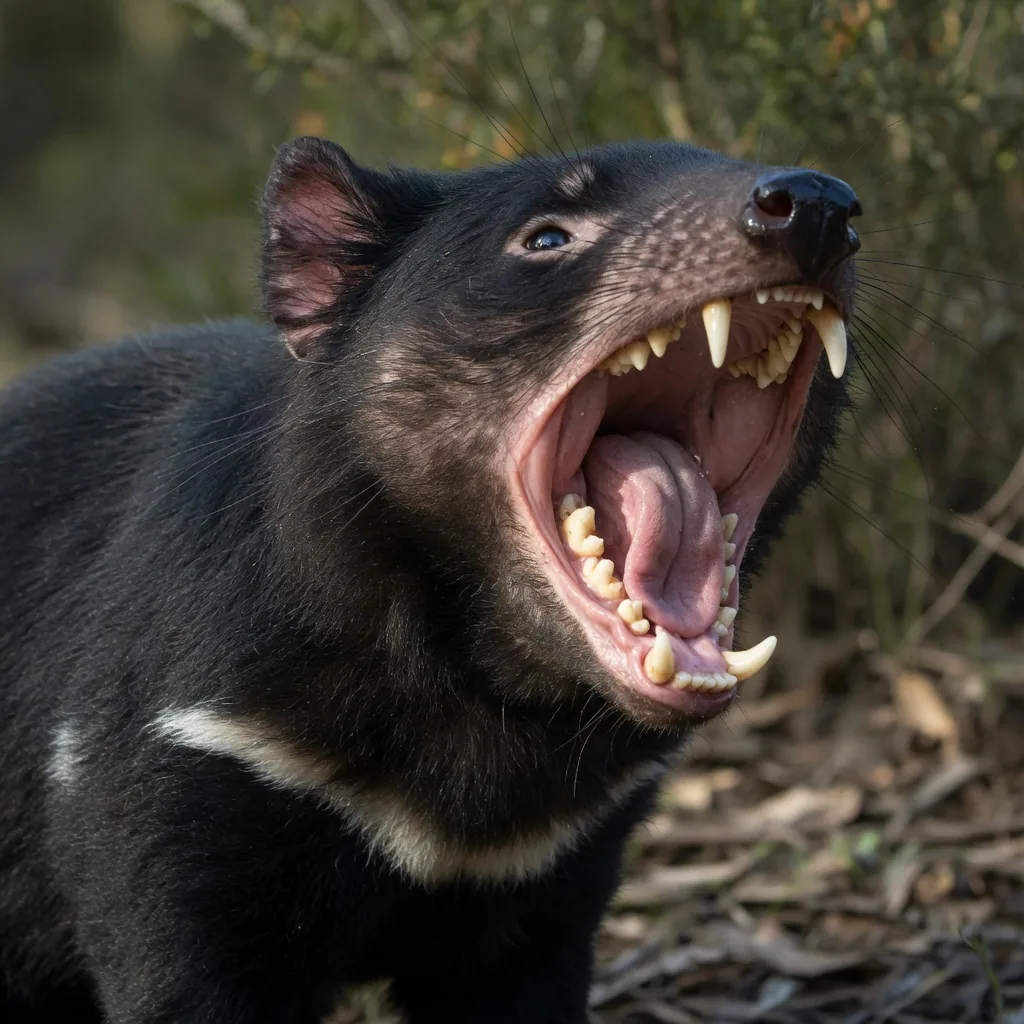
The Tasmanian devil has the strongest bite of all living mammals. It also has a single set of teeth that keeps growing throughout its life. This means its teeth never wear down completely, a big advantage for an animal that crunches through bones.
Take the Tasmanian Devil Quiz!
5 questions. How much do you know about Australia's most ferocious marsupial?
Breeding and Young
Tasmanian devils mate in March. The pregnancy lasts only twenty-one days, and around 30 young are born at the end of it. The newborns are tiny (about the size of a grain of rice) and they must race to their mother's pouch to survive. Since the pouch has only a limited number of teats, most of the newborns do not make it. On average, female Tasmanian devils live longer than males.
Explore More Animals
 Marsupials List: 334 Pouched Mammals of the WorldFrom the red kangaroo to the tiny long-tailed planigale: meet the marsupials, the pouched mammals. A photo guide plus a full list of 334 species with ranges and
 Temperate Rainforest Animals List: A Field Guide to the Cool, Misty WoodsNot all rainforests are tropical! Meet the bears, elk, snow monkeys, koalas and other amazing animals of the world's cool, misty temperate rainforests.
 Mammals That Lay EggsLong and short-beaked echidna and platypus are the only mammals that lay eggs. Learn about monotremes, the egg-laying mammals classified under the order Monotr
 Facts About the Raccoon DogRaccoon dogs have a distinct and rare genealogy, which makes them unique from all other canines. Discover their surprising habits, biology, and why they're the
History and Protection
Historically, Tasmanian devils were wiped out from the wild about 400 years ago on mainland Australia, because people saw them as a threat to livestock. They were hunted heavily until 1941, when they were finally given official protection by law.
Over the last century, scientists and conservation groups have noticed a growing problem: a facial tumor disease has been spreading through devil populations. This illness blocks the animals from feeding and eventually kills them through starvation. It has caused a large drop in devil numbers and is the main reason the species is now classed as endangered.
Today, researchers monitor devil populations both to track how the disease is spreading and to count healthy animals. The tumor is the most serious threat the species faces. Saving the Tasmanian devil depends on understanding and stopping this disease before it is too late.

 Fun fact for today!The Tasmanian devil is the world's largest carnivorous marsupial still alive today!