

The word Tyrannosaurus Rex reminds everyone of the giant, scary, sharp-toothed dinosaur who tries to kill the lead trio by pushing its snout through their car roof in the movie Jurassic Park. Steven Spielberg managed to make the T-Rex a legend, unforgettable by the world. The Allosaurus, on the other hand, is a not-quite-as-famous dinosaur, a smaller species that existed a very, very long time ago.
Making a comparison between these two dinosaurs is a bit tricky, really, because they existed in different time periods. The T-Rex came about 70 million years after the Allosaurus, and the only way they could really meet was by time travel. Anyway, there are many differences between these two theropods, listed below. Take a look and decide for yourself which dino you think is more likely to win.
Meet the Contenders
Before we start scoring rounds, let's meet our fighters. Both were large theropod dinosaurs, two-legged, warm-blooded hunters built for killing. But they couldn't be more different in size, era, and fighting style.
| Feature | 🦕 Tyrannosaurus Rex | 🦖 Allosaurus |
|---|---|---|
| Scientific name | Tyrannosaurus rex | Allosaurus fragilis |
| Name meaning | Tyrant lizard | Other lizard |
| Length | 40 feet (12 meters) | 32-40 feet (10-12 meters) |
| Height | 18-20 feet | 12-14 feet |
| Weight | 7 metric tons (~15,000 lbs) | 2 metric tons (~5,000 lbs) |
| Habitat | North America, Canada | North America, Europe, Portugal |
| Period | Cretaceous (~60 million years ago) | Jurassic (~150 million years ago) |
| Lifespan | ~30 years | ~26 years |
| Top Speed | ~25 mph | ~21 mph |
| Bite Force | ~40,000 Newtons | ~4,000 Newtons |
| Fingers (forelegs) | 2 | 3 |
Appearance: Teeth and Fingers
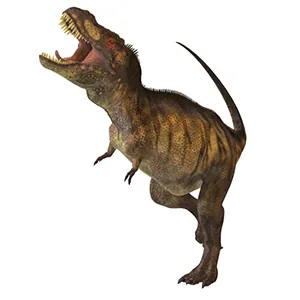
The teeth of the T-Rex are powerful and huge, about 10 inches in length. They are thick and rounded, like a stick, and can pierce through almost anything, as you'll find out in the diet section below.
The teeth of the Allosaurus are about 4 inches long. They are flattened laterally, like a knife or a sword. They grow in a backward slant, making it hard for prey to escape, and are extremely sharp.
The T-Rex has 2 fingers on its forelegs, whereas the Allosaurus has 3.
Vision and Hearing
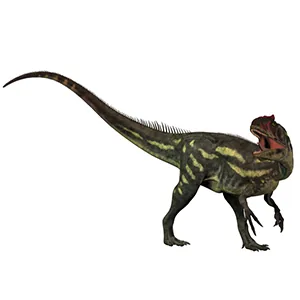
The T-Rex has binocular vision which is very powerful, about 13 times that of humans. This lets it see objects at long distances and spot prey in its periphery quite easily. Any poor creature will have almost no chance of escaping once the Rex has laid its eyes on it. Its sense of hearing is also excellent; it can pick up sounds of varying frequencies from miles away.
The Allosaurus takes a beating here too. It does have binocular vision, but compared to the Rex's, it is quite poor. It is also restricted to 20 degrees, so if prey manages to slip outside this range, it probably gets to live for one more day. The hearing capacity of the Allosaurus is not great either, the size of its ears is similar to a crocodile's.
Take the T-Rex vs. Allosaurus Quiz!
5 quick questions. Do you know your dino stats?
Diet and Hunting Technique
The T-Rex is considered by many to be a scavenger, and by many others simply as a predator. Either way, this massive dinosaur is a voracious eater and will consume just about anything, literally. It is a carnivore, obviously, but is also believed to have indulged in cannibalism, meaning it could eat another T-Rex just as easily as, say, a Stegosaurus or a Velociraptor.
Compared to the T-Rex, the Allosaurus seems like an absolute darling because it does NOT eat its family members, but sticks to other species. However, this lighter dino turned out to be a complete powerhouse, fossil studies have evidence that the Allosaurus took on dinosaurs and other creatures much bigger than itself, and emerged victorious, with a few proud battle scars to show for it.
Speed and Agility
The speed the Rex could reach while running is about 25 miles per hour. It is hard to imagine a Rex making its enormous body run so fast, but it could. Seems scarier with every fresh bit of information!
The Allosaurus is not far behind (but behind nonetheless) with a running speed of 21 miles per hour. Though the Allosaurus is slower, it is more agile and has better reflexes. This gives it a small glimmer of hope after all the size statistics above.
Explore More Animals
 Giganotosaurus vs. Megalosaurus: 2 Carnivore Giants ComparedGiganotosaurus vs. Megalosaurus, a kid-friendly showdown of two legendary meat-eating dinosaurs. Compare their size, weight, teeth, and brains in a side-by-sid
 Long-Necked Dinosaur Species: An OverviewDinosaurs, the gigantic creatures that existed on Earth millions of years ago, have always fascinated us ever since we knew of their existence. AnimalSake prese
 Types of Dinosaurs: How Each One Got Its NameMeet the different types of dinosaurs and learn the clever way each got its name, from teeth and horns to feet, armor, places and people. A fun, fact-packed gu
 Bull Shark vs. Great White Shark: How to Tell Them ApartBull shark or great white? Meet two of the ocean's most feared sharks side by side (habitat, size, teeth, and hunting tricks) plus a quiz, glossary, and myth-
Bite Force: The Knockout Stat
The bite force of an Allosaurus is less than even an alligator's, not more than 4,000 Newtons. Pretty bad, considering what it's up against.
The Rex is believed to have the highest bite force of all terrestrial animals, measuring about 40,000 Newtons. That is ten times more powerful than the Allosaurus, and strong enough to crunch through bone like dry wood. You can read more about jaw strength across the animal kingdom in our look at animals with the most powerful bite force.
The Final Verdict
So, what do you think? Who would win, the scary giant or the lighter, faster fighter? After comparing all the aspects, the verdict seems to point quite obviously towards the Rex. It is fast, it bites to kill, it has excellent vision, and it is huge. But don't give up hope on the Allosaurus just yet. It is quick and more agile, its smaller size lets it dodge more easily, and it has a proven history of taking on bigger opponents, and winning.
Like I said, unless the two actually travel through time to meet and duel, it is quite difficult to say who will really win. They both have their advantages and disadvantages, and they are both just as awesome and unique in their own ways.

 Fun fact for today!The T-Rex is more popular than the Allosaurus, chiefly because it is the first dinosaur in Jurassic Park to have a proper attack scene of its own!