

What Is a Flounder Fish?
In 1960, a Swiss scientist and a US Navy lieutenant discovered a flounder at the very bottom of the Mariana Trench (the deepest part of the Pacific Ocean) at a depth of 35,814 feet. Flounder fish are a type of flatfish. They live in the warm coastal waters of the Northern Atlantic and Pacific Oceans, including Canada and the United States.
There are many species of flounder. They belong to four main families: Pleuronectidae, Paralichthyidae, Bothidae, and Achiropsettidae. One of the easiest ways to tell them apart is by where their eyes sit. Fish in the Pleuronectidae family have both eyes on the right side, while fish in the Bothidae and Paralichthyidae families have both eyes on the left side.
Types of Flounder
- Right-eyed Flounder
- Left-eyed Flounder
- Winter Flounder
- Olive Flounder
- European Flounder
- Southern Flounder
- Arrowtooth Flounder
- Summer Flounder
- Barfin Flounder
- Leopard flounder
- Flathead Flounder
- Twospot Flounder
- Bering Flounder
- Witch Flounder
- Arctic Flounder
- Crested Flounder
- Banded-fin Flounder
- Shrimp Flounder
- Comb Flounder
- Gray Flounder
- Cresthead Flounder
- Fine Flounder
- Ridged-eye Flounder
- Gulf Flounder
- Derwent Flounder
- Four-spotted Flounder
- Slime Flounder
- Five-eyed Flounder
Appearance and Size
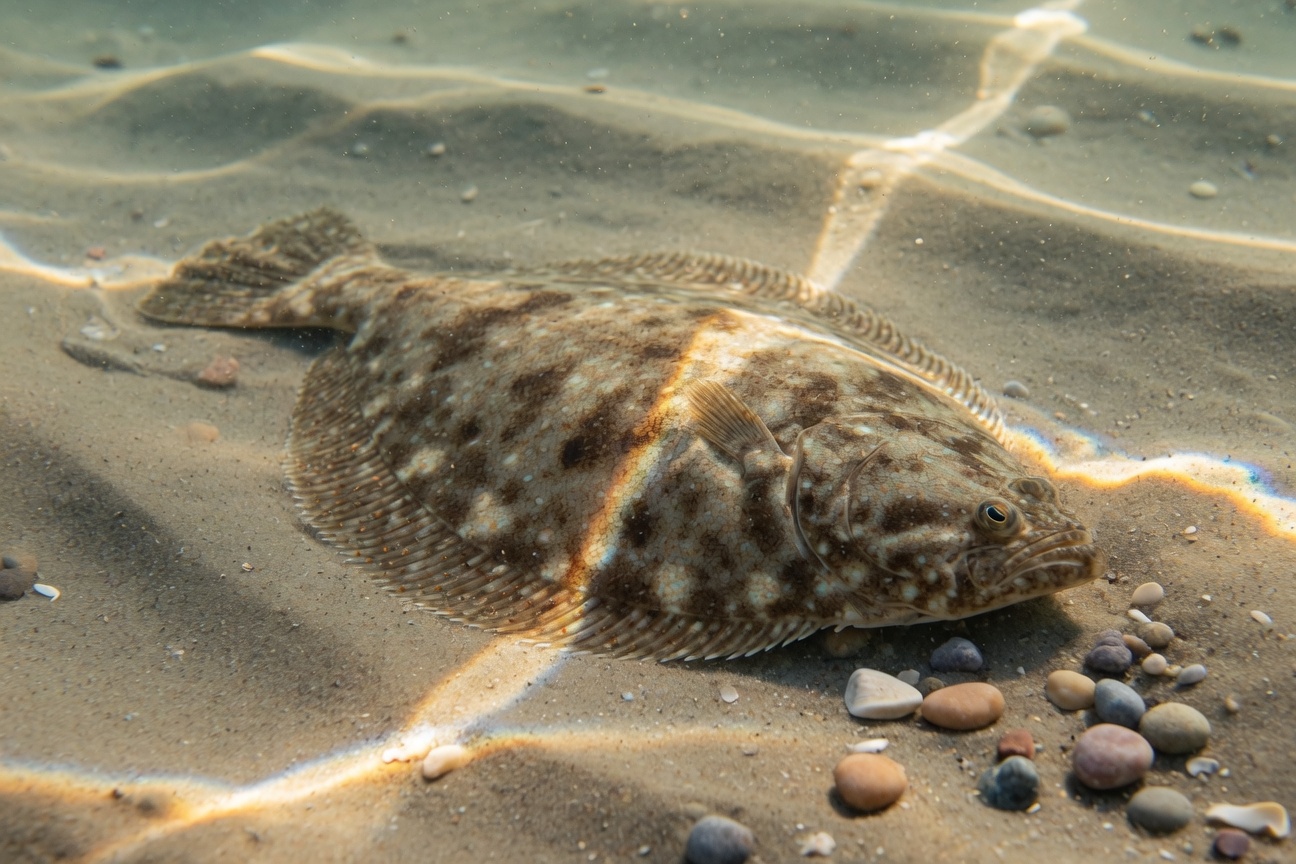
Flounder fish look like a flat, oval disc, with fins running all around the edge. They are usually brown in color, but they can also appear red, orange, green, or blue depending on the species.
Flounder come in many sizes. It all depends on which species you are looking at. Some, like the sole fish, are only a few inches long. Others, like the halibut, can grow to enormous lengths, for some flounder species, the only ocean fish bigger than they are is the whale shark! If you want to explore the full range of fish diversity, see our guide to different types of fish.
Habitat and Behavior
Most flounder species live in warm or mild oceans, though a few turn up in Arctic waters too. They prefer the shallow waters near the coast, where they blend in so well with the seafloor that they become almost invisible. Most flounder are nocturnal, they are most active at night.
Flounders are demersal fish, which means they feed at the bottom of the sea. They are also ambush predators: instead of chasing their prey, they keep perfectly still and wait for it to come to them. They eat a wide range of sea creatures, some hunt other fish, while others prefer worms, mollusks, and crawfish. Flounder can be quite picky about what they eat.
The Amazing Eye Migration
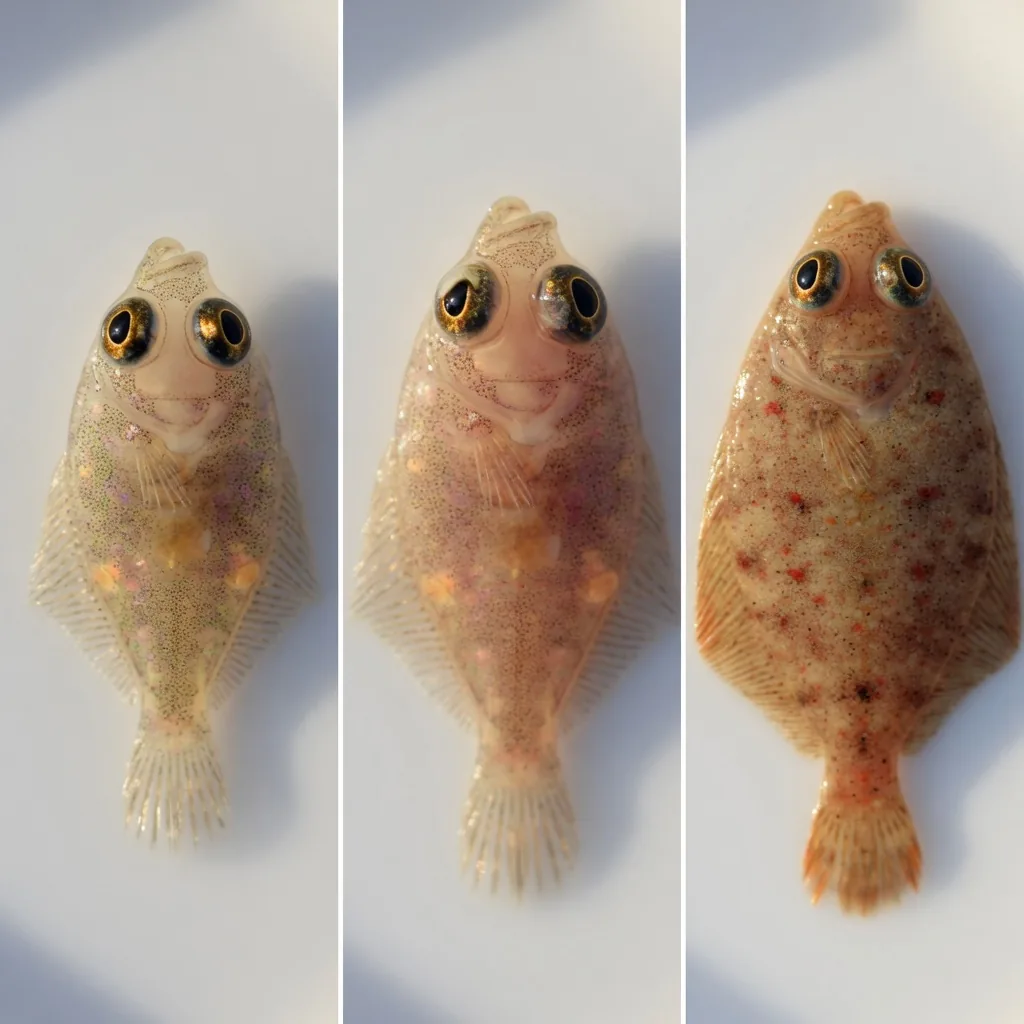
During its lifetime, a flounder goes through an amazing change in its body. When the egg hatches, the tiny larva looks like a normal fish, with one eye on each side of its head. After a few days, it starts to lean to one side, and the eye on the opposite side slowly migrates across the skull to join the other eye. Now both eyes are on the same side. That side becomes the top of the fish, and the now-eyeless underside fades and becomes the flat belly.
Take the Flounder Fish Quiz!
5 questions about one of the ocean's strangest fish. How much do you know?
Spawning and Early Life
In most flounder species, spawning happens during the warmer months of the year. Some species travel from deeper water to their coastal breeding grounds. Others simply move along the coast to their favorite spawning spot. After the females lay the eggs, each tiny egg floats in the water thanks to a small oil bubble inside it. Depending on the species, the eggs may drift near the bottom among the seagrass, or they may rise right up to the surface.
Once the eggs hatch, the tiny larvae drift through the water with eyes on both sides of their heads, feeding freely on plankton and tiny crustaceans. As they grow into adults, they move down to the sea bottom and settle into their life as flat-bodied bottom-dwellers.
Frequently Asked Questions
Why do flounder fish have both eyes on one side?
When a flounder hatches it has one eye on each side. As it matures it tilts to one side and one eye migrates across the head to join the other, so both eyes face upward.
How does a flounder camouflage itself?
Flounders bury themselves in sand or gravel using their fins to pull bottom sediment over their bodies, making them nearly invisible to predators and prey alike.
What do flounder fish eat?
Flounders are ambush predators that eat fish, worms, mollusks, and crustaceans.
How deep in the ocean can flounders live?
One was discovered at the bottom of the Mariana Trench at 35,814 feet, the deepest part of the Pacific Ocean.
Masters of Camouflage
Depending on where a flounder lives, its coloring may be spotted or dappled to match the local sea floor, sandy, pebbly, or muddy. Some flounders take hiding one step further: they dig themselves into the bottom and use their fins to pull sand and gravel right over their bodies, becoming almost completely invisible.
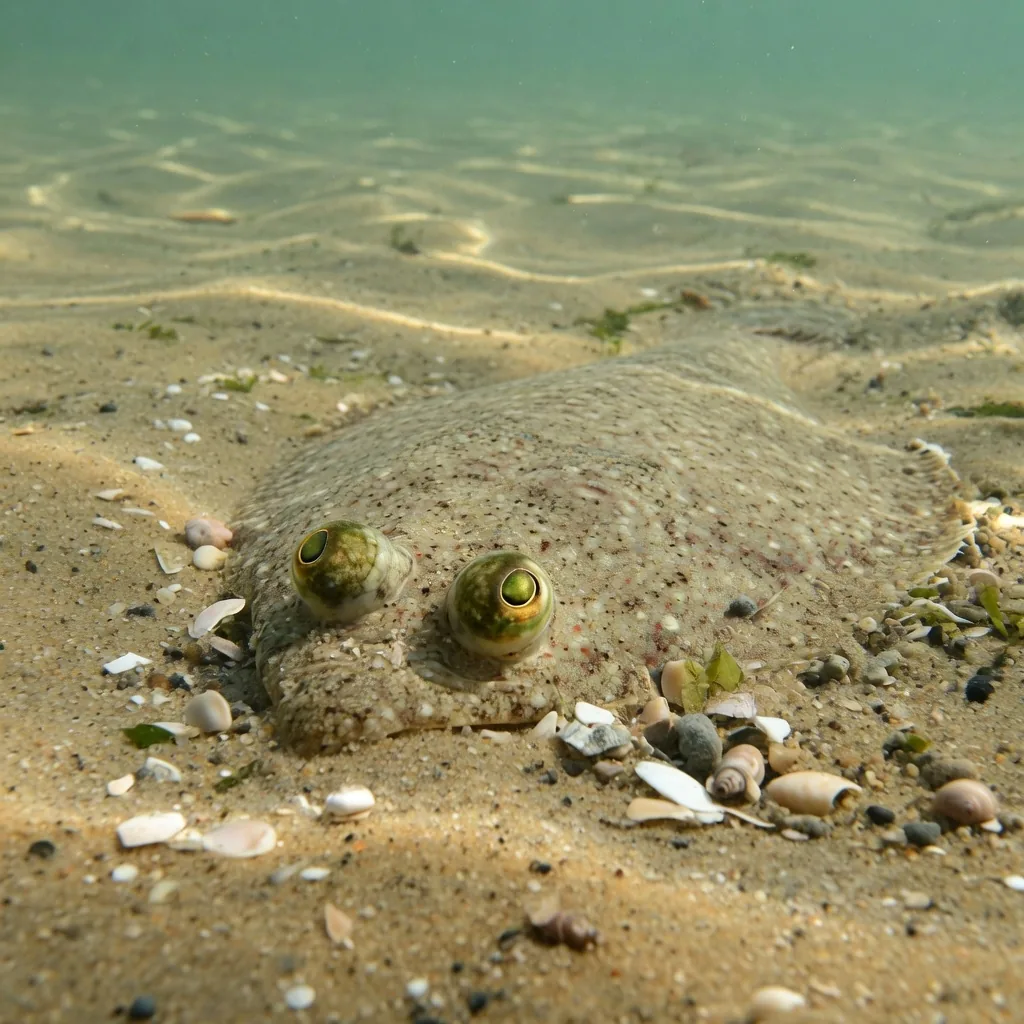
Most flounder species have outward-bulging eyes that swivel around to watch for danger or prey. Often the only part of the fish you can see is those two eyes peeking above the sand. If something disturbs it, the flounder shoots away quickly, stirring up a cloud of silt as it goes. Once it feels safe, it settles back to the bottom and disappears again.
Predators and Conservation
Because of their excellent camouflage, flounders are hard to spot. But they do have predators: large fish, eels, sharks, and humans.
Flounder is a popular game fish, and overfishing has caused a big drop in their numbers. Industrial pollution is making things worse by damaging the coastal habitats where they live.
Explore More Animals
 Fluke vs. Flounder: How to Tell These Flatfish ApartFluke or flounder? Learn the quick clues (which side the eyes are on, mouth and teeth, size, and taste) that tell these two look-alike flatfish apart, with a
 Interesting Facts About the Beautiful Blowfish (Puffer Fish)Also known as puffer fish, blowfish can inflate themselves to scare away their predators, hence the name. They are believed to be the second most poisonous vert
 Unbelievably Fascinating Facts About LionfishVividly striped, armed with venomous spines, and invading the Atlantic, discover where lionfish live, what they eat, the Red, Black, Freshwater and Dwarf speci
 Types of FishThere are over 32,000 species of fish, more than all other vertebrates combined. Discover how fish are classified by species and habitat, plus the fish we keep

 Fun fact for today!In 1960, a flounder was found at the very bottom of the Mariana Trench, 35,814 feet deep!