

A Brief History of the Breed
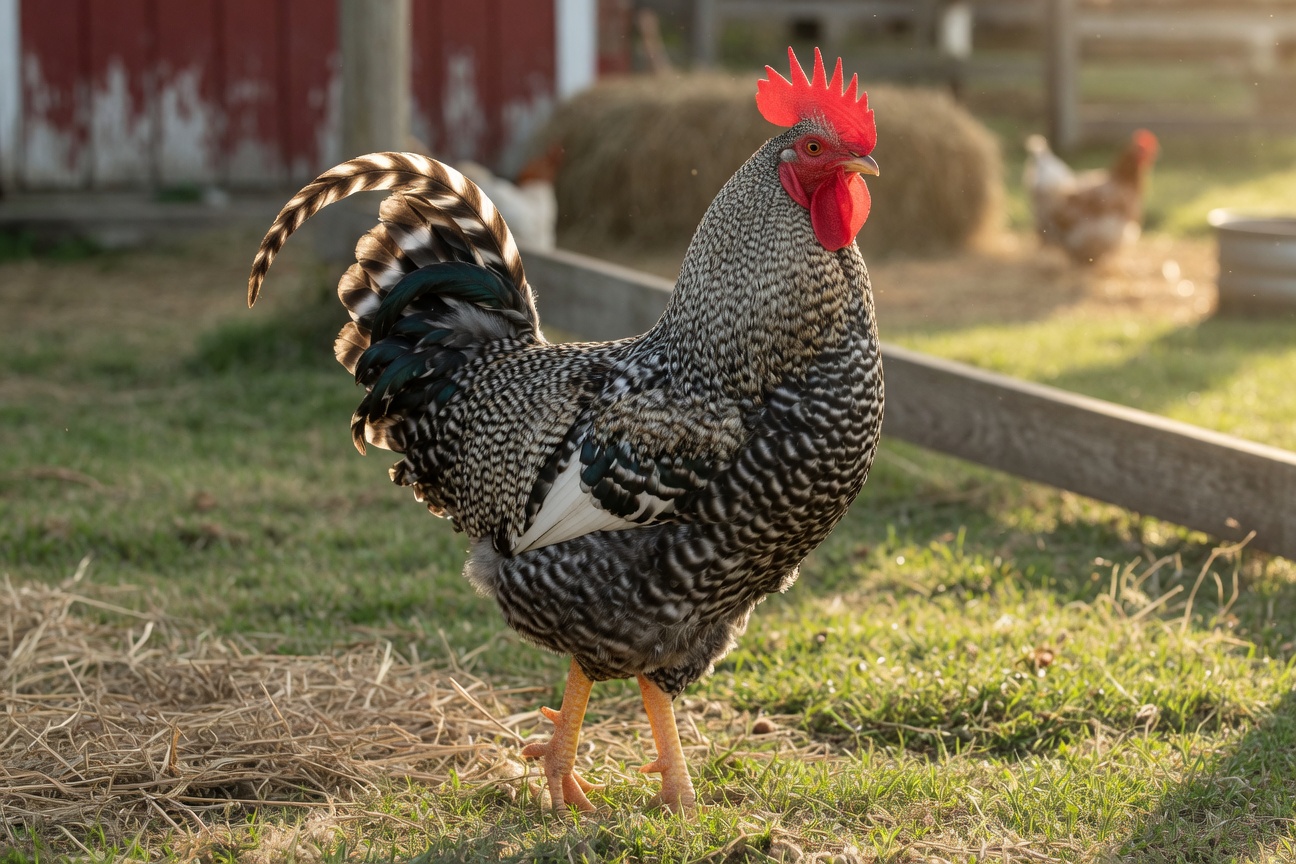
The Plymouth Rock chicken was developed in the 1870s from crosses of Dominiques, Black Javas, Cochins, and perhaps Malays and Dorkings. The very first Plymouths were barred. Other Plymouth varieties (like buff, silver-penciled, and black) were developed later. Today, the Plymouth Rock is most often called the Barred Rock, or simply "Rock," because of its well-known striped color.
At first glance, it is difficult to tell the difference between a Barred Rock rooster and hen. The sections below break down the main differences one by one.
Weight
The males are noticeably larger than the females. According to the American Poultry Association, the standard weights for Plymouth Rock roosters are: cock, 7.5-9.5 lb (3.4-4.3 kg), cockerel, 8 lb (3.6 kg), Bantam variety, 3.09 lb (1.4 kg).
For hens, the standard weights are: hen, 6.6-7.5 lb (3-3.4 kg), pullet, 5-6 lb (2.3-2.7 kg), Bantam variety, 2.65 lb (1.2 kg).
Color and Barring Pattern
Both hens and roosters have black and white bars all over their bodies, but roosters are lighter in color overall, while hens are darker.
The dark and light bars are almost the same width and sit in parallel rows. Both sexes have straight, uniform bars. However, males appear gray and white rather than black and white, they look more white than black.
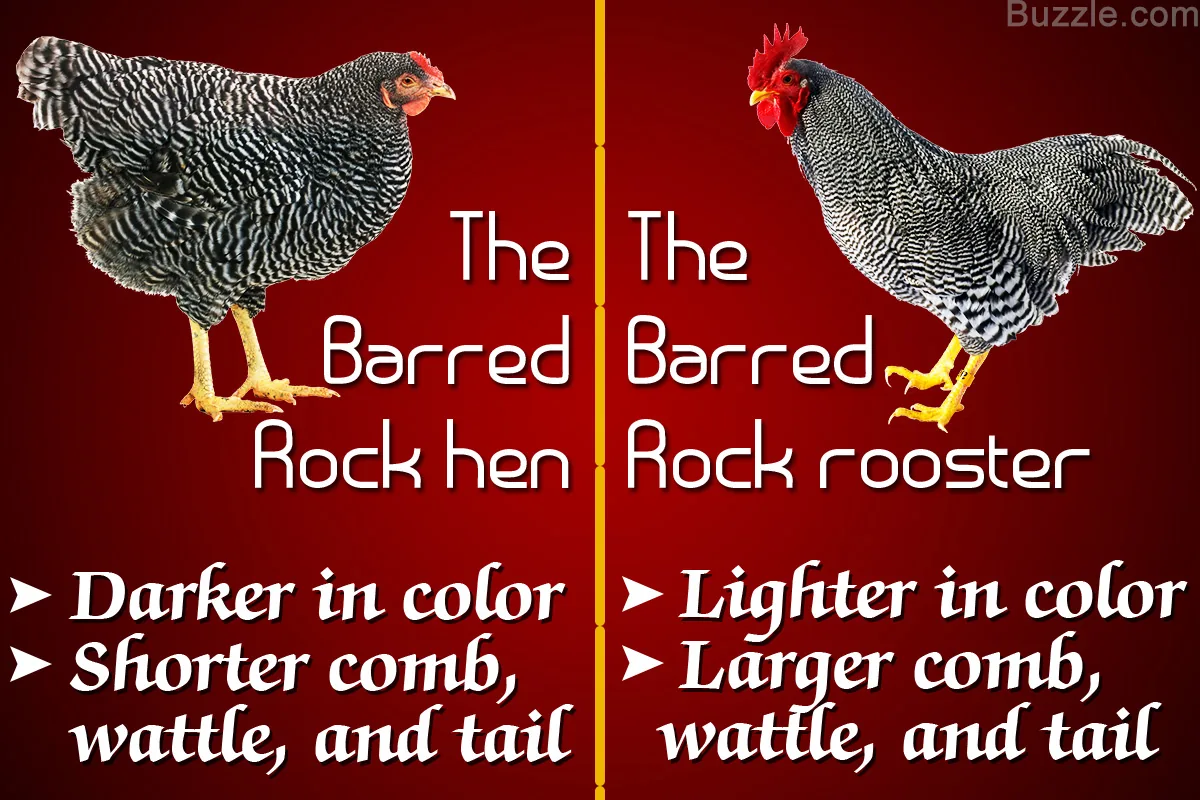
The barring on a hen is sharper and more contrasting than on a male. Barred Rock hens are slightly darker because they carry only one chromosome for barring, while males carry two. So the hens appear more black than white, while the roosters look more white than black.
Appearance
Roosters are larger than hens and carry themselves more upright. They have bigger wattles and combs, and hold their heads high. The comb on a rooster is single and dark red. Hens, on the other hand, have smaller wattles and combs and a single comb that is light red. One easy tell: a hen's abdomen is deeper and fuller than a rooster's.
Neck and Tail Feathers
Roosters have larger tails and bigger neck feathers. Hackle feathers are the feathers around the neck area, while saddle feathers grow right above the tail, they grow over and turn downwards, almost like straight hair. On a rooster, the saddle and hackle feathers are longer and pointed. These pointed feathers are one of the easiest ways to tell a male from a female.
Hens have much smaller tails, so short they can almost look tailless. On a hen, the saddle and hackle feathers are round-ended and shorter.
Rooster or Hen? Take the Quiz!
5 quick questions. How well do you know your Barred Rocks?
Spurs
Roosters usually have spurs on their legs. Hens usually do not. However, this is not a 100% sure way of determining the gender of a Barred Rock, there are exceptions in both directions.
Temperament
As cockerels grow up, they become more dominant, but young ones may still act like hens. Adult roosters are generally calm and friendly, though they can be quite aggressive compared to hens at times.
Hens are calm and docile. They are very good egg layers and good mothers too. They can go broody if the conditions are right.
Telling Them Apart as Chicks
Sexing baby chicks is very difficult. Professional sexing experts try to determine the sex of a chick by examining the chick's vent. A common untrained person should not follow this method, it requires real skill. Even experienced experts cannot be 100% accurate when sexing chicks.
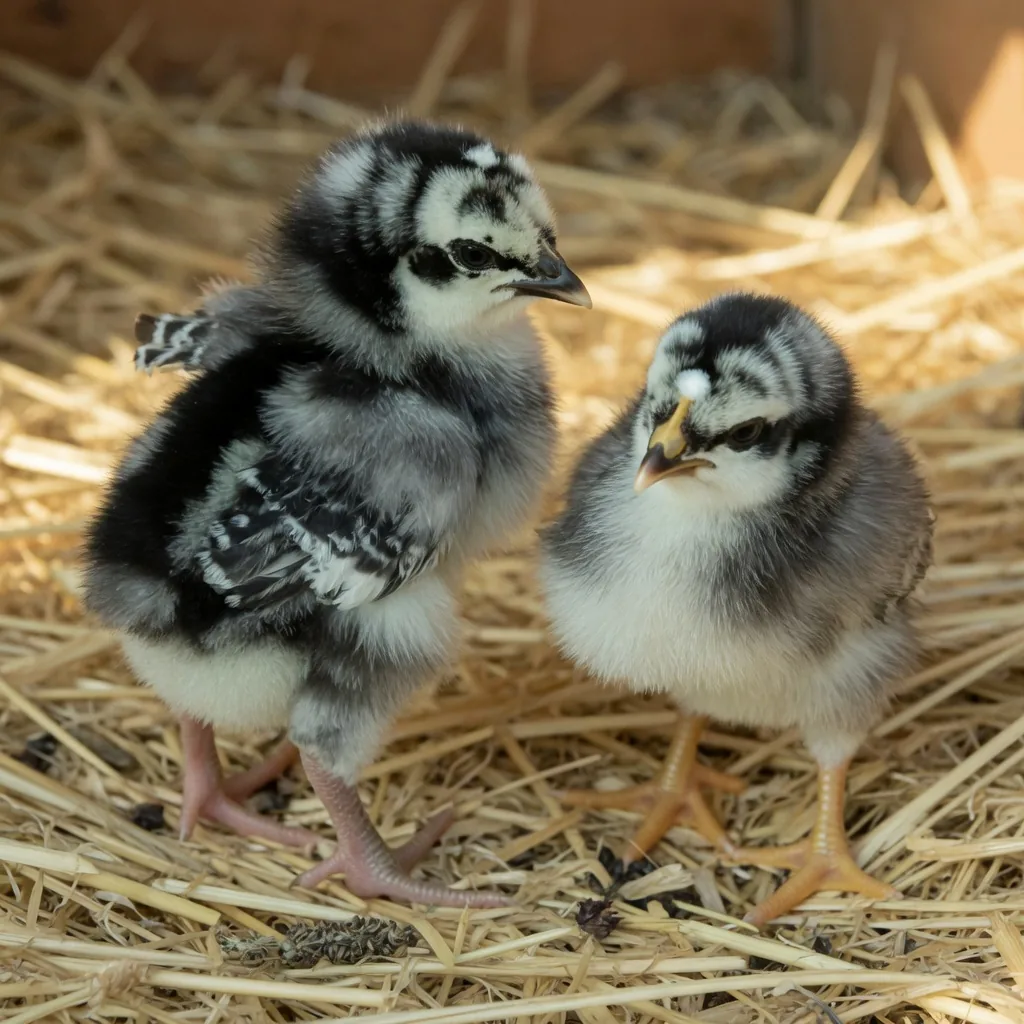
There are some visual clues, though. The white spot on the head of a male will be scattered and irregularly shaped. The legs of a male chick can be thicker than those of a female chick. The feathers on the head will stand upright and curve toward the back. Around five to six weeks, cockerels will start getting larger than hens and begin developing a red-colored comb. Cockerels will usually grow hackle feathers at around two to three months of age. Males, at an age of 4-5 months, may attempt to crow. After about six to nine months, the combs and wattles of cockerels will look larger than those of pullets, and they will develop spurs on their legs.
A female chick usually has a more distinct white dot on its head. The legs of a female chick can be larger and more yellow than those of a male. The female head feathers usually form a rounded, fluffy puff. Pullets usually grow tail and wing feathers before cockerels do. Hens do not crow.
What Are They Raised For?
Roosters are raised mainly for meat. Hens are raised for both eggs and meat, making the Barred Rock one of the most versatile dual-purpose breeds.
A Few Important Notes
Most features described here may take weeks to develop. It is relatively easier to tell the sex of grown-up chickens than of chicks.
Over the years, the Barred Rock has gained popularity all over the world. However, most hatchery-grade chickens have crosses that can mix up the sex-link properties. Certain features that help determine a chicken's sex may vary depending on the bird's age and genetic line.
Explore More Animals
 Crazily Fabulous Facts About the Plymouth Rock ChickenEverything you need to know about the Plymouth Rock chicken: barred and white varieties, egg production, the White Rock's dramatic growth story, and why this br
 An Awesome List of Different Types of Chickens With PicturesChickens are one of the most popular domesticated animals in the world. There are many different breeds of chickens with interesting characteristics.
 Life Cycle of a Chicken: Egg, Chick, and Chicken ExplainedThe life cycle comprises three basic stages: egg, chick, and chicken. Chickens may be raised for their meat, eggs, or both on local as well as commercial farms.
 Facts About Ameraucana Chickens That Will Simply Enchant YouChicken breeds consist of three blue egg layers: the Araucana, the Easter Egger, and the Ameraucana. AnimalSake will provide interesting facts about Ameraucana

 Fun fact for today!In flocks where hens outnumber roosters by more than 10 to 1, one hen may even start acting like a rooster!